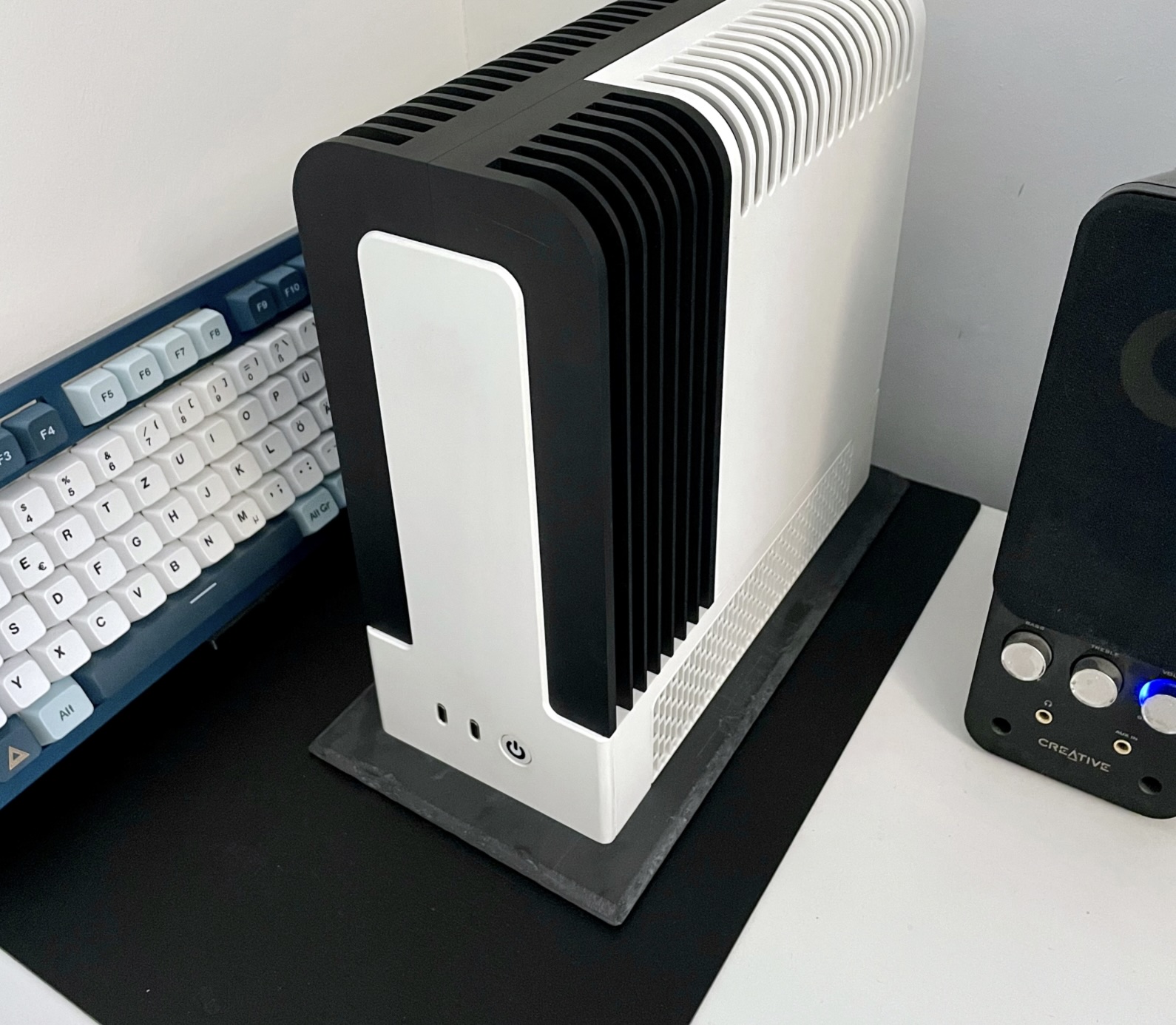
A small-form-factor enthusiast has pushed AMD’s Ryzen AI Strix Halo APU into truly fanless territory, revealing how far passive cooling can go before thermals tap out. After experimenting with higher power targets, the builder ultimately found a sweet spot that balances silence, performance, and safe temperatures.
In testing, the system was briefly run at 120 and 140 watts, but that proved too aggressive for a passive setup. After two hours of sustained stress, temperatures peaked at 98.8 C, prompting a step back to preserve longevity and stability. Dialing power down to 100 watts delivered the kind of performance the builder expected from the Strix Halo APU, while keeping thermals much more manageable.
At that 100-watt setting, the passively cooled rig stayed under control and only crept past 80 C when both the CPU and GPU were hammered at the same time. For a fanless, compact build, that’s a meaningful win: virtually silent operation under typical loads, with acceptable headroom when workloads spike. External case temperatures, shown in the image, give a real-world picture of how heat distributes across the enclosure during heavy use.
Key takeaways for silent SFF fans:
– 140 W and 120 W pushed the system to 98.8 C after a 2-hour stress test
– 100 W emerged as the practical limit for a passive configuration
– Temperatures exceeded 80 C only under simultaneous CPU and GPU loads
– Exterior case temperatures align with what you’d expect from a dense, fanless design
For anyone curious about Strix Halo performance but not ready to wrestle with the constraints of a fanless build, there’s an off-the-shelf option. The actively cooled GMKTec EVO-X2, built around the Strix Halo APU, is available for around $1,999 on Amazon, offering a plug-and-play experience with the airflow and thermal headroom that passive systems sacrifice. Pricing can change, but it’s a straightforward path to experiencing AMD’s latest APU without the DIY thermal tuning.
The big picture is clear: Ryzen AI Strix Halo can be tamed in a passive SFF chassis if you respect power limits. Keep it to about 100 W, expect whisper-quiet operation most of the time, and understand that heavy mixed CPU/GPU workloads will push temperatures higher. For builders chasing zero-noise computing with modern AI-capable silicon, this is a promising blueprint—and a reminder that smart power management is the real secret sauce in fanless performance.