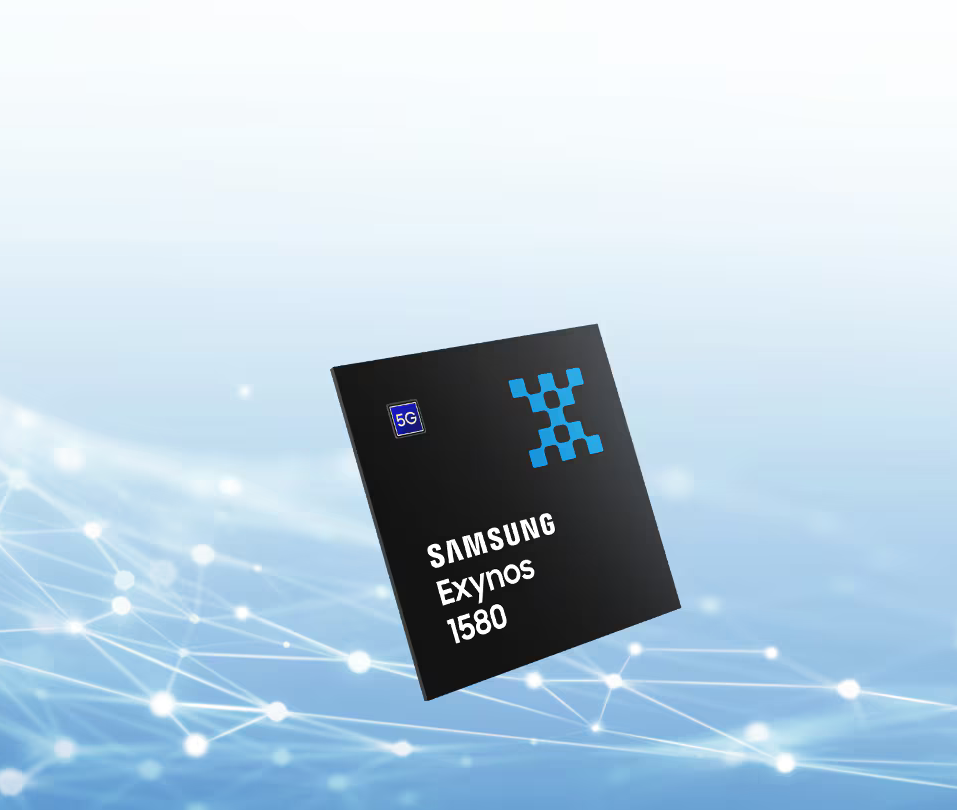
Samsung has just taken the wraps off its latest mid-range marvel in the smartphone world, the Exynos 1580 SoC. This new processor is designed to elevate performance for upcoming devices like the anticipated Galaxy A56, thanks to its cutting-edge architecture and advanced features.
The Exynos 1580 flaunts an impressive 8-core CPU configuration, consisting of a powerhouse Cortex-A720 core clocked at 2.9 GHz, three additional Cortex-A720 cores running at 2.6 GHz, and four efficient Cortex-A520 cores at 1.95 GHz. This setup marks a significant leap from its predecessor, offering a 17% performance boost in both CPU and GPU sectors.
On the graphical front, Samsung’s Exynos 1580 features the RDNA-based Xclipse 540 GPU with two Work Group Processors (WGPs) that translates to four Compute Units (CUs). This upgrade promises a remarkable 37% boost in performance while enhancing energy efficiency by reducing power consumption by 20%.
The chipset is loaded with top-of-the-line specs, such as support for UFS 3.1 storage and LPDDR5 RAM, enabling swift operations and seamless multitasking. It can handle high-refresh display outputs with its 1080p 144Hz display capability and supports stunning 4K video recording at 60 FPS. Photographers can rejoice with the potential for a single 200 MP camera sensor, ensuring ultra-detailed captures.
Connectivity is also fortified with Wi-Fi 6E and Bluetooth 5.4, along with a capable Exynos 5G modem designed for sub-6 GHz bands. While it doesn’t cater to mmWave frequencies, it still offers substantial network speeds. Manufactured with what Samsung hints as their third-generation 4 nm EUV technology, the chip’s efficient design parallels that of other high-performance processors like the Exynos 2400 and Google Tensor G4.
As Samsung continues to innovate, the Exynos 1580 is set to push the boundaries of mid-range smart devices, delivering a powerhouse experience without compromising on efficiency or connectivity. This new release is slated to make significant waves in the smartphone market, promising enriched user experiences with its robust capabilities.