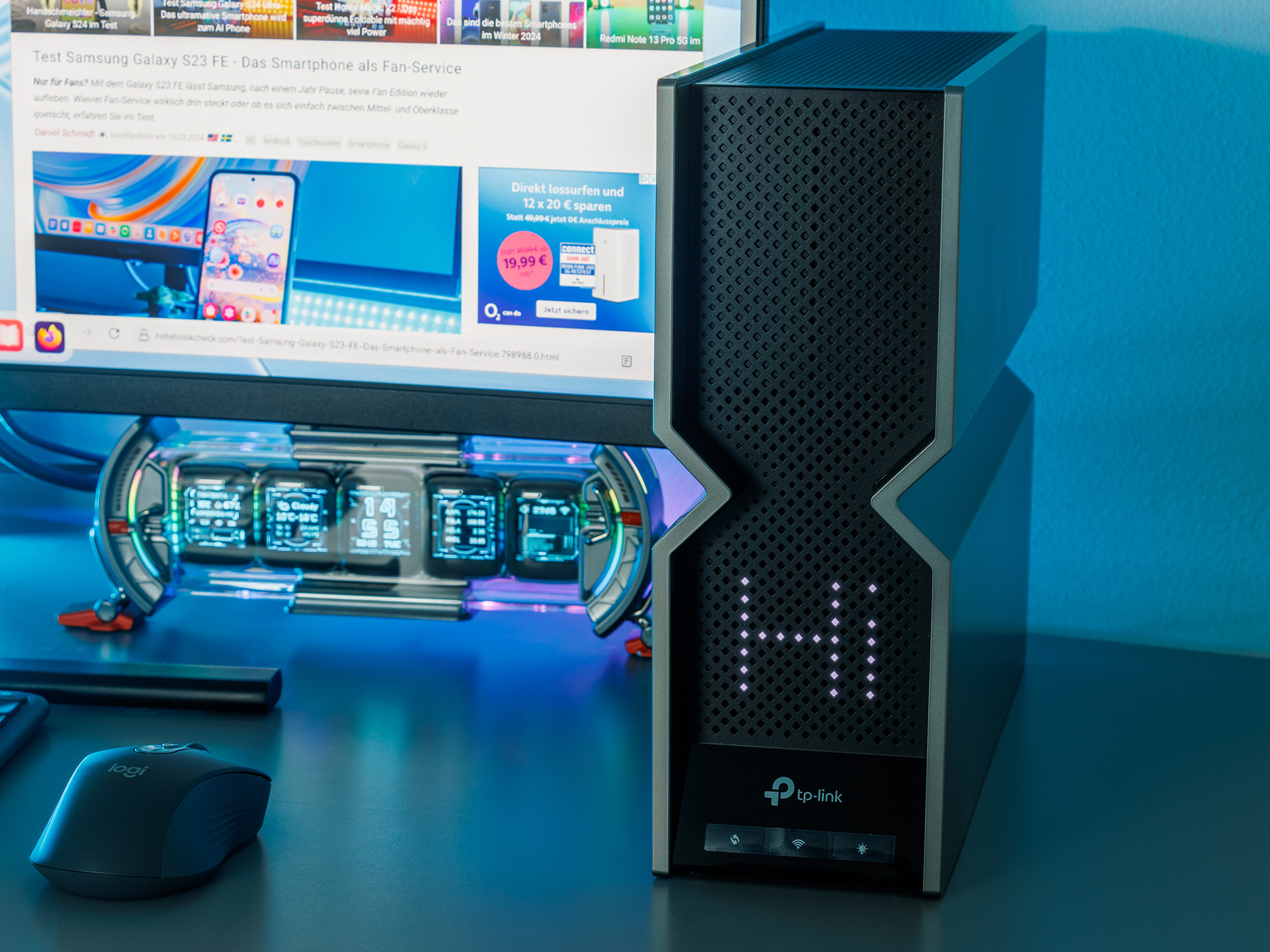
The TP-Link Archer BE800 (BE19000) exemplifies cutting-edge networking technology, powered by the Qualcomm Networking Pro 1220 platform. This revolutionary router embraces Wi-Fi 7, the latest evolution in wireless standards, also known as IEEE 802.11 a/b/g/n/ac/ax/be, unlocking astonishing speeds and efficiency across three frequency bands: 2.4, 5, and 6 GHz.
Diving into its capabilities, the Archer BE800 facilitates a new epoch of wireless speed with channel bandwidths ranging from 20 MHz up to an expansive 320 MHz, primarily dedicated to the 6 GHz band through Wi-Fi 7. This extends its data-transmitting prowess to lofty levels—double those recorded with Wi-Fi 6E. The router’s antenna sophistication is also noteworthy, boasting a 4×4 configuration across all three bands, enhanced by the technological synergy of MU-MIMO to enable multiple device connections without hiccups.
TP-Link’s router propels the wireless speed metrics to unprecedented heights supporting up to 11,520 MBit/s, 5,760 MBit/s, and 1,376 MBit/s on the 6, 5, and 2.4 GHz bands respectively under Wi-Fi 7. An exceptional feature is Multi-link operation (MLO), allowing simultaneous utilisation of all bands and raising the data throughput bar to around 18,656 MBit/s, simultaneously aiming to slash latency to a minimum.
Integrating wired connectivity prowess, the Archer BE800 doesn’t skimp on options. It presents an array of four 2.5 Gbit/s ports and three 10 Gbit/s ports, among which one is an SPF+ supportive combination port, effectively rendering two 10 Gbit/s connections. For router mode operations, one of those high-speed 10 Gbit/s ports will serve as your internet connection gateway.
Focusing on wireless performance, detailed testing was performed. Two specific points were selected for analysis: the first, positioned just a meter away from the router, and the second, 5 meters distant, a floor up with concrete separation. An Asus ROG Rapture GT-AXE11000, sans Wi-Fi 7 support, was used as a reference. In the arena of client devices, Wi-Fi 7-ready smartphones like the Google Pixel 8 Pro, OnePlus 12, and Xiaomi 14, provided an insight into the potential and future of high-speed mobile connectivity.
The TP-Link Archer BE800 emerges not just as a router, but as a harbinger of the Wi-Fi 7 standard, promising to redefine the parameters of wireless and wired network performance. As technology moves forward, devices such as the Archer BE800 are defining the landscape of connectivity for both current and future digital ecosystems.