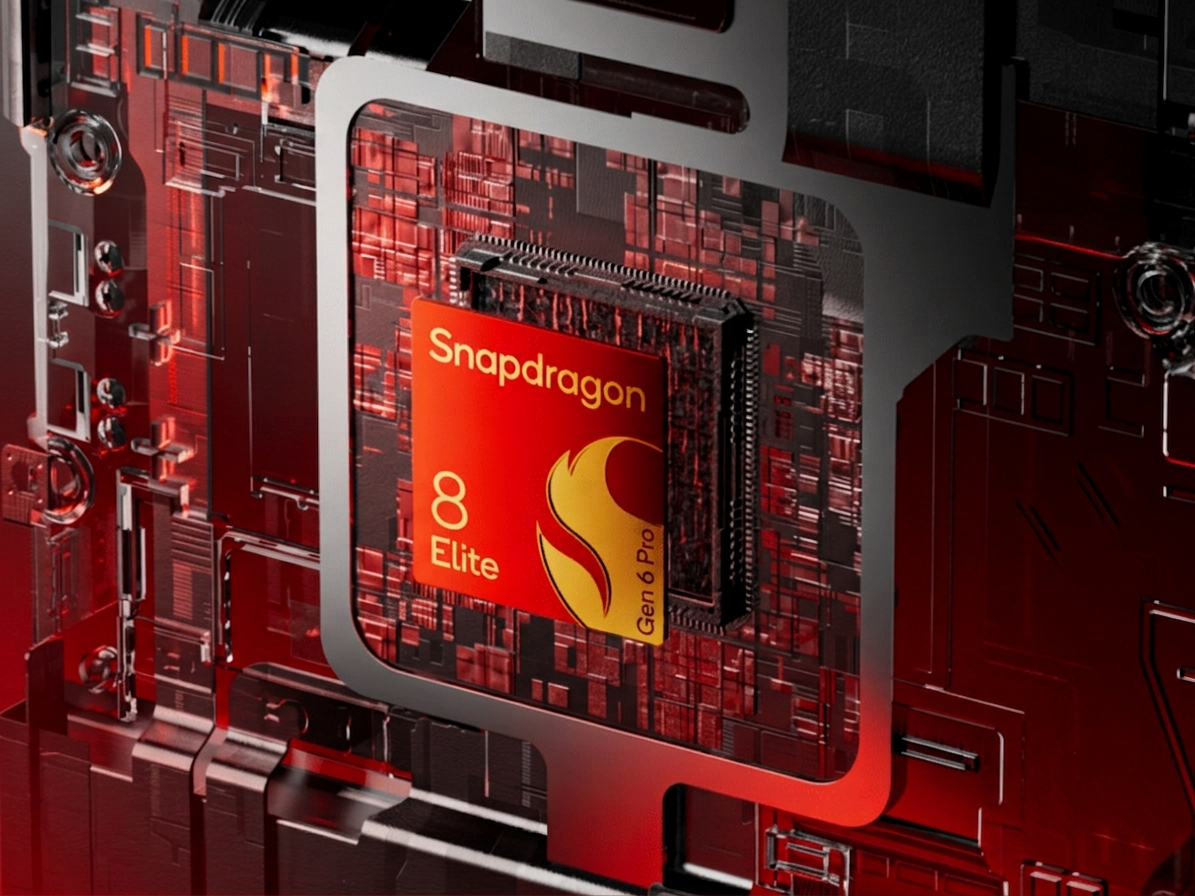
Snapdragon 8 Elite Gen 6 Pro leak points to a bigger, smarter, and more expensive Qualcomm flagship chip
Qualcomm’s next-generation flagship mobile processor is already shaping up to be one of the company’s most ambitious upgrades in years. The chip, reportedly known internally as SM8975 and expected to arrive as the Snapdragon 8 Elite Gen 6 Pro, appears to bring major changes across the CPU, GPU, AI hardware, modem, wireless connectivity, and manufacturing process.
Based on newly surfaced technical details, the Snapdragon 8 Elite Gen 6 Pro may not simply be a faster version of the current flagship chip. Instead, it looks like Qualcomm is preparing a more clearly separated “Pro” platform aimed at ultra-premium Android phones, with higher production costs and several features that may not appear on the standard Snapdragon 8 Elite Gen 6.
One of the most interesting details is the estimated die size. Measurements based on the reported package dimensions of 21.2 × 14 mm suggest the SM8975 die is around 12.6 × 10.67 mm, or roughly 134 mm². That would make it larger than the Snapdragon 8 Elite Gen 5 die, which is said to be around 126.2 mm², even though the newer chip is expected to move to a smaller process node.
That might sound unusual at first, but it makes sense when looking at the broader hardware changes. The Snapdragon 8 Elite Gen 6 Pro is expected to include more advanced GPU AI hardware, larger cache resources, next-generation memory support, and a new modem platform. In other words, the benefits of the smaller manufacturing process may be partly offset by the extra silicon Qualcomm is adding.
The chip is reportedly built on TSMC’s N2P process, an enhanced 2 nm-class technology. If accurate, this would make it Qualcomm’s first flagship smartphone SoC to move beyond 3 nm. It would also place the chip ahead of the Snapdragon 8 Elite Gen 5, which uses a 3 nm-class process, and slightly ahead of some competing mobile processors expected to use the baseline N2 node.
A yield-based cost estimate places the raw silicon cost at around $84.62 per good die, assuming a 300 mm wafer, a defect density of 0.1 defects per cm², and a wafer cost estimate of $33,000. However, that number should be treated as a rough model rather than a confirmed bill of materials. It does not include packaging, testing, binning, modem-related components, wireless chips, licensing, or other platform costs paid by phone makers.
On the CPU side, the Snapdragon 8 Elite Gen 6 Pro is expected to use a 2+3+3 core layout based on Qualcomm’s custom Oryon architecture. That means two prime cores, three performance cores, and three efficiency cores. This setup suggests Qualcomm is continuing to push its own CPU design rather than relying on off-the-shelf Arm cores.
Clock speeds remain unclear. Some rumors have pointed to peak frequencies near 4.8 GHz, but that figure has not been confirmed. Final speeds may depend on power targets, thermals, and the specific binning strategy Qualcomm chooses for different device makers.
The GPU may be one of the biggest upgrades. The Pro chip is expected to feature the Adreno 850, replacing the Adreno 840 used in the previous generation. Interestingly, graphics memory is said to remain at 18 MB, matching the current flagship rather than increasing. Even so, Qualcomm appears to be improving performance and efficiency through smarter scheduling, more refined dynamic clock and voltage scaling, and better handling of multiple GPU workloads at once.
The graphics API support reportedly remains familiar, with OpenGL ES 3.2, OpenCL 3.0 FP, EGL 1.5, and Vulkan 1.4. That should make it easier for phone brands and developers to move from the current generation to the next one without major driver changes.
The standard Snapdragon 8 Elite Gen 6, reportedly known as SM8950, may use a lower-tier Adreno 845 GPU with 12 MB of graphics memory. This points to a wider gap between Qualcomm’s standard and Pro flagship chips than in previous years.
A key Pro-exclusive feature may be the addition of two dedicated Matrix ALU blocks inside the GPU shader processor. These blocks are designed to accelerate mathematical workloads such as GEMM and convolution operations, which are essential for on-device AI tasks. This hardware is expected to power a new feature called AI Frame Fusion.
AI Frame Fusion appears to target gaming and visual enhancement. In one mode, it can use motion vectors, depth data, a lower-resolution color buffer, and the previously rendered frame to upscale games to 1080p or 1440p. In another mode, it can generate an extra frame between two rendered frames using motion-vector and optical-flow data. The goal is to make games look smoother without increasing power consumption as much as traditional rendering would.
If implemented well, this could become one of the Snapdragon 8 Elite Gen 6 Pro’s standout gaming features. AI-based frame generation and upscaling are already important on PCs and consoles, and Qualcomm seems ready to push similar technology into high-end Android phones.
Cache is also expected to increase. The SM8975 reportedly includes a shared 16 MB L2 cache and an 8 MB system-level cache. More cache can help improve performance and efficiency by reducing how often the chip needs to access external memory.
Memory support could be another major difference between the Pro and standard models. The Snapdragon 8 Elite Gen 6 Pro is expected to support both LPDDR5X and LPDDR6 memory, while the standard version may only support LPDDR5X. LPDDR6 support would help future premium phones achieve higher bandwidth and better efficiency, though it may also raise costs due to tighter DRAM supply and early-generation pricing.
Connectivity is expected to get a major boost as well. The Pro platform is reportedly paired with Qualcomm’s new X105 modem, which has not yet appeared in a shipping Snapdragon chip. The standard model may use the same modem or a reduced version of it, since both the Pro and standard platforms are said to share the same RF front-end design.
Two wireless companion chips have also surfaced: WCN8841 and WCN8851, both part of the FastConnect 8800 family. Both are said to support Wi-Fi 8 with a 2×2, 300 MHz MIMO configuration, along with Thread and Bluetooth HDT on the 2.4 GHz band.
The WCN8841 reportedly supports Bluetooth 6.0, while the higher-end WCN8851 adds Bluetooth 7.0, a second Wi-Fi radio path with 2×4 or 4×4 MIMO at 320 MHz, Bluetooth 7.0 support on 5 GHz and 6 GHz bands, and ultra-wideband support. This suggests Qualcomm may offer different connectivity packages depending on the target phone tier.
The modem-RF system also appears to be changing. The SDR765 is reportedly a sub-6 GHz transceiver built on TSMC’s N6RF process. It supports 2×2 MIMO uplink, 4×4 MIMO downlink, 1024-QAM modulation, and satellite bands including n253, n255, and n256.
The more advanced SDR885 could be even more important. It is said to be Qualcomm’s first sub-6 GHz transceiver capable of 4×4 MIMO on uplink and downlink at the same time. That means upload performance could finally catch up more closely with download performance on Snapdragon-powered devices. It reportedly supports 256-QAM uplink, 1024-QAM downlink, sub-6 GHz and mmWave under 3GPP Release 18, 20 transmit ports, and 16 primary plus 16 diversity receive paths.
All of this points to a flagship platform that may be faster, more AI-focused, and more capable in wireless performance, but also more expensive. The Snapdragon 8 Elite Gen 6 Pro is expected to cost significantly more to produce than the standard Snapdragon 8 Elite Gen 6, especially when factoring in LPDDR6 memory, the modem-RF system, and advanced connectivity chips.
Because of that, the Pro version may not appear in every flagship Android phone. Qualcomm could reserve it for ultra-premium devices, gaming phones, and top-tier “Pro” or “Ultra” models, while more mainstream flagships use the standard Snapdragon 8 Elite Gen 6.
The Snapdragon 8 Elite Gen 6 series is expected to be announced at Qualcomm’s Snapdragon Summit in Maui, Hawaii, scheduled for September 22 to September 24, 2026. Xiaomi is widely expected to be among the first brands to launch a phone using the new chip, possibly with the Xiaomi 18 series in China. Other Android flagship phones should follow later in 2026 and into early 2027.
If these details prove accurate, the Snapdragon 8 Elite Gen 6 Pro could be one of Qualcomm’s most important mobile platforms in years. With a 2 nm-class process, custom Oryon CPU cores, Adreno 850 graphics, dedicated AI acceleration, LPDDR6 support, Wi-Fi 8, and a new modem system, it looks designed to push premium Android phones into a new performance category.