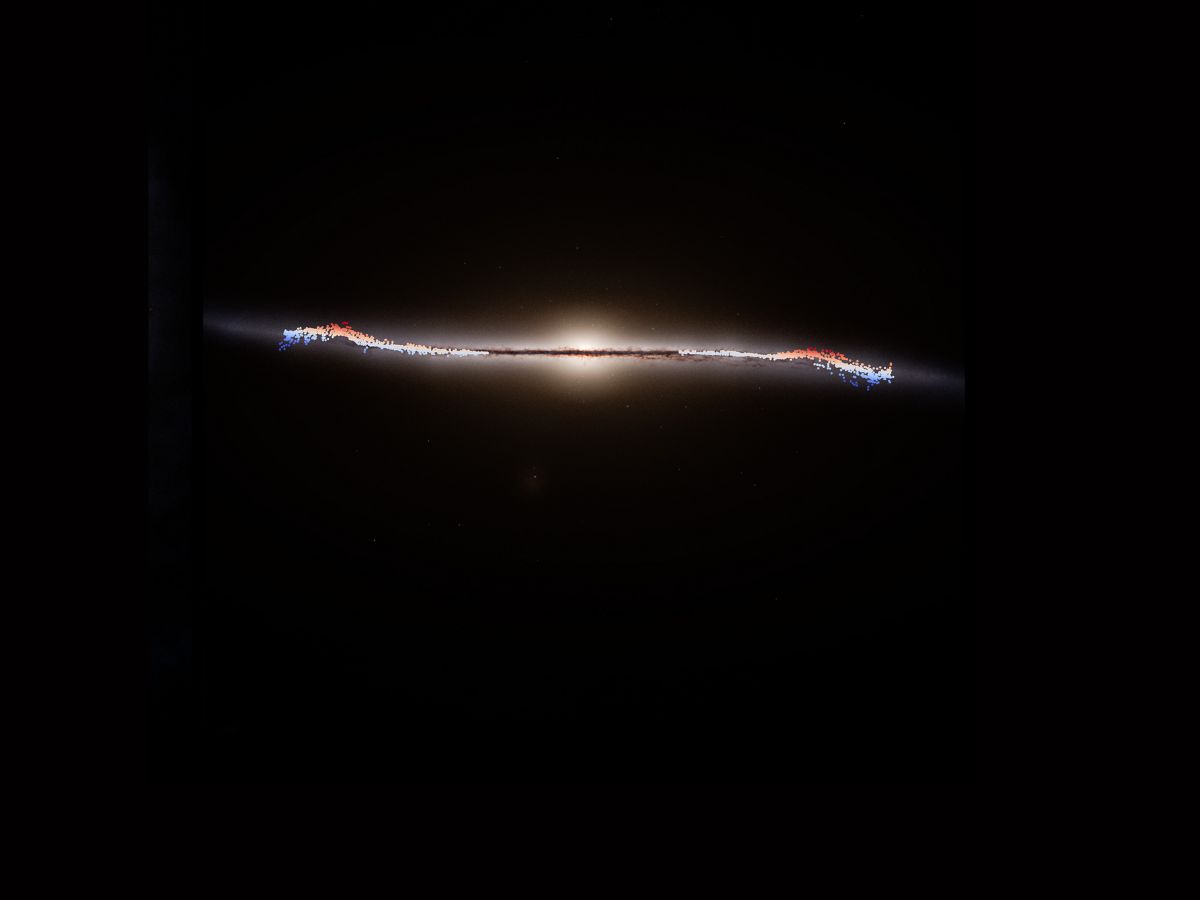
ESA’s Gaia finds a giant wave rippling through the Milky Way
The Milky Way isn’t a flat, quiet disk—it’s flexing. Using exquisitely detailed measurements from ESA’s Gaia space telescope, astronomers have detected a vast, galaxy-scale wave sweeping through our home galaxy. This ripple is moving outward from the galactic center and is influencing stars tens of thousands of light-years away, reshaping how we understand the Milky Way’s structure and motion.
Astronomers have long known that our galaxy’s stellar disk is warped rather than perfectly flat. In 2020, Gaia revealed that this warp actually wobbles over time. Now, the latest analysis shows something even more dramatic: an up-and-down oscillation traveling through the disk like a swell on a cosmic ocean. Gaia’s edge-on, 3D view of the Milky Way captures this vertical rippling, providing clear evidence of a great wave that affects stars roughly 30,000 to 65,000 light-years from the center.
To trace the wave, astronomer Eloisa Poggio and her team studied the positions and motions of two stellar groups that are ideal for mapping galactic dynamics: young giant stars and Cepheid variables. Cepheids are especially valuable because their brightness pulses in a predictable way, letting scientists measure their distances with high precision across enormous spans. Both the young giants and the Cepheids appear to be moving in sync with the ripple, acting like drifting buoys that reveal the swell beneath them.
Because these young stars form from interstellar gas, the team concludes that the gas itself must be flowing in the same wave-like pattern. That means the ripple isn’t just a quirk of stellar orbits—it’s a genuine, large-scale motion embedded in the Milky Way’s disk.
What could set an entire galaxy waving? One compelling idea is a past encounter with a smaller, passing galaxy. A close brush or collision with a dwarf galaxy could have tugged on the Milky Way’s disk, sending a gravitational shock that propagated outward as a wave. Another possibility is a connection to the Radcliffe Wave, a nearer, smaller-scale ripple in the local arm of the galaxy located about 500 light-years from the Sun. Whether these structures share an origin or simply reflect the Milky Way’s complex, layered dynamics remains an open question.
The discovery matters because it offers a powerful new handle on the forces sculpting our galaxy. By watching how different kinds of stars respond to the wave, astronomers can refine models of the Milky Way’s mass distribution, the behavior of its gas and dust, and the lingering fingerprints of ancient galactic flybys.
More answers are on the horizon. A major Gaia data release expected in December 2026 will deliver even sharper measurements of stellar positions and motions. With that, researchers hope to pin down the wave’s speed, age, and cause—and determine whether we’re seeing the aftermath of a cosmic encounter or a fundamental rhythm of the Milky Way itself.
Keywords: Milky Way wave, Gaia space telescope, galactic disk warp, stellar kinematics, Cepheid variables, dwarf galaxy collision, Radcliffe Wave, ESA, Gaia data release 2026, interstellar gas dynamics.


