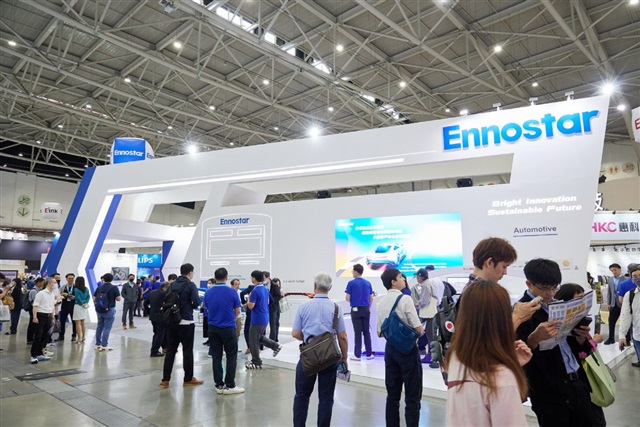
Ennostar, the largest LED manufacturer in Taiwan, has announced a strategic partnership with German epitaxy specialist Allos Semiconductors to push microLED technology closer to mainstream adoption. The two companies plan to bring 8-inch gallium nitride-on-silicon (GaN-on-Si) LED epitaxial wafers into mass production, a move that could help scale microLED displays while improving consistency and manufacturing efficiency.
At the center of the deal is epitaxy, the critical process used to grow ultra-thin crystalline layers that determine LED performance. By combining Ennostar’s manufacturing scale with Allos’ epitaxy expertise, the partners aim to deliver 8-inch GaN-on-Si epi wafers designed specifically for the demands of microLED. Larger wafer sizes generally allow more devices per wafer, better throughput, and the potential for lower cost per chip—key factors for microLED, which requires enormous numbers of tiny, highly uniform emitters.
The collaboration is also positioned as a direct boost for highly integrated microLED applications, especially augmented reality. AR devices demand compact, bright, power-efficient display solutions, and microLED is often seen as one of the most promising candidates because it can deliver high brightness and efficiency in very small form factors. Scaling up GaN-on-Si production to 8-inch wafers could help address one of microLED’s biggest obstacles: manufacturing at volume with consistent yields.
Beyond the immediate goal of ramping 8-inch GaN-on-Si wafers, the partnership is meant to set up the industry’s next step: a future transition to 12-inch GaN-on-Si technology. Moving to 12-inch wafers would align more closely with mature silicon manufacturing infrastructure, potentially opening the door to even greater economies of scale and broader supply chain compatibility.
In short, Ennostar and Allos are targeting a major manufacturing milestone for microLED displays—mass-produced 8-inch GaN-on-Si LED epitaxial wafers—while preparing a pathway toward 12-inch technology. If successful, this could accelerate microLED readiness for demanding products like AR displays and other next-generation, highly integrated devices.