Elon Musk says SpaceX will rely exclusively on NVIDIA GPUs for its AI ambitions
SpaceX is making a major commitment to NVIDIA hardware as it expands its artificial intelligence infrastructure on Earth and beyond. Elon Musk has stated that SpaceX will use NVIDIA GPUs exclusively, describing them as the best option available for the company’s growing AI workloads.
The move puts NVIDIA at the center of SpaceX’s next phase of AI computing, including large-scale data centers designed to support advanced machine learning, autonomous systems, orbital analytics, and future space-based compute platforms.
According to Musk, SpaceX plans to use NVIDIA’s Vera Rubin platform for AI data centers, with deployments expected across global facilities and potentially in orbit. The NVIDIA Vera Rubin NVL72 rack, reportedly codenamed Kyber, is set to play a key role in powering these AI systems.
SpaceX is expected to bring around 2 gigawatts of compute capacity online by the end of the year, with a much larger target of 10 gigawatts by the end of 2027. If achieved, this would represent one of the most aggressive AI infrastructure buildouts in the technology and aerospace industries.
The decision is also a major boost for NVIDIA, which continues to dominate the AI hardware market. Demand for its GPUs remains extremely high as companies race to build larger and faster AI clusters for training and inference. SpaceX choosing NVIDIA exclusively further strengthens the company’s position as the preferred supplier for high-performance AI computing.
What makes this development especially interesting is SpaceX’s focus on orbital AI data centers. While most AI infrastructure today is built on land, SpaceX appears to be exploring ways to move parts of that computing power into space.
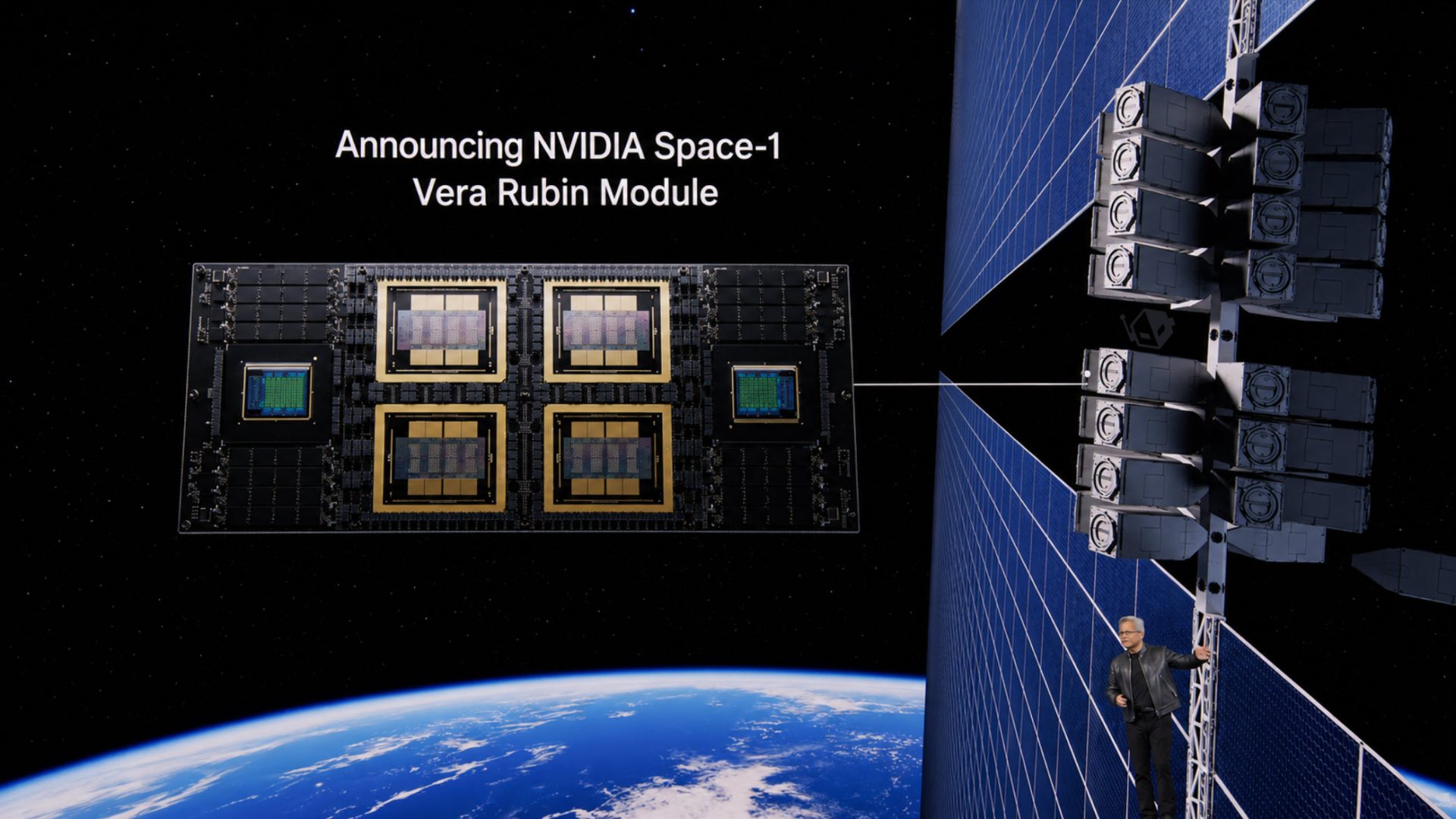
NVIDIA has already introduced a space-certified Vera Rubin module known as Space-1. This module is designed specifically for satellites, orbital platforms, and other space-based systems that require powerful AI inference capabilities.
The Space-1 Vera Rubin module includes four Rubin GPUs, two Vera CPUs, and a large memory configuration. It is built to handle demanding workloads in orbit, where real-time processing can be critical.
NVIDIA says the module can deliver up to 25 times the AI compute performance of the previous H100 GPU for orbital workloads. That level of performance could be useful for applications such as geospatial intelligence, autonomous spacecraft operations, satellite data analysis, and on-orbit decision-making.
Another important advantage is that the space-certified module uses the same Vera Rubin architecture as NVIDIA’s Earth-based systems. This creates a unified software and development environment, making it easier for engineers to build AI applications that can operate both on the ground and in space.
The idea of AI data centers in orbit may sound futuristic, but SpaceX has already shown interest in building large-scale space-based compute infrastructure. The company has previously been connected to plans for a multi-gigawatt orbital AI data center, a concept that could help address some of the biggest challenges facing traditional data centers.
On Earth, AI data centers require massive amounts of electricity, land, and cooling. These limitations are becoming more serious as companies build increasingly powerful AI clusters. Space-based data centers could potentially reduce some of these constraints by taking advantage of solar energy and the cold environment of space.
However, the concept also comes with enormous challenges. Launching hundreds of thousands of GPUs and supporting equipment into orbit would require an unprecedented logistics effort. Even with SpaceX’s reusable rocket technology, transporting enough hardware to build a true orbital AI supercomputing network would be a massive undertaking.
There is also the question of maintenance, hardware reliability, radiation protection, data transfer speeds, and long-term operational costs. AI chips in space must be able to survive harsh orbital conditions while delivering consistent performance.
Still, the direction is clear: SpaceX is not just thinking about AI as a ground-based tool. The company appears to be preparing for a future where artificial intelligence supports spacecraft, satellites, robotics, communications networks, and potentially large-scale compute systems beyond Earth.
By choosing NVIDIA GPUs exclusively, SpaceX is aligning itself with the current leader in AI acceleration. NVIDIA’s hardware and software ecosystem has become the backbone of modern AI development, powering everything from large language models to autonomous systems and scientific research.
For SpaceX, the partnership could help accelerate AI development across several areas, including Starlink network optimization, launch operations, spacecraft autonomy, satellite imaging, robotics, simulation, and future Mars-related systems.
As AI workloads continue to grow, the need for faster and more efficient compute infrastructure will only increase. SpaceX’s commitment to NVIDIA suggests the company sees GPU-powered AI as essential to its future, both on Earth and in orbit.
If SpaceX succeeds in scaling AI data centers beyond the planet, it could open a new chapter in computing infrastructure. The race for AI power may no longer be limited to data centers on the ground. It could soon extend into space, where energy, cooling, and scale may be reimagined entirely.