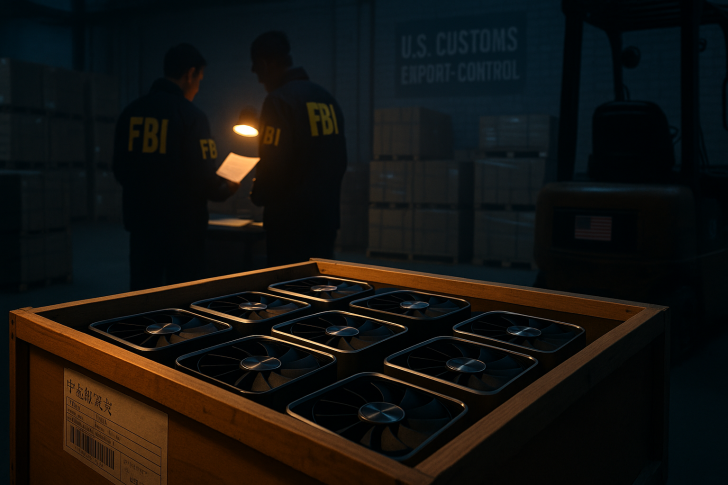
Federal agents in Los Angeles have dismantled a smuggling network responsible for funneling millions of dollars’ worth of advanced graphics processors to China, bypassing strict export controls. Two young individuals allegedly orchestrated this operation from a modest strip-mall office in El Monte.
Details emerged from court documents revealing that ALX Solutions Inc. was established shortly after the U.S. enforced tighter chip-export regulations in 2022. Over the subsequent 20 months, the company completed 21 outbound shipments, cleverly routing them through Singapore or Malaysia. They deceptively labeled these as commodity video cards exempt from licensing. However, a routine inspection uncovered the truth. Customs scanners detected crates packed with high-demand accelerators, marked only as “computer parts.”
Financial records showed a Hong Kong buyer wiring $1 million initially, complemented by smaller deposits from mainland companies linked to defense contractors. Investigators also uncovered Signal chats where co-founder Chuan Geng advised his partner, Shiwei Yang, on evading detection: “slice orders, never repeat a forwarder, switch labels if someone asks questions.”
The charges link back to a Bureau of Industry and Security regulation introduced in October 2022. This rule blocked China’s access to chips capable of handling large neural-network tasks unless exporters obtained a Commerce license. The mandatory threshold of around 600 gigabytes per second of interconnect bandwidth closely aligns with hardware suitable for military AI applications.
The unfolding investigation resembled a spy thriller. A mislabelled package was intercepted by Long Beach customs in December, leading to a serial-number trace that hit Nvidia’s database. A late-night stakeout followed a delivery van to ALX’s rented warehouse. When agents searched the premises, they found empty trays for approximately 1,000 premium GPUs, valued at over $25 million, alongside packing slips destined for a burgeoning AI firm in Shenzhen.
Geng surrendered to authorities without incident, while Yang was apprehended at LAX attempting to fly to Taipei. Geng was released on a $250,000 bond, but Yang remains in custody pending a detention hearing. Both face charges under the Export Control Reform Act, with potential sentences of up to 20 years.
The Justice Department’s Counterintelligence and Export Control Section prosecutes alongside the Los Angeles U.S. Attorney’s Office. The FBI described the scheme as “classic transshipment with modern flair,” while BIS aims to pursue civil penalties and possibly a lifetime export ban.
Public filings reveal Geng was previously a finance chief for a now-dissolved e-commerce business, and Yang co-owned a parcel-forwarding company catering to overseas sneaker buyers. Neither has a technological background, supporting prosecutors’ claims that ALX was specifically formed to smuggle restricted hardware into China’s market hungry for accelerators.
A grand jury indictment is still needed, but defense attorneys suggest they might argue the chips were below the performance thresholds when purchased. This case could bring expert testimonies on bandwidth limits and firmware changes, potentially setting the stage for a trial in spring 2026 to explore how Washington plans to curb silicon smuggling in the AI age.