DRAM Prices Are Now Beating Cutting-Edge 2nm Silicon, and AI Demand Is the Reason
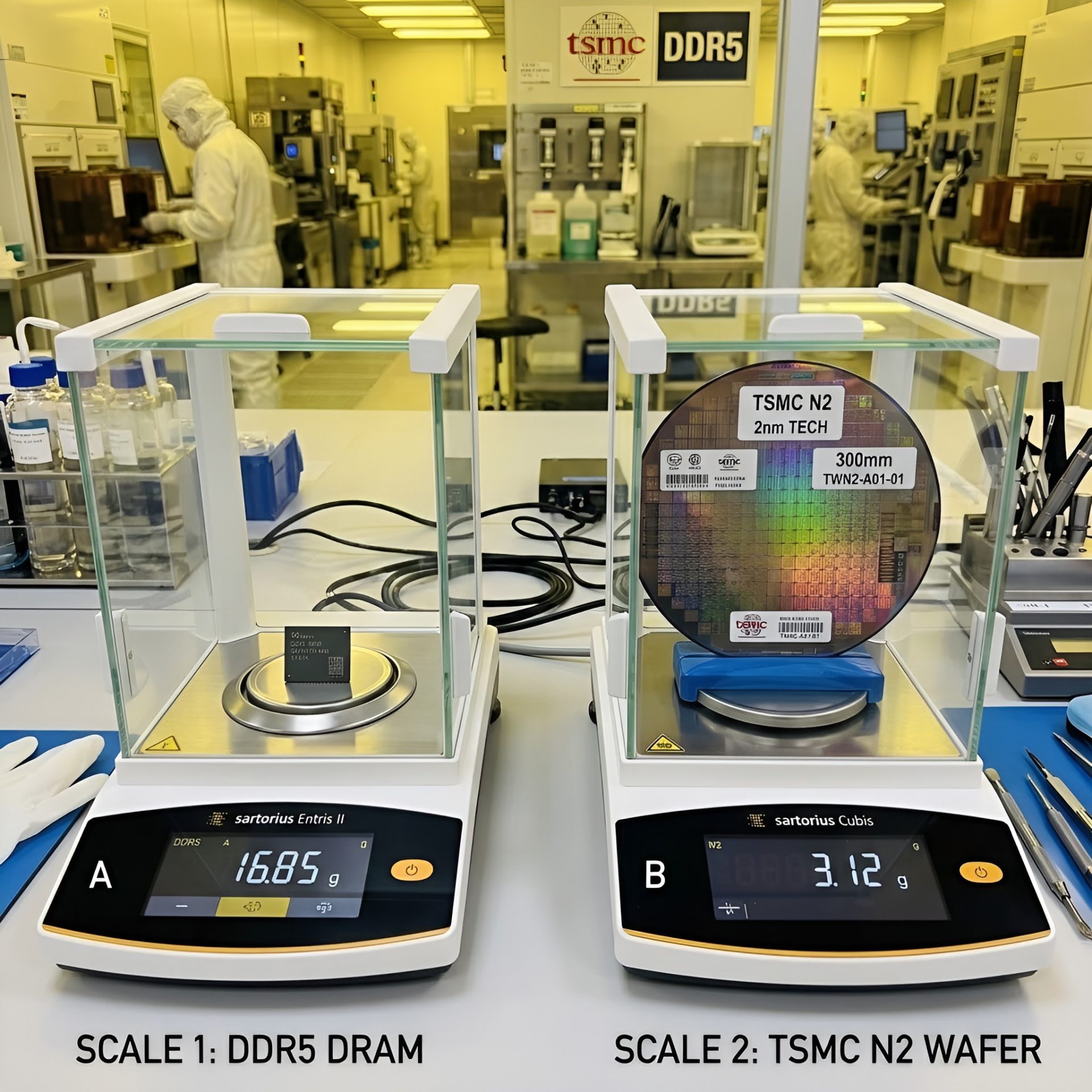
The AI hardware boom is reshaping the semiconductor market in ways that would have sounded unlikely just a few years ago. One of the clearest examples is the current pricing of advanced DRAM: on a per-square-millimeter basis, modern 1b DRAM is now more expensive than TSMC’s upcoming N2-class wafer technology, even though the 2nm-class logic process is far more complex to manufacture.
According to recent wafer pricing estimates, a 300mm TSMC N3 wafer costs roughly $20,000, while an N2 wafer of the same size is estimated at around $30,000. That works out to approximately $0.283 per square millimeter for N3 and about $0.424 per square millimeter for N2.
By comparison, 1b DRAM currently carries a bit density of around 0.436 Gb per square millimeter. Using a reference DRAM price of $1.50 per Gb, the cost comes out to roughly $0.654 per square millimeter. That makes 1b DRAM about 54% more expensive than an equivalent area of TSMC N2 silicon.
This is striking because DRAM manufacturing, while highly advanced, is generally considered less difficult than producing leading-edge logic wafers on a 2nm-class process. Yet market forces are overriding manufacturing complexity. The reason is simple: demand for memory, especially DDR5 and high-performance DRAM used in AI servers, remains extremely strong while supply continues to lag.
Recent market pricing supports this trend. A 16 Gb DDR5 eTT part has been quoted near $24.80, which translates to about $1.55 per Gb. That makes the $1.50 per Gb reference point a realistic benchmark rather than an inflated estimate.
Even older DRAM generations are approaching the cost of leading-edge logic silicon. For example, 1z DRAM, which is several generations behind the newest 1b products, offers a bit density of around 0.273 Gb per square millimeter. At the same reference pricing, that puts its value near $0.410 per square millimeter, almost on par with TSMC’s N2 wafer pricing.
The larger story is that commodity DRAM is no longer behaving like a low-margin, easily available component. The rapid expansion of AI data centers has created intense demand for memory across the board. Servers built for artificial intelligence workloads require large amounts of DDR5, HBM, and other advanced memory products. As cloud providers, chipmakers, and enterprise AI customers compete for supply, prices have risen sharply.
The situation may not cool down soon. Samsung is reportedly adjusting its next-generation DRAM strategy, including work on its B1b process, expected to be the company’s first sub-10nm DRAM technology. This approach may involve fabricating memory cells and peripheral driver circuitry on separate wafers before joining them using wafer-to-wafer hybrid bonding.
Hybrid bonding can improve density and performance, but it is also expensive. If this method becomes central to next-generation DRAM production, future memory chips could arrive with even higher price tags, especially if AI demand remains elevated.
Other memory manufacturers are also preparing to scale production of newer DRAM generations over the next few years. However, expanding DRAM capacity is not instant. It requires advanced equipment, large capital investment, process tuning, and time. Until new supply meaningfully catches up with demand, premium pricing could remain a key feature of the memory market.
For consumers, this could mean higher prices for PCs, laptops, graphics cards, servers, and other electronics that rely on DDR5 memory. For data center operators, it could increase the cost of building AI infrastructure. For memory manufacturers, however, the current cycle represents a major opportunity after years of oversupply and weak margins.
The takeaway is clear: the AI boom has turned advanced DRAM into one of the hottest assets in the semiconductor industry. A square millimeter of 1b DRAM now commands more value than the same area of one of the world’s most advanced logic wafers. That is not just a pricing oddity; it is a sign of how dramatically artificial intelligence is changing the economics of chips.