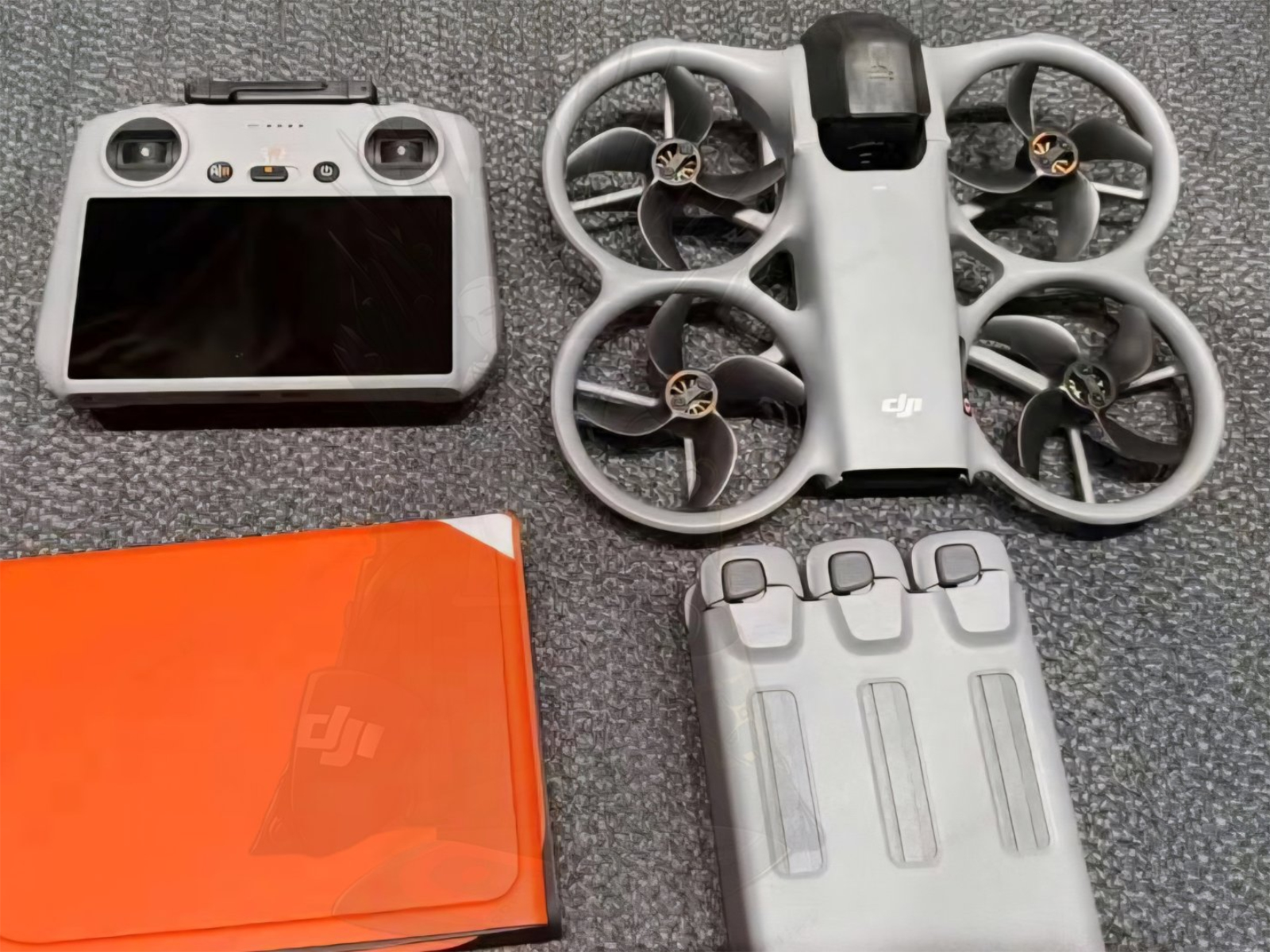
DJI’s next big step in immersive aerial video is getting closer. The long-rumored DJI Avata 360, positioned as a direct rival to the Antigravity A1, has surfaced again in newly leaked photos—and they appear to confirm a major design advantage that could make DJI’s upcoming drone far more versatile.
Right now, the Antigravity A1 stands out as the only consumer 360° drone you can actually buy. But leaks over the past few months suggest DJI has been developing its own alternative, expected to arrive as part of the Avata lineup. While DJI still hasn’t confirmed an official launch date, sightings and images have been stacking up, pointing to a debut that’s likely not far off.
The newest images back up earlier claims that the Avata 360 will include a rotating camera structure—something the Antigravity A1 doesn’t offer. That detail matters more than it sounds. On the Antigravity A1, landing gear is essentially necessary because of the drone’s bottom camera lens, helping prevent scratches during takeoff and landing. With a rotating camera module, the Avata 360 may be able to avoid that requirement by repositioning its lenses as needed, potentially simplifying the design and improving real-world usability.
What really grabs attention in the latest leak is how the Avata 360 appears to be operating: one lens is shown facing inward while the other faces outward. Even more telling, the nearby controller display shows a normal live view rather than a full 360° preview. That strongly suggests the DJI Avata 360 won’t be limited to only 360° capture. Instead, it could function as both a 360° drone and a traditional FPV drone, giving users the option to fly immersive first-person routes when they want, then switch to full panoramic capture for action shots or travel footage.
Early specs floating around the rumor mill point to serious imaging hardware, too. The Avata 360 is expected to record up to 8K video using dual 1/1.1-inch CMOS sensors, which—if accurate—would signal a major push into high-detail 360 recording without sacrificing FPV flexibility.
Pricing rumors indicate DJI may aim aggressively for the mainstream market. The Avata 360 is reportedly expected to start at around CNY 2,988 (roughly $425), with a launch anticipated later this quarter. DJI hasn’t revealed how much the drone weighs yet, but if it’s built to balance stability, flight time, and portability, it could quickly become a standout option for creators who want one drone that can do it all.
If these leaks hold true, the DJI Avata 360 could be more than just another 360 camera drone—it may be a hybrid designed for both cinematic 360° capture and fast, immersive FPV flying, potentially setting a new standard in the consumer drone space.