Imagine building a high-end gaming PC with almost no visible cables, effortless airflow, and a cleaner-than-ever layout. That’s the vision behind DIY-APE’s next-generation BTF 3.0 ecosystem, a major leap for back-side motherboard design that pushes cable management, power delivery, and IO integration to the next level.
DIY-APE pioneered the idea of shifting connectors to the back of the motherboard and has spent years refining it in partnership with big names across the industry, including ASUS, MSI, Maxsun, Colorful, Yeston, Gigabyte, and numerous PSU, case, and cooling brands. With BTF-compatible parts already at retail, the company’s focus now is making the experience simpler, sleeker, and more universal for future DIY builds.
At the heart of BTF 3.0 is a new 50‑pin power connector based on ATX 3.0 and ATX 3.1. Unlike purely 12V designs, this connector also carries 5V and 3.3V rails to avoid sleep/wake quirks and ensure broad compatibility. Built around a CRPS-style approach borrowed from servers, the 50‑pin solution targets stability under heavy, sustained loads, and it’s rated up to 2145W overall. Up to 1680W can be dedicated to the CPU and GPU, which is more than enough for a flagship graphics card like an RTX 5090 paired with a top-tier Intel or AMD processor.
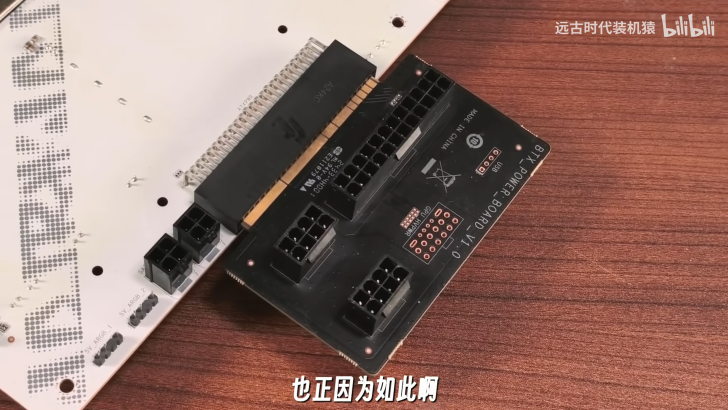
While early concepts implied the PSU must sit right beside the motherboard connector and therefore required BTF-only cases, DIY-APE now clarifies that BTF 3.0 is designed to play nicer with existing hardware. For builders using traditional power supplies, a compatibility adapter board is planned. It includes a standard 24‑pin, two EPS 8‑pin CPU power ports, and a 12VHPWR line for the GPU. BTF 3.0 motherboards will also feature two 4‑pin connectors to power SATA devices, easing the transition from current builds to the cleaner BTF ecosystem.
Graphics card power is getting a makeover too. DIY-APE already supports a GC_HPWR slot that, similar to existing back-side solutions, can deliver well over 1000W. With BTF 3.0, the company aims to extend this to non-BTF GPUs by using a modular adapter that bridges a conventional 16‑pin GPU power input to the GC_HPWR interface. That means a hidden, high-capacity power path without the bulky front-side cable clutter.
Another ambitious goal is unifying motherboard IO through a single back-side connector. To get there, DIY-APE is developing a new rear IO interface paired with easy adapters that bundle USB and chassis connections. Two versions are planned—an extended adapter and a simpler one—paving the way for case and motherboard makers to align on a single, standardized plug that streamlines front-panel wiring and setup.
Cooling and lighting are also being rethought for a neater finish. BTF 3.0 encourages short-tube AIO designs for tighter routing and a tidier look. To simplify RGB and fan control, DIY-APE outlines best practices for next-gen cases:
– Pre-installed power and RGB hubs or 1-to-N splitter cables matched to the case’s fan mounts
– Dedicated cable channels for fan power and lighting
– Factory pre-installed fan power and RGB runs
– Reserved, easy-to-reach female connectors near every fan slot
DIY-APE has already showcased a proof-of-concept build using pre-release Colorful hardware—pairing a BTF 3.0 PSU and 50‑pin cable with a BTF 3.0-ready motherboard and graphics card. The result is a striking, cable-free presentation that hints at how streamlined tomorrow’s DIY PCs could be.
Key changes DIY-APE is targeting with BTF 3.0 include:
– Hidden power delivery for graphics cards through high-capacity back-side connectors
– A modular adapter to support non-BTF GPUs
– Short-tube AIO cooling for cleaner loops
– A single 50‑pin power connector for the motherboard and components
– Side-insertion PSU options for easier installs
– A unified back-side IO interface on motherboards
– Matching back-side IO layouts for cases to standardize cable runs
What this means for builders is simple: faster, cleaner assembly with fewer visible cables, better airflow, and a more professional finish—without abandoning compatibility. By maintaining support for BTF 2.0 and conventional standards, DIY-APE is paving a practical path forward rather than forcing an overnight transition.
If this vision gains widespread adoption among motherboard, GPU, case, and PSU makers, BTF 3.0 could mark the moment when cable-free PC builds move from niche to mainstream. For now, the concept is already proving itself in early demos, and the roadmap suggests a future where building a powerful, ultra-clean PC is easier than ever.