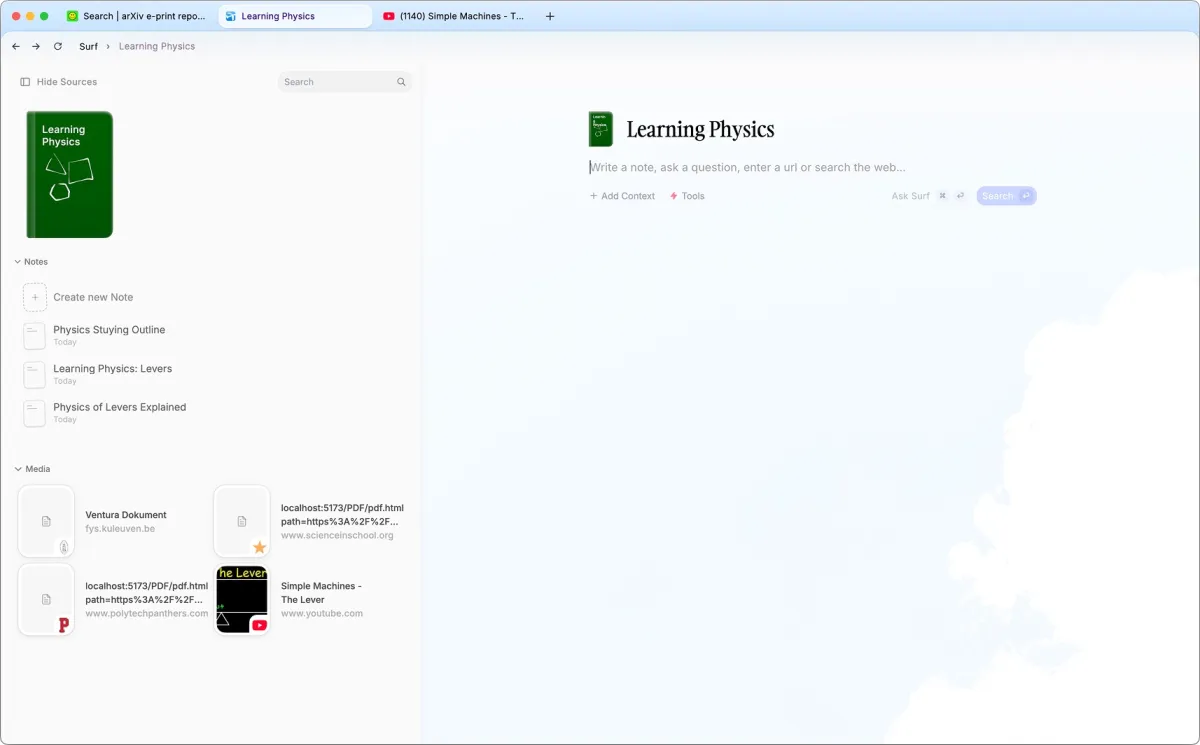
In the current wave of “AI meets X” apps, a Berlin- and New York-based startup is launching a notable entry: Deta Surf, an AI-powered browser fused with a research and knowledge management workspace. Now in beta, Surf combines web browsing, AI summaries, and notebook-style organization to help you explore topics, collect sources, and turn findings into editable, structured notes.
At its core, Surf is both a browser and a notebook. Start with a prompt, and the AI drafts a clear, Notion-like summary you can refine as you go. Because it’s a browser, you can open any page, then summarize and extract key insights from websites, PDFs, and even YouTube videos without leaving your workspace.
Key features include:
– Topic notebooks that compile AI-generated summaries you can edit and expand
– Multi-tab context for the built-in chatbot, letting you ask questions across several open sources at once
– One-click summaries and takeaways from web pages, PDFs, and videos
– Code generation to spin up mini apps, interactive charts, and graphs directly inside your notes
– The ability to add any AI output into a chosen notebook for organized research trails
Several modern AI browsers already let you use tabs as context, and some can produce small code snippets. Deta’s approach aims to go further by anchoring research in editable notebooks and keeping data local so you can keep working offline—an advantage the team believes makes Surf especially useful for students and researchers. The company sees Google’s NotebookLM as a direct competitor, but positions Surf’s tab context and local-first design as differentiators.
Deta’s path to Surf has been iterative. Founded in 2019, the team initially pursued a new operating system centered on an infinite canvas. That project was sunset in 2023, prompting a pivot to AI browsing and, ultimately, to a research-first browser. Along the way, Deta concluded that many AI browsers risk turning into agents clicking through human-oriented hypertext, and that an interface you can’t edit undermines productive human–machine collaboration—hence the notebook-centric model.
Surf is available for free during the beta. An image generation feature is in the works, and a future premium plan may add cloud backup, collaboration, and multi-device support.
Deta raised $3.6 million in 2023 in a seed round led by Crane Venture Partners, with participation from System.One, Tomahawk.VC, Tiny.VC, Acequia Capital, Angel Invest, and NPHard. The company has since secured an additional $500,000 from existing and new investors.
If you’re looking for an AI research assistant that blends browsing, summarization, coding, and structured note-taking—while keeping data local—Deta Surf is a compelling new option to try.