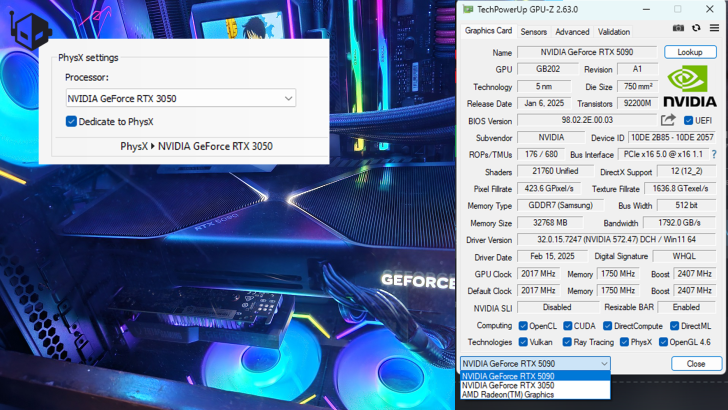
Imagine breathing new life into your favorite classic games, simply with a clever tweak to your gaming setup. That’s exactly what one innovative gamer showcased, demonstrating a significant boost in performance for older PhysX-dependent games by integrating an RTX 3050 into his system, which primarily runs on the powerful RTX 50 series GPU.
The catch here is that NVIDIA recently phased out PhysX support for their latest RTX 50 series cards. This decision left many classic games like “Batman: Arkham Asylum,” “Borderlands 2,” and “Mirror’s Edge” struggling to perform smoothly, even on the cutting-edge GeForce RTX 5090. It’s a disappointing scenario for those who revel in the nostalgia of these iconic titles.
In a stroke of ingenuity, Reddit user u/jerubedo found a workaround: pairing the RTX 5090 with an older NVIDIA GPU, the RTX 3050, which still supports PhysX. By dedicating the RTX 3050 to handle PhysX tasks through the NVIDIA Control Panel, he successfully overcame performance issues seen in some fan-favorite games.
The results were nothing short of impressive. Performance benchmarks revealed considerable improvements in frame rates. For instance, “Mafia II Classic” jumped from 28.8 FPS to a remarkable 157.1 FPS—a staggering 545% increase. More notably, “Mirror’s Edge” saw its frame rate skyrocket from an unplayable 12 FPS to a smooth 171 FPS, marking an astonishing 1425% performance boost.
As for “Borderlands 2,” the game simply couldn’t activate PhysX without the aid of the RTX 3050, underlining its necessity. However, in “Assassin’s Creed IV: Black Flag,” the CPU managed the PhysX load well, rendering the additional GPU unnecessary for improvements.
This creative solution highlights an intriguing possibility: using an earlier-generation GPU as a dedicated PhysX processor really can transform your gaming experience. It’s an unexpected reminder of how a mix of old and new technology can work wonders—perhaps echoing NVIDIA’s sentiment of “the more you buy, the more you save” in a whole new light.
While NVIDIA stated the non-support for 32-bit CUDA applications in their latest series, they didn’t explicitly mention dropping PhysX support. This ambiguity has cleverly been capitalized upon by resourceful gamers, making older games enjoyable once more.
So if you’re yearning to revisit some classics, consider dusting off an older GPU and giving it a second lease of life to enhance your gaming adventures. It might just be the upgrade you never knew you needed.