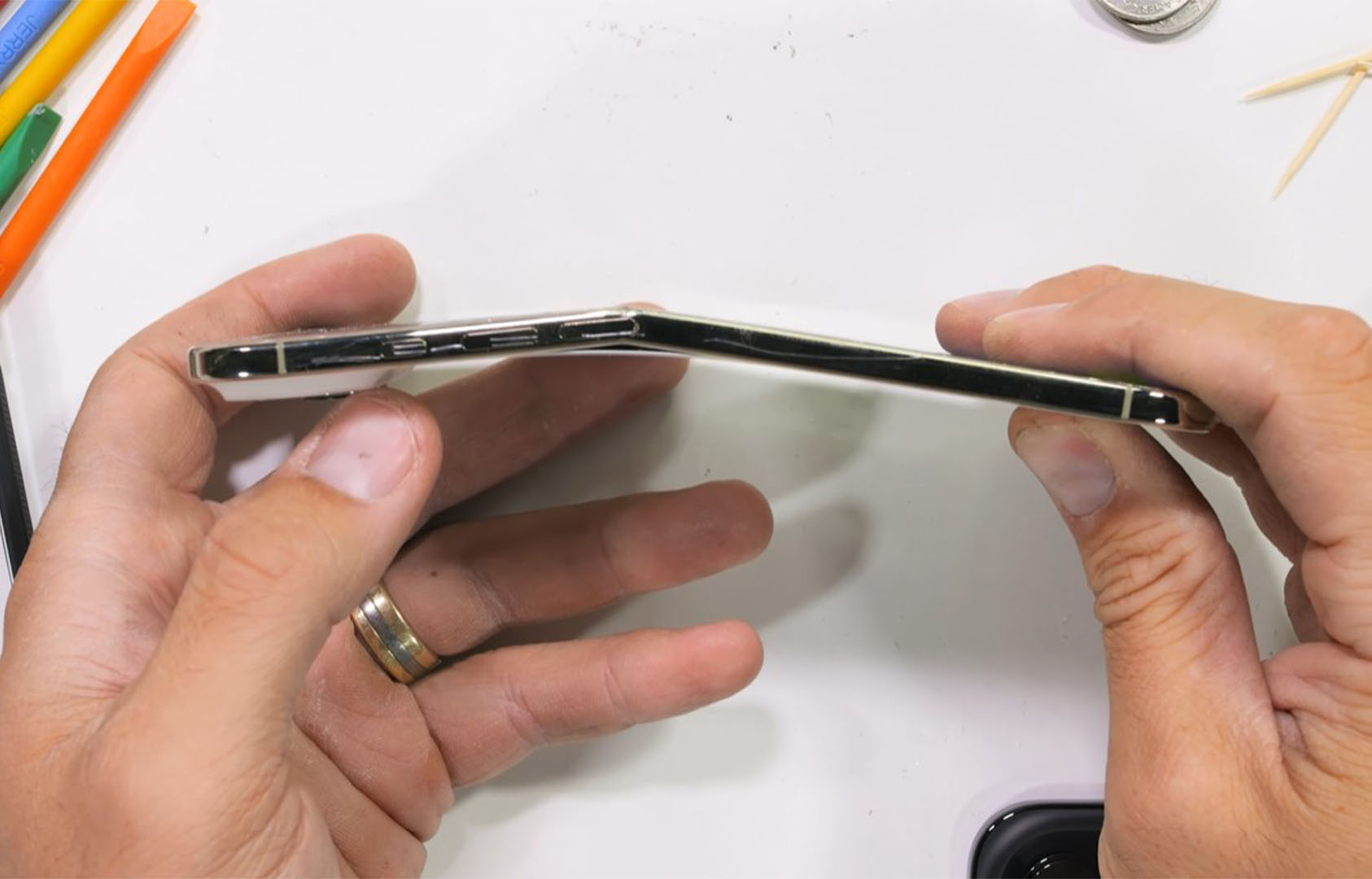
Apple’s thinnest iPhone yet was bound to spark durability doubts. At just 5.6mm thick, the iPhone Air looks like it should be fragile—but an aggressive bend test from YouTuber Zach of JerryRigEverything paints a very different picture. It took a concentrated load of about 216 pounds of force (nearly 100 kgf) to crack the front glass, and even then the phone kept working and remained impressively rigid.
The testing started the old-fashioned way, with a bare-handed bend attempt. Despite visible flex, there was no snap and no cracking sound—an early sign Apple’s internal structure is doing serious work. Then came the extreme round: a garage setup with steel chains and a crane scale to apply a focused, measurable load to the middle of the frame. That’s far harsher than real-world scenarios, where pressure is spread out in a pocket or bag.
Only around the 216-pound mark did the display glass finally give with an audible pop. Even so, the screen still functioned, and the chassis held its new shape without collapsing or creasing further. In practical terms, it would take a remarkably unlucky incident to damage the iPhone Air this way in everyday life. The test underscores that concentrated pressure is a worst-case scenario, not what your phone experiences during normal use.
Apple itself seems confident in the engineering, with executives casually tossing and flexing units to showcase how robust the ultrathin design really is. For anyone worried that a 5.6mm profile equals a bend-prone device, this stress test suggests the opposite: the iPhone Air is a surprisingly tough, premium build that withstands serious abuse before showing weakness.