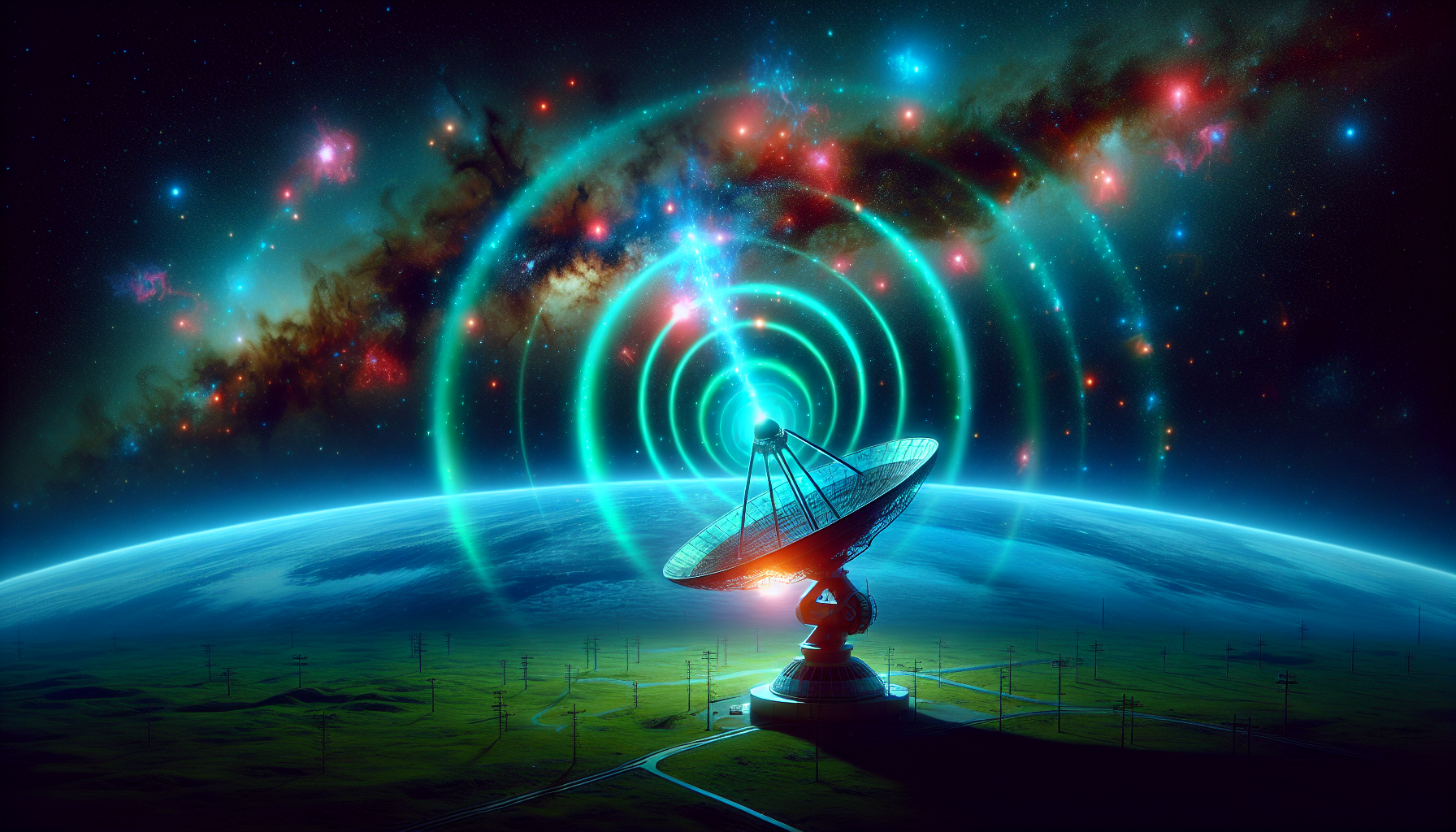
A recent breakthrough has left astronomers buzzing with excitement: a radio signal from deep space, FRB 20220610A, was detected after traveling 8 billion years to reach Earth. This fast, super-energetic burst is one of the most powerful and distant signals ever recorded and could eventually help us unlock the universe’s long-standing mysteries, including the whereabouts of its missing matter.
Fast radio bursts (FRBs) like this one are a fascinating phenomenon to scientists. They are incredibly brief but extremely potent, leaving researchers scratching their heads about their origins. The discovery of FRB 20220610A was spearheaded by Dr. Stuart Ryder and his team at Macquarie University, using the Australian Square Kilometre Array Pathfinder (ASKAP).
The signal’s journey began in an ancient galaxy farther away than any known FRB source to date. In just a few milliseconds, FRB 20220610A emitted as much energy as our Sun does in 30 years. This extraordinary release of energy makes it a goldmine for scientists aiming to understand the universe better.
The significance of this discovery extends beyond just the thrill of detection. Scientists speculate that FRBs might be the key to locating the universe’s “missing matter.” Current cosmological models suggest there is much more ordinary matter than what is visibly accounted for. FRBs could potentially guide us to map this elusive material that hides in the vast spaces between galaxies.
As radio telescopes continue to advance in capability, we can look forward to more such discoveries in the future. Each detected signal brings us a step closer to piecing together the puzzle of our universe, offering a new lens through which we can study these cosmic mysteries.
With technology and scientific curiosity propelling us forward, who knows what other surprises the universe has in store?