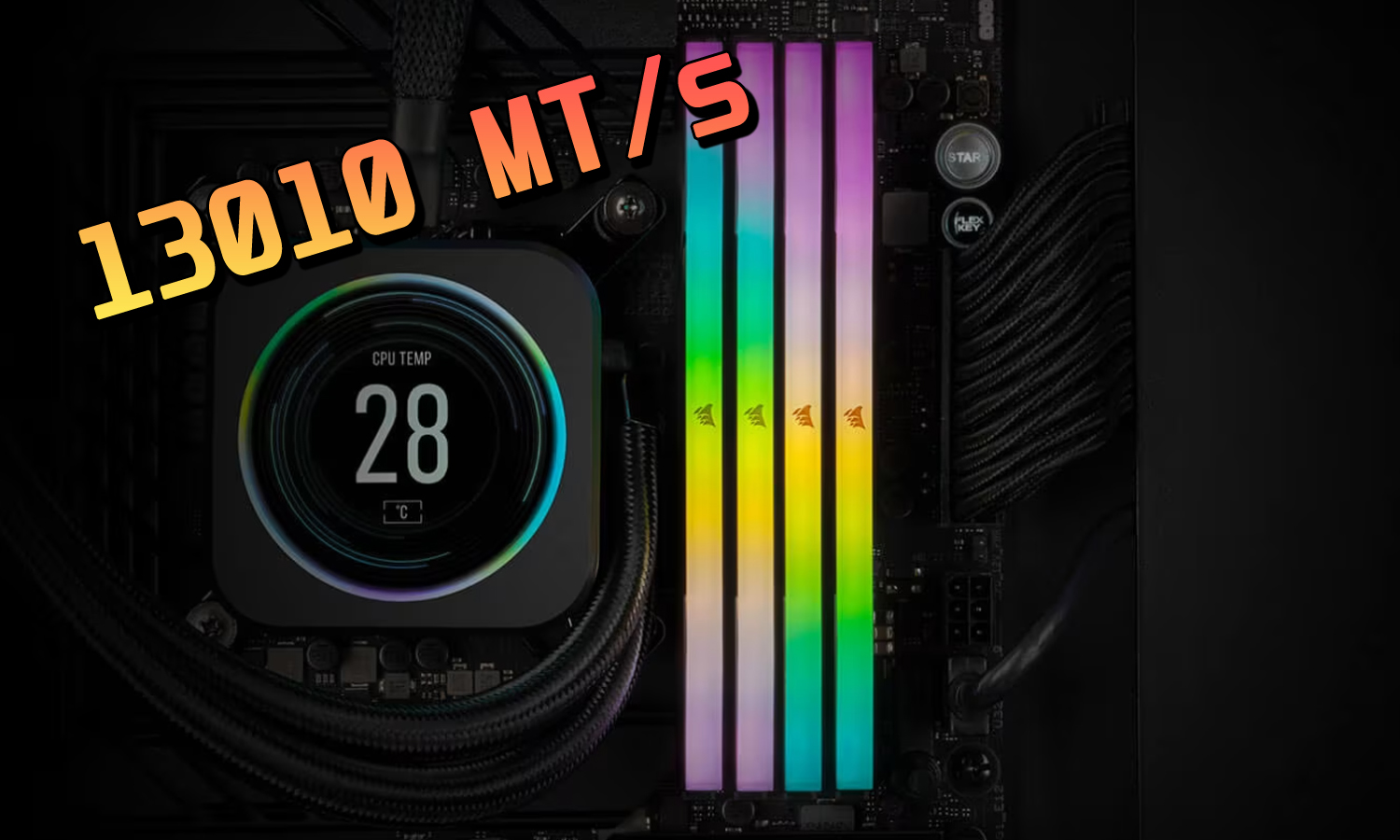
DDR5 has a new speed champion. The long-anticipated 13,000 MT/s barrier has finally fallen, with German overclocker “sergmann” officially pushing a single Corsair Vengeance DDR5 module to an astonishing 13,010 MT/s on GIGABYTE’s Z890 Aorus Tachyon ICE motherboard.
The new record, verified by HWBot and CPU-Z, registers a memory clock of 6504.0 MHz, which translates to an effective data rate of approximately 13,010 MT/s thanks to double data rate signaling. This feat comes after months of incremental gains in the extreme overclocking scene. Just last month, well-known overclocker “saltycroissant” set a 12,920 MT/s mark on the same overclocking-focused board and even teased breaking 13,000 MT/s unofficially. Sergmann, however, is the first to cross the line with an officially validated result.
This surge in DDR5 frequency records really took off following the release of Intel’s Core Ultra 200S processors and Z890 motherboards, whose memory controllers have enabled unprecedented headroom. Since then, dozens of enthusiasts have surpassed 10,000 MT/s, with several breaking through 12,000 MT/s. Hitting 13,000 MT/s, though, represents a meaningful escalation in what’s possible under extreme conditions.
The record-setting setup featured:
– A 24 GB Corsair Vengeance DDR5 module
– GIGABYTE Z890 Aorus Tachyon ICE
– Intel Core Ultra 9 285K
– Liquid nitrogen cooling applied to both CPU and memory
To achieve the top frequency, the memory ran at CL68-127-127-127-2 with a very aggressive IMC-to-memory clock ratio of 3:190. These timings and ratios are far from practical for everyday systems; the goal here is absolute frequency, not balanced performance. High latency offsets many of the gains you’d expect from such a massive data rate, underscoring that this is a leaderboard achievement rather than a daily-driver configuration.
Breaking records at this level demands meticulous tuning, a robust motherboard design, a strong integrated memory controller, and cherry-picked DRAM. While 13,000 MT/s has now been reached, climbing from 13,000 to 14,000 MT/s will likely be exponentially harder than the step from 12,000, requiring even finer optimization and perhaps new breakthroughs in both hardware and technique.
For now, the crown belongs to sergmann, and the DDR5 overclocking community has a new, formidable target in sight. The race to 14,000 MT/s begins.