Hygon Unveils Next-Generation Data Center Chips With Up to 128 CPU Cores and 512 Threads
Hygon is accelerating its push into China’s high-performance computing market with a new lineup of data center processors, GPU accelerators, and networking chips. The Beijing-based chipmaker has outlined six upcoming products designed to strengthen domestic server, AI, and enterprise computing infrastructure.
The biggest highlight is the next-generation Hygon C86 CPU series, a major step forward from the current C86-4G family used in mainstream and enterprise systems. The upcoming C86-5G platform is being designed for heavier workloads, higher concurrency, and modern AI-driven data center environments.
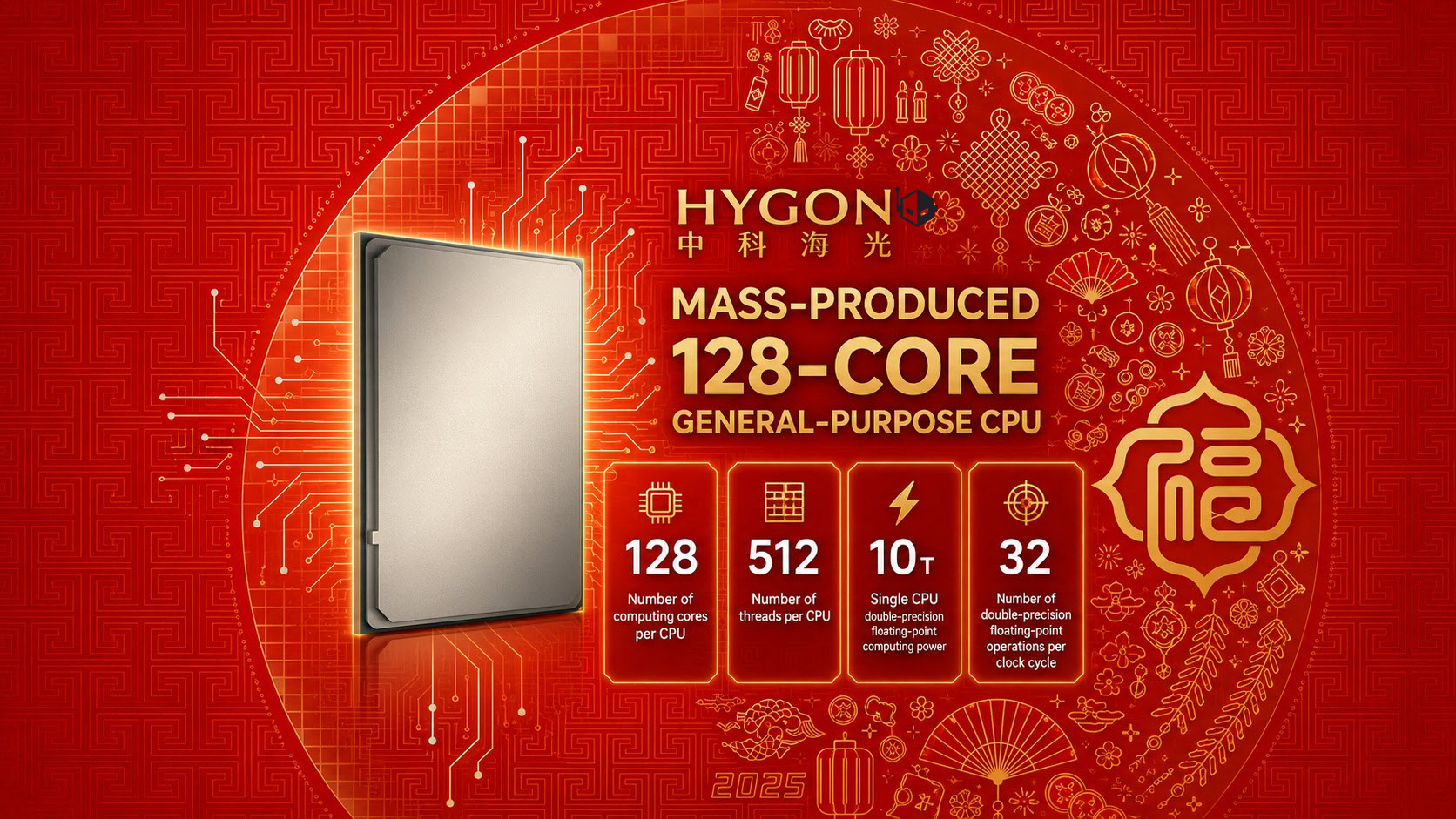
The new C86 architecture is expected to deliver more than a 15% improvement in IPC, giving it stronger per-core performance for server applications. Hygon is also adding SMT4 multi-threading support, allowing each CPU core to process four threads at the same time. At the top of the stack, the flagship processor will offer up to 128 cores and 512 threads, making it one of the most ambitious server CPU designs coming from China’s domestic semiconductor industry.
The new processors will also support AVX-512 instructions, improving vector computing performance for technical, scientific, and enterprise workloads. For artificial intelligence and machine learning tasks, Hygon is adding acceleration support for INT8 and BF16, two important formats widely used in AI inference and training.
Performance claims are also aggressive. Hygon says its next-generation C86 chips are being positioned to compete with Intel’s Xeon 6 server processors. Each chip is expected to deliver up to 10 TFLOPS of FP64 compute performance, which is especially important for high-performance computing workloads that rely on double-precision calculations.
The platform will support 104 PCIe 5.0 lanes, giving data center operators more bandwidth for accelerators, storage, networking cards, and expansion devices. This could also reduce dependence on third-party PCIe switching solutions in large server deployments.
Hygon says the first of these processors has already entered mass production. Several server systems are being prepared around the new chips, including the H620G59, a 2U air-cooled dual-socket rack server. The company is also offering the TC800G6, a fanless liquid-cooled cold-plate high-density cabinet designed for efficient large-scale deployment, with a reported PUE of 1.08. Another solution, the TC8600H G5, uses immersion phase-change liquid cooling and is designed for ultra-high-density installations with more than 80,000 CPU cores per group.
Hygon is also developing a new GPU accelerator called DCU, aimed at AI training, compute acceleration, and high-performance workloads. The accelerator will use a full-precision GPGPU architecture and support FP64, FP16, and BF16 calculations. It will also feature ultra-high-speed inter-chip connectivity and high-bandwidth HBM memory.
The DCU accelerator is being positioned as a domestic alternative for AI and compute-focused data centers, with Hygon indicating that it will compete in a similar performance class to NVIDIA’s A100 accelerator based on the Ampere architecture. If the company can deliver on its performance and software ecosystem goals, the DCU could become a key part of China’s growing AI hardware market.
Beyond CPUs and GPUs, Hygon is building out a broader data center platform with its own networking and interconnect chips. This includes a PCIe 5.0 switch, a scale-up interconnect switch, a 400G network interface chip, and a ScaleFabric 400/800G switch.
The PCIe 5.0 switch is designed for high-speed I/O and offers 104 lanes, targeting demanding server and accelerator environments. The scale-up interconnect switch is intended to connect multiple CPUs and GPUs through an ultra-fast internal fabric, helping data centers build larger compute clusters with lower communication bottlenecks.
The ScaleFabric 400G network interface chip supports 400Gb/s port speeds, native RDMA, credit-based flow control, and lossless link-layer reliability features. Hygon claims communication latency of 0.93 microseconds, support for up to 256K queue pairs, and a plug-and-play design that can smoothly evolve toward 800G networking.
The ScaleFabric 400/800G switch is built for large-scale data center networking, with 400Gb/s and 800Gb/s port speeds, native RDMA support, 80 ports of 400Gb/s switching density, and up to 64Tb of switching capacity. It also features 260ns switching latency, millisecond-level failover, and self-developed 112G high-speed SerDes IP.
Together, these products show that Hygon is not only working on faster processors but also trying to create a complete domestic ecosystem for AI servers, enterprise computing, high-performance computing, and large data center deployments.
With its next-generation C86 CPUs already moving into mass production and GPU accelerators expected to follow, Hygon is positioning itself as a major force in China’s server chip market. The combination of 128-core CPUs, SMT4 support, AVX-512 compatibility, AI acceleration, HBM-based GPU compute, and high-speed networking could make the company an important player in the next wave of data center hardware.