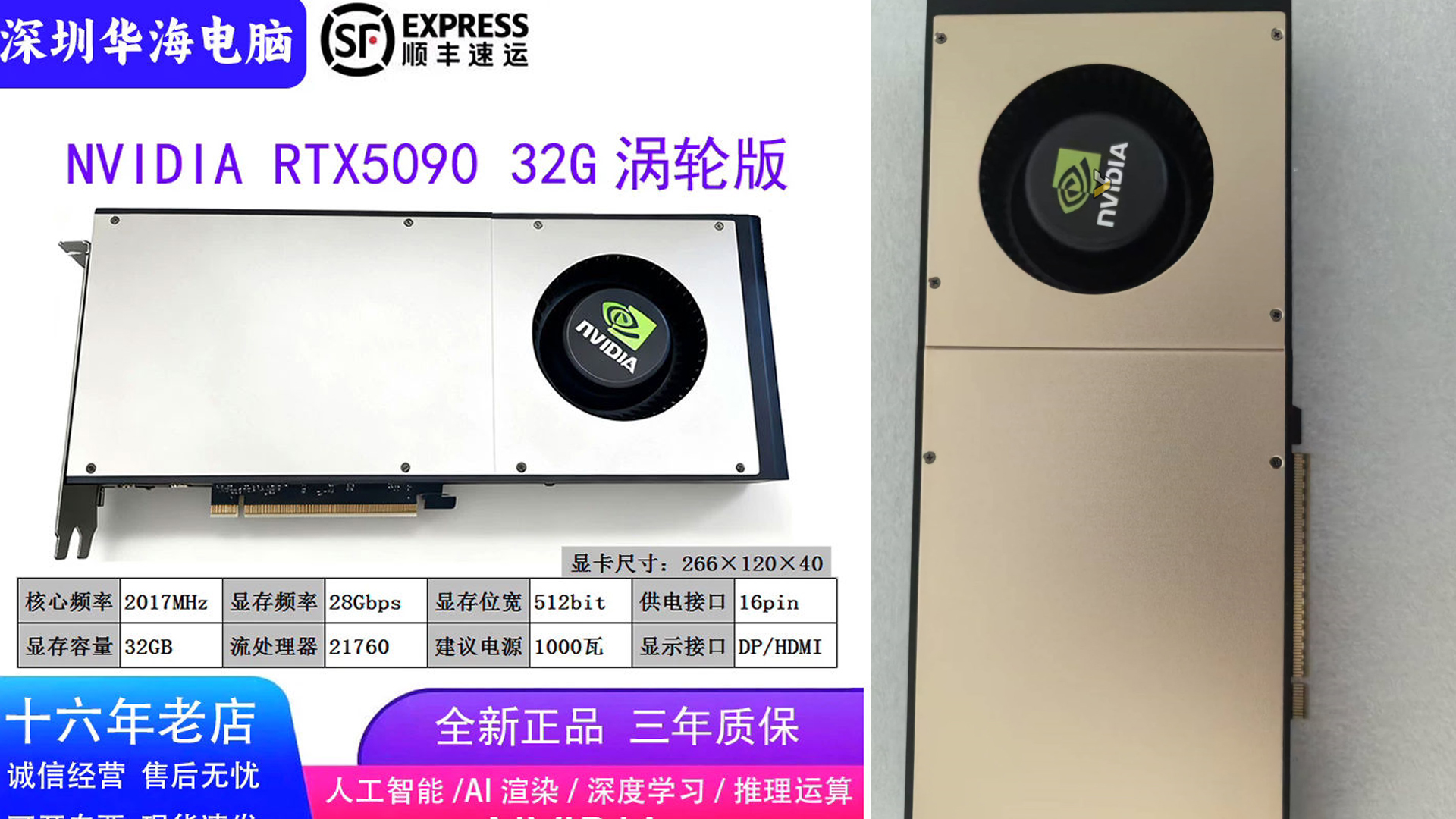
NVIDIA’s GeForce RTX 50 series is increasingly being reshaped to meet booming AI demand, and it’s no longer limited to the flagship GeForce RTX 5090. A growing number of RTX 50-series cards are now appearing in blower-style designs built specifically for AI workloads and dense workstation setups, where traditional open-air gaming coolers aren’t ideal.
The trend first drew attention around the GeForce RTX 5090, which has exceptionally high demand in China. Because U.S. government restrictions have limited official availability, NVIDIA introduced a 24GB version called the GeForce RTX 5090 D V2. Even so, large quantities of the standard RTX 5090 reportedly continue to find their way into the Chinese market. Once there, specialized shops or labs are said to remove the GPU chip and VRAM from the original board and re-deploy them onto different PCBs designed to work with blower-style coolers.
This type of conversion helps explain why gamers often struggle to find the top-end RTX 50-series graphics cards at reasonable prices: cards that would normally end up in gaming PCs can be redirected into higher-margin AI use cases instead.
Now, similar blower-style versions of additional GeForce RTX 50-series GPUs are being listed on Chinese marketplaces. The latest cards reportedly joining the blower-style AI-focused wave include the GeForce RTX 5080, GeForce RTX 5070 Ti, and GeForce RTX 5060 Ti. Notably, these models are being shown with 16GB of GDDR7 memory, matching the configurations commonly discussed for these SKUs rather than introducing expanded VRAM options.
While it’s not fully clear whether the boards pictured come directly from NVIDIA or from partner designs, the overall approach mirrors what has been seen with converted RTX 5090 units: a blower-style cooler exhausts hot air out through the rear I/O area, which is especially useful for workstations, servers, and multi-GPU rigs packed tightly together. These converted boards also tend to place the power connector along the right edge, improving clearance and making it easier to fit multiple cards in a single chassis.
For now, there’s no indication these blower-style variants come with higher memory capacities, and upgrading VRAM in the current market could be difficult due to supply and pricing conditions.
Pricing for these blower-style RTX 50-series cards varies widely, with the most extreme figures at the top end. The GeForce RTX 5090 32GB has been listed around $4,150, while the GeForce RTX 5090 D 32GB is listed near $3,869, and the RTX 5090 D V2 comes in a bit over $3,400. Lower down the stack, the RTX 5080 is appearing around $1,300, the RTX 5070 Ti around $1,100, and the RTX 5060 Ti 16GB is listed at roughly $573, making it the most affordable route to a 16GB RTX 50-series GPU in these listings.
With AI acceleration demand still rising, blower-style RTX 50-series GPUs could become even more common—especially in regions where supply constraints and market incentives make repurposing gaming hardware into AI-focused configurations a profitable business.