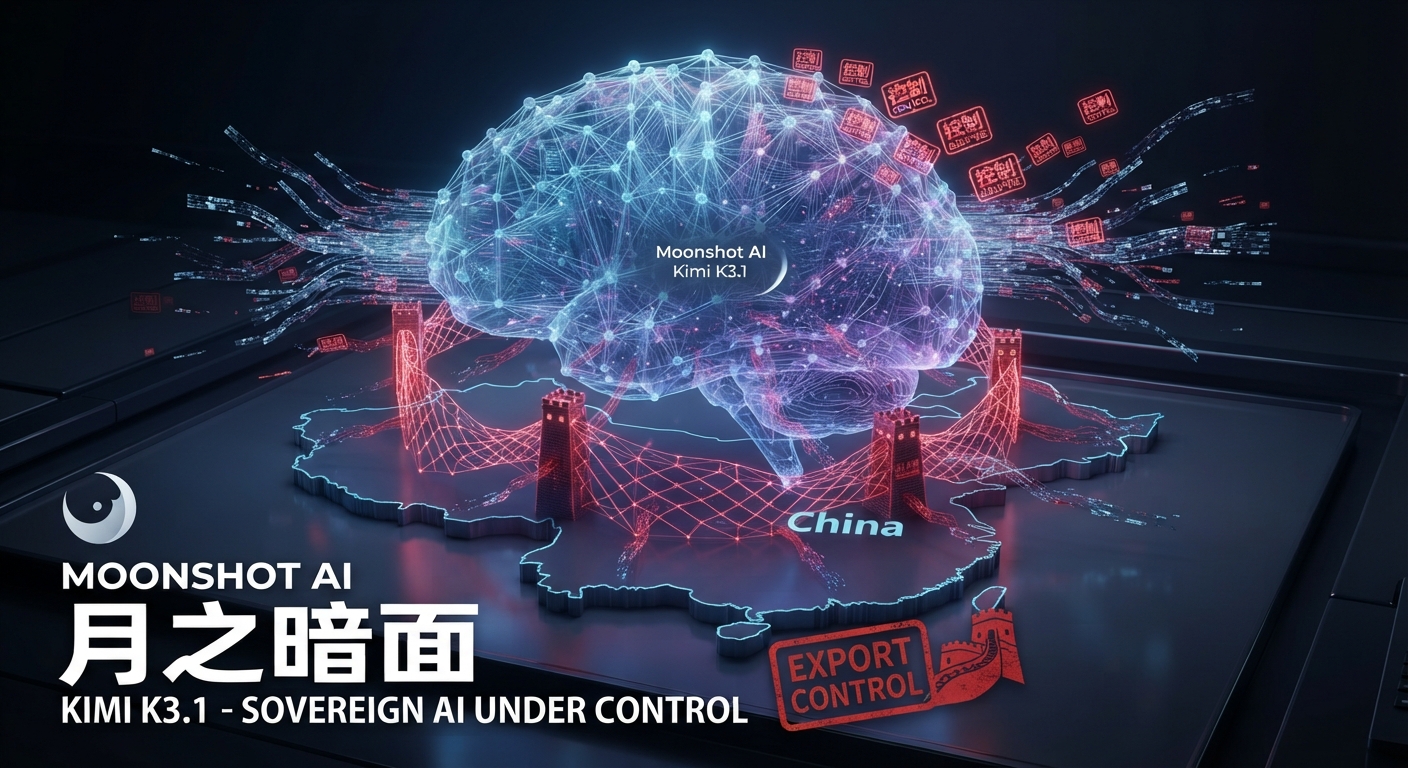
China Tightens AI Export Rules as Moonshot AI’s Kimi K3.1 Launch Draws Closer
China is moving to place tighter controls on some of its most advanced artificial intelligence technologies, a shift that could reshape how major Chinese AI labs release powerful new models to the global market. The latest draft rules cover 23 AI-related technologies, including large language models, AI agents, and compute clusters, and could directly affect upcoming open-weight models such as Moonshot AI’s highly anticipated Kimi K3.1.
The new measures arrive at a sensitive moment for the global AI industry. China is trying to protect its fastest-growing artificial intelligence sector while also managing national security concerns around frontier AI capabilities. At the same time, Taiwan has taken a harder line by criminalizing the export or rerouting of advanced chips and servers to China under its trade arrangement with the United States.
Under China’s proposed export control framework, AI companies would need to obtain official approval before releasing certain advanced models outside the country. The most important threshold appears to target open-weight AI models with more than 2 trillion parameters or models trained using more than 10^26 FLOPS of compute. In practice, this means China’s leading AI labs may need permission before making their largest and most capable models available globally.
China’s Ministry of Commerce is expected to oversee the licensing process. According to current information, the system may be designed to be streamlined and largely automatic, which suggests the government does not intend to completely block the release of major AI models. Still, even a fast approval process adds an extra layer of uncertainty for companies preparing global launches.
That uncertainty matters because timing is critical in the AI race. Developers, enterprise customers, researchers, and cloud platforms often move quickly when new open-weight models arrive. Any delay, even if temporary, could affect adoption, especially if competing models from other countries are available without similar approval requirements.
The rules appear to apply mainly to new and upcoming open-weight models rather than models that have already been released. Existing models are expected to remain exempt. However, the change could affect several of China’s most prominent AI players, many of which are already building or preparing models that cross the 2-trillion-parameter mark.
Moonshot AI is one of the companies most likely to face immediate attention. Its Kimi K3 model, introduced in July 2026, reportedly featured 2.8 trillion parameters, putting it well above the proposed licensing threshold. The company is now widely believed to be preparing Kimi K3.1, a follow-up model expected to build on the technical strengths of its predecessor.
Alibaba is another major name that could be affected. Its Qwen3.8-Max model debuted in August 2026 with around 2.4 trillion parameters. The company has also indicated that future Qwen 4.5 and Qwen 5.0 models could range from 4 trillion to 10 trillion parameters, which would place them firmly within the scope of the new rules.
Baidu’s Ernie 5.0, launched earlier in 2026, reportedly includes roughly 2.4 trillion parameters, though it is proprietary rather than open-weight. ByteDance is also said to be working on a model with around 10 trillion parameters, showing just how quickly Chinese AI labs are scaling their systems.
For Moonshot AI, the timing is especially important. Kimi K3.1 has been the subject of growing industry interest, with many expecting a formal launch soon. However, signs suggest the release may not be immediate, as the company’s media and launch materials are reportedly still not fully prepared. The new licensing requirements could add another bureaucratic step before the model is released to a wider audience.
Kimi K3.1 is expected to be a major upgrade. Based on previously surfaced technical clues, the model may include adjustable reasoning effort levels such as Low, High, and Max. It is also expected to offer multiple context length options, including an “Extra Long” setting, with a possible overall context window of up to 1 million tokens. That would make it especially useful for long documents, complex coding tasks, research workflows, and multi-step agentic operations.
The model is also expected to include an agent mode, potentially with support for swarm-style AI agents. This would allow multiple AI agents to coordinate across tasks, a feature increasingly viewed as important for the next phase of AI productivity tools.
Moonshot AI’s previous Kimi K3 model gained attention for introducing a new architecture related to KV cache optimization called Kimi Delta Attention, or KDA. This technology was designed to improve efficiency when handling long contexts, reducing the compute burden that usually comes with processing huge amounts of text. Kimi K3.1 is expected to expand on that foundation, potentially offering a more efficient compute footprint while still operating at a massive parameter scale.
The broader impact of China’s draft AI export controls could be significant. Open-weight models from Chinese labs have become increasingly competitive, often offering strong performance at lower operating costs. Developers around the world have shown interest in these models because they can be adapted, deployed, and studied more freely than closed proprietary systems. If approvals become a regular requirement, companies may need to factor regulatory timing into every major release.
At the same time, the rules show that China is treating frontier AI as a strategic technology. Large models, AI agents, and compute infrastructure are no longer viewed simply as commercial software products. They are increasingly considered part of a nation’s technological and security framework.
Taiwan’s latest move adds another layer to this fast-changing landscape. By criminalizing the routing of advanced chips and servers to China, Taiwan is making it much riskier for companies or intermediaries to bypass export restrictions. Taiwan had already banned such activity, but previous enforcement often depended on other legal tools that were harder to prosecute. Criminal penalties could make enforcement sharper and more effective.
Together, China’s new AI export rules and Taiwan’s tougher chip controls highlight the growing connection between artificial intelligence, semiconductors, and geopolitics. AI model releases are no longer just about benchmark scores, parameter counts, or developer excitement. They are increasingly shaped by trade rules, licensing systems, and national security concerns.
For now, the key question is whether China’s licensing process will be as smooth as officials suggest. If approvals are quick and predictable, major models like Kimi K3.1 may still reach global users with only minor delays. But if the process becomes slow or uncertain, it could affect the momentum of China’s top AI labs at a time when competition in artificial intelligence is accelerating worldwide.
Moonshot AI’s Kimi K3.1 remains one of the most closely watched upcoming AI models from China. Its expected long-context capabilities, reasoning controls, agent features, and efficiency improvements could make it a strong contender in the global AI market. But its path to release may now depend not only on technical readiness, but also on how China’s new export licensing regime takes shape.