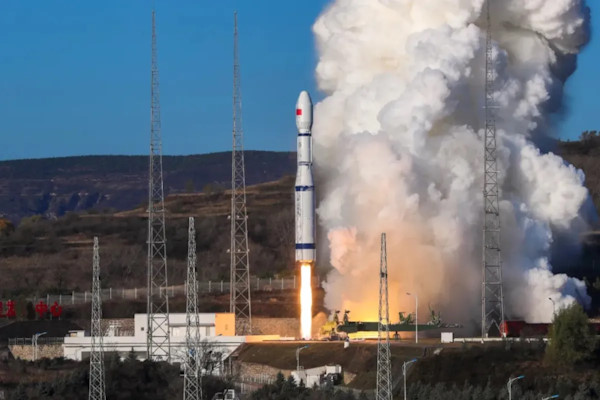
China’s ambitious endeavors in space technology took another leap forward with the recent launch of three Tianping-3 satellites. These satellites, identified as Tianping-3A (01), B (01), and B (02), were sent into orbit aboard a Long March 6 rocket. The launch was executed from China’s Taiyuan Satellite Launch Center at 00:10 UTC on October 22, adding these newcomers to an existing fleet exceeding 10,000 satellites.
The primary mission of these satellites involves calibrating ground radar equipment and conducting radar cross-section measurements. This mission will enhance ground optical imaging experiments and facilitate low-orbit space environment detection and monitoring. Additionally, the satellites are expected to contribute to atmospheric space environment measurement and improve orbit prediction models, although further details remain sparse.
The Long March 6 rocket, which played a crucial role in this mission, has been a reliable vehicle since 2015, successfully notching 13 launches to its roster. China’s ambitious space program continues to break new ground, with 50 orbital launch attempts lined up this year alone. Recently, the Gaofen-12 Earth observation satellite joined a squadron of 18 others to observe the Qianfan megaconstellation.
On the horizon, China is set to scale new heights with the Shenzhou-19 mission, aiming to send three astronauts to the Tiangong space station before the close of the month. This mission is poised to draw significant attention, promising more exciting developments in the coming weeks.
For those curious about the historical context of space exploration, Asif A. Siddiqi’s book, “The Soviet Space Race with Apollo,” offers an intriguing dive into the early days of the space race. Currently available at a discount on Amazon, it’s an opportunity to explore the fascinating past that paved the way for today’s space pursuits.