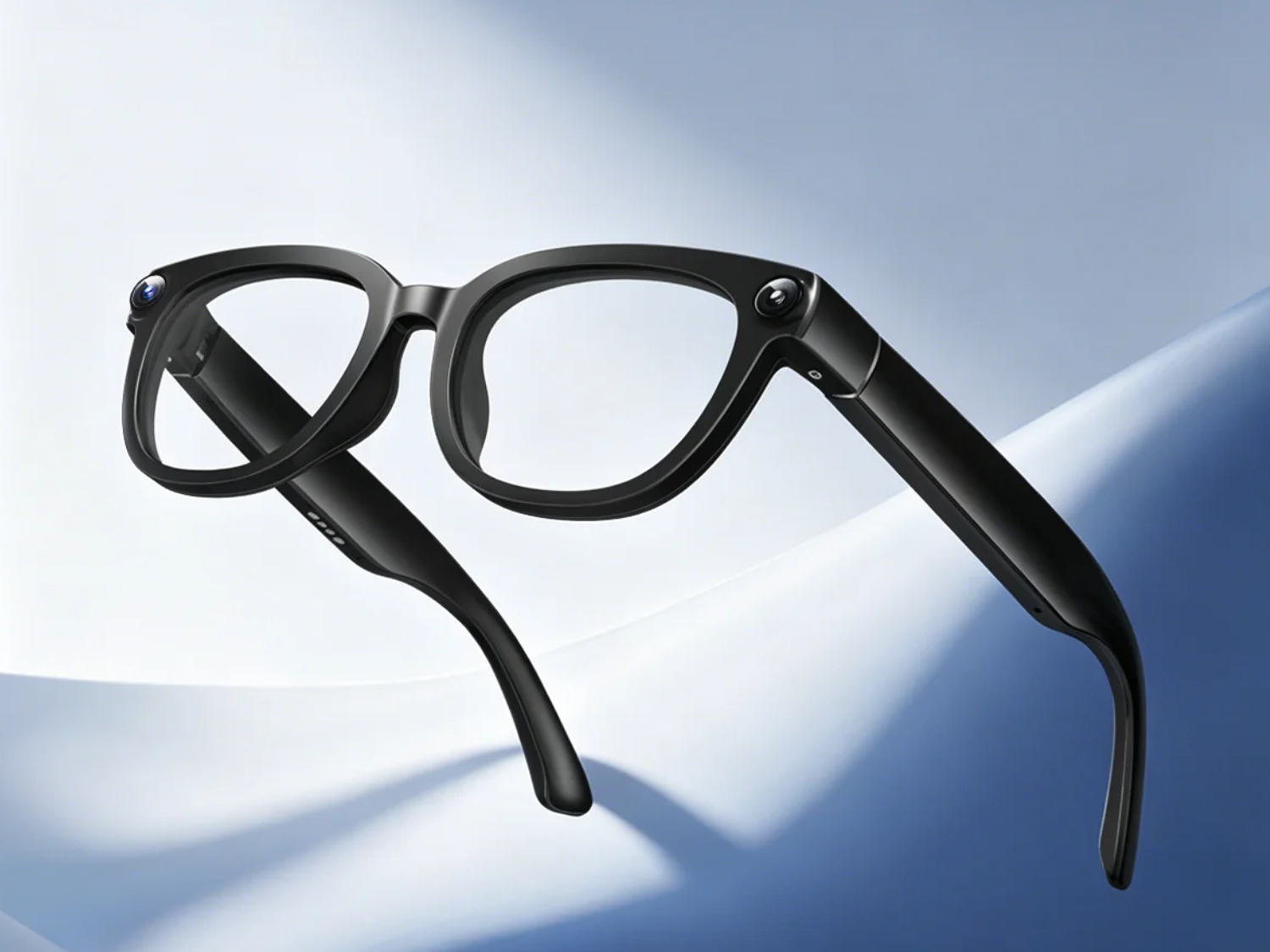
Rogbid has introduced its new VisionPro smart glasses, an affordable AI-powered wearable designed for users who want camera features, voice assistance, translation tools, and all-day connectivity without paying premium smart glasses prices.
Priced at $119.99, the Rogbid VisionPro is now available through the company’s official store in a single black color option. While the name may sound familiar to some tech fans, this product is not a mixed-reality headset. Instead, it is a lightweight pair of smart glasses built for everyday use, combining a camera, speakers, microphones, wireless connectivity, and AI features into a traditional glasses-style frame.
One of the biggest highlights is the built-in 13 MP camera positioned in the left temple. Rogbid uses a Sony IMX386 sensor, giving the glasses a capable imaging setup for quick photos and video recording. The company says the glasses support 0.6-second instant capture, making them useful for snapping moments on the go without pulling out a smartphone.
Users can capture photos or videos in two ways: by pressing a physical button or by using the voice command “Hey Alice.” The hands-free option could be especially useful while walking, traveling, cycling, or handling tasks where reaching for a phone is inconvenient. Electronic image stabilization is also included to help make video footage smoother.
The VisionPro smart glasses come with 4 GB of built-in storage, allowing users to save media directly on the device. While this is not a huge amount of space for heavy video recording, it should be enough for casual snapshots and short clips.
Rogbid is also pushing the AI side of the VisionPro. The glasses are powered by a dual-chip setup using the NT96562 and JL7018 processors, which the company describes as a “Dual AI architecture.” In practical terms, this enables features such as object recognition, landmark recognition, printed text translation, and AI voice assistance.
The real-time translation feature may be one of the most appealing tools for travelers and multilingual conversations. Rogbid says the VisionPro can help translate live conversations as they happen, which could make the glasses useful in airports, hotels, restaurants, and business meetings. As with many AI translation products, real-world performance will depend on language support, background noise, accents, and internet connectivity.
The glasses can also translate text from books, signs, menus, documents, and other printed materials. This gives the VisionPro added value as a travel companion or study tool, especially for users who regularly encounter foreign-language content.
For audio, Rogbid has built two 13 mm speakers into the temples, one on each side. These allow users to hear calls, voice assistant responses, translations, and media without needing separate earbuds. A noise-reduction microphone is included for clearer voice pickup during calls and commands.
Connectivity is another strong point for the price. The VisionPro supports dual-band Wi-Fi 6 and Bluetooth 5.4, giving it modern wireless capabilities for pairing with smartphones and accessing connected AI features. Bluetooth 5.4 should also help with stable connections and efficient power use.
Battery life is rated at 10 to 12 hours from a 290 mAh battery. That estimate suggests the glasses are designed for a full day of mixed use, though actual endurance will likely vary depending on camera recording, translation, calls, and wireless activity.
The frame is made from TR90 plastic, a material commonly used in lightweight eyewear because it is flexible and durable. Rogbid has also included adaptive photochromic lenses, which automatically darken when exposed to outdoor sunlight. This means the glasses can work as regular indoor eyewear and outdoor sunglasses without needing lens swaps.
At $119.99, the Rogbid VisionPro enters the smart glasses market at a much lower price than many well-known alternatives. That makes it an attractive option for buyers who are curious about AI smart glasses but do not want to spend several hundred dollars.
The main question is how well the AI tools perform in daily use. Features like real-time translation, object recognition, and hands-free camera capture sound promising, but their value will depend on speed, accuracy, and reliability outside controlled demonstrations.
Still, the VisionPro offers an impressive feature set for the price. With a 13 MP Sony camera sensor, voice-controlled capture, AI translation, Wi-Fi 6, Bluetooth 5.4, open-ear speakers, and claimed 10 to 12 hour battery life, Rogbid’s latest smart glasses could appeal to travelers, students, content creators, and anyone looking for an affordable entry point into wearable AI technology.