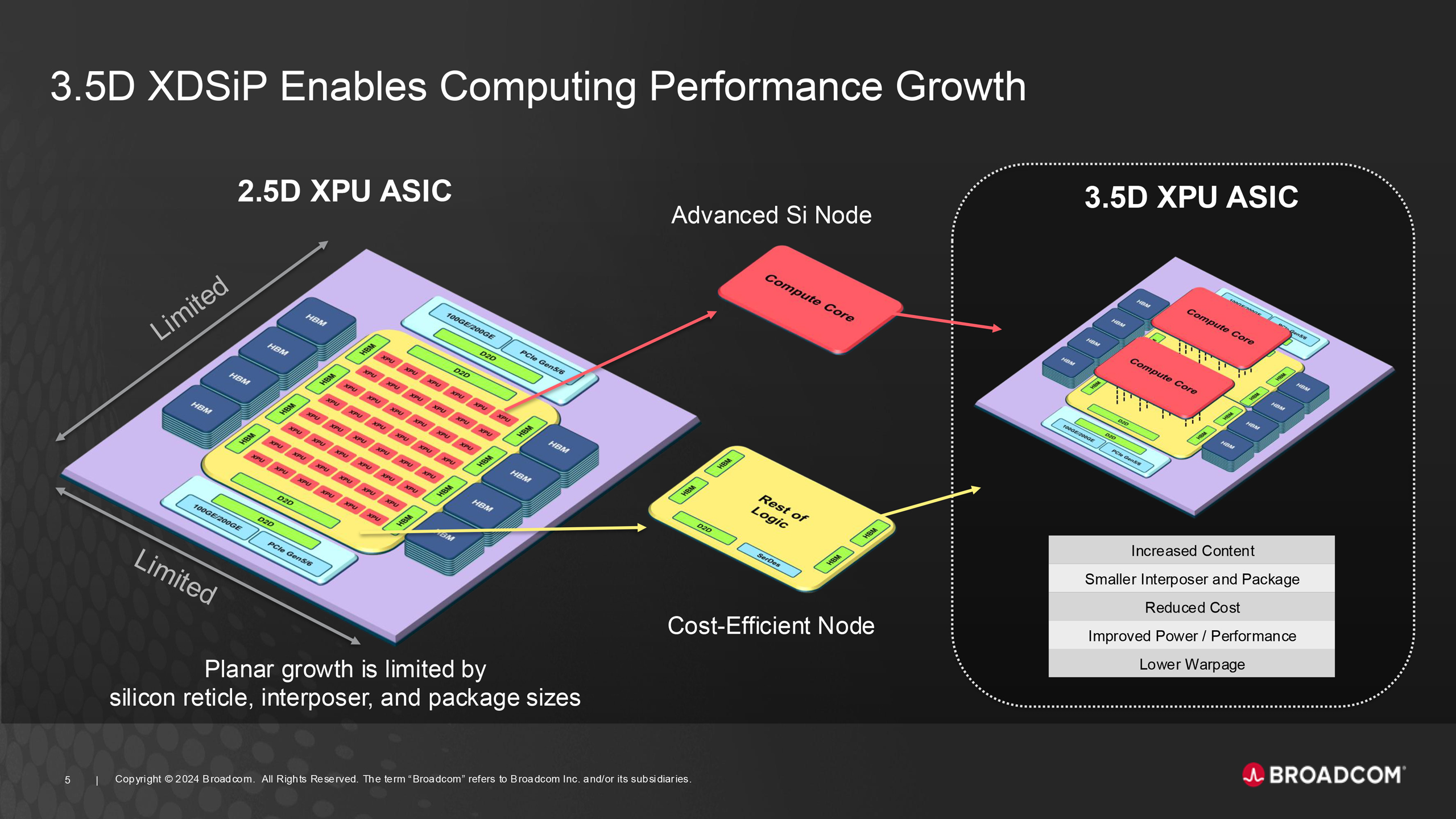
Broadcom has introduced its revolutionary 3.5D XDSiP platform technology, heralding a new era in custom computing platforms designed to deliver remarkable performance and efficiency enhancements. This cutting-edge technology is set to transform large-scale AI and HPC workloads, providing a vital boost to artificial intelligence and high-performance computing realms.
The company’s latest innovation, the 3.5D eXtreme Dimension System in Package (XDSiP) platform technology, is a game-changer for consumer AI markets, offering a unique capability to develop next-generation custom accelerators, known as XPUs. This sophisticated platform brings together over 6000 mm² of silicon combined with up to 12 high bandwidth memory (HBM) stacks into a single package. Such integration promises to optimize power efficiency and computing capability at scale, making it ideal for AI applications.
Crucially, this platform marks Broadcom’s pioneering achievement in creating the industry’s first Face-to-Face (F2F) 3.5D XPU. The significance of such a feat lies in the immense computing power required to train complex generative AI models, which involve using vast clusters of XPUs, scaling from tens of thousands to potentially millions. As demands increase, traditional approaches like Moore’s Law are failing to keep pace, necessitating more advanced system-in-package (SiP) integration for the upcoming wave of XPUs.
For the past several years, 2.5D integration has been a valuable tool in developing XPUs, integrating a multitude of chiplets and up to 8 HBM modules on an interposer. However, the introduction of more intricate and expansive models requires a shift toward 3D silicon stacking for enhanced power, size, and cost efficiency. Enter 3.5D integration — a harmonious blend of 3D silicon stacking with 2.5D packaging — poised to dominate the future of XPUs.
Broadcom’s 3.5D XDSiP platform represents a leap forward in interconnect density and power efficiency, surpassing the traditional Face-to-Back (F2B) approach. By directly connecting metal layers in the top and bottom dies, the F2F stacking delivers a robust and dense connection, minimizing electrical interference while maintaining strong mechanical integrity. The 3.5D platform leverages precise design flow and proprietary techniques, facilitating the correct construction of 3D die stacking for power, clock, and signal interconnections.
Key benefits of Broadcom’s 3.5D XDSiP technology include:
– Enhanced Interconnect Density: A remarkable 7x increase in signal density between stacked dies compared to F2B technology.
– Superior Power Efficiency: An impressive 10x reduction in power consumption in die-to-die interfaces through the use of 3D HCB rather than planar die-to-die PHYs.
– Reduced Latency: A significant decrease in latency between compute, memory, and I/O components within the 3D stack.
– Compact Form Factor: A conduit to smaller interposer and package sizes, translating into cost savings and reduced package warpage.
The lead F2F 3.5D XPU from Broadcom integrates four compute dies, an I/O die, and six HBM modules, harnessing TSMC’s state-of-the-art process nodes and 2.5D CoWoS packaging technologies. Despite the complexity of the design, Broadcom’s proprietary flow and automation methodology, rooted in industry-standard tools, assured first-pass success.
Functionality and performance have been validated across critical IP blocks, such as high-speed SerDes, HBM memory interfaces, and die-to-die interconnects, showcasing Broadcom’s prowess in crafting and testing intricate 3.5D integrated circuits. This achievement highlights the fruitful collaboration between TSMC and Broadcom, merging TSMC’s pioneering logic processes and 3D chip stacking technologies with Broadcom’s design capabilities.
Looking forward, the aim is to operationalize this platform to drive forward AI innovations and facilitate future growth. With more than five 3.5D products under development, a significant segment of Broadcom’s consumer AI clients have already embraced this breakthrough technology, with production starting in February 2026. Broadcom is paving the way for a future teeming with possibilities in AI and computing.