BOSGAME M5 AI Mini Desktop Review: Ryzen AI MAX+ 395 Power, 128GB Memory, and Impressive Mini PC Performance
High-end Strix Halo mini PCs and laptops have become much more expensive this year, especially models equipped with 128GB of LPDDR5X memory. Not long ago, a fully loaded Strix Halo system could be found for a little over $2,000. Now, many similar configurations sit comfortably above $3,000.
That makes the BOSGAME M5 AI Mini Desktop stand out. Priced at $2,999, it brings together AMD’s Ryzen AI MAX+ 395 processor, 128GB of LPDDR5X memory, and a 2TB PCIe 4.0 SSD in a compact desktop form factor. For buyers looking for a powerful mini PC for gaming, productivity, local AI workloads, and content creation, this machine is one of the more interesting options in its class.
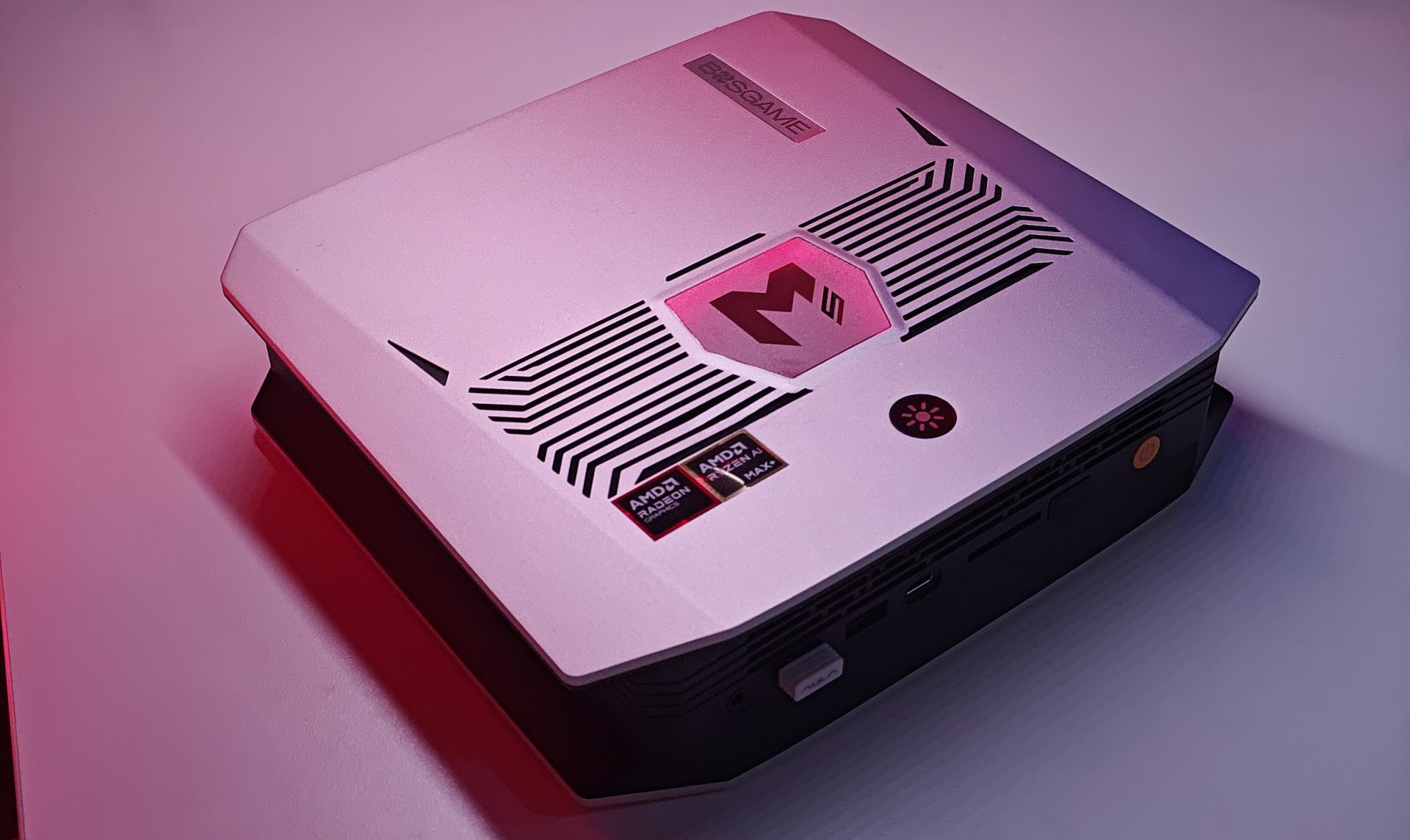
The package is simple but complete. Inside the box, BOSGAME includes the mini PC, a large 200W power adapter, an HDMI cable, and a vertical stand. The presentation is not flashy, but the hardware itself feels well-built. The M5 uses a solid metal chassis with intake vents across the top and rubber feet on the bottom to keep it stable on a desk.
There is also an RGB light strip on the front, giving the system a bit of visual personality without making it look overly aggressive. A capacitive lightbulb button on top lets users cycle through several lighting modes. It is a small touch, but it helps the M5 feel more like a premium compact desktop rather than a plain office box.
The main attraction is the hardware inside. The BOSGAME M5 is powered by the AMD Ryzen AI MAX+ 395, a high-end APU featuring 16 Zen 5 cores with boost clocks up to 5.1GHz. Graphics are handled by the Radeon 8060S integrated GPU, which includes 40 RDNA 3.5 compute units and 32MB of MALL cache. The system also includes 128GB of LPDDR5X memory running at 8000 MT/s in quad-channel mode.
Storage is handled by a 2TB PCIe 4.0 SSD. In testing, the drive delivered sequential read speeds of around 5,686MB/s and write speeds of around 5,151MB/s, which is strong performance for a midrange Gen 4 SSD. Random performance was also respectable, making the system feel quick during everyday use, app launches, file transfers, and game loading.
Expansion is another strong point. The M5 includes a second PCIe 4.0 M.2 slot for an additional SSD. Better yet, accessing it is extremely easy. A small dedicated hatch is held in place by a single screw, so adding another drive does not require fully disassembling the machine. This is especially useful for users who want separate drives for Windows, Linux, games, project files, or AI models.
Connectivity is generous for a mini PC. On the front, the BOSGAME M5 includes one USB4 port, two USB 3.2 Gen 2 ports rated at 10Gbps, a 3.5mm audio jack, and an SDXC card slot. Around the back, there is another USB4 port, one additional USB 3.2 Gen 2 port, two USB 2.0 ports, 2.5Gb Ethernet, HDMI 2.1, DisplayPort 1.4, and another 3.5mm audio jack.
That port selection makes the system flexible enough for many setups. It can handle high-speed external storage, multiple displays, wired networking, audio equipment, card transfers, and peripherals without immediately needing a hub.
BOSGAME includes three power profiles: Performance, Default, and Eco. These can be changed using the button on the front panel.
Performance mode allows the system to push up to 160W briefly, 140W for shorter sustained loads, and 120W under longer sustained workloads. In this mode, operating temperatures can reach around 91°C, with brief spikes higher during heavier boost periods.
Default mode lowers the limits to 120W briefly and 85W sustained, keeping temperatures closer to 79°C. Eco mode drops the system further to 75W briefly and 55W sustained, with temperatures around 67°C.
Performance mode delivers the best benchmark and gaming results, but it can get loud under CPU-heavy workloads. Gaming tends to be more balanced because power is shared between CPU and GPU resources, which helps distribute heat more evenly. Default mode is much quieter and still fast enough for most tasks, while Eco mode is nearly silent and well-suited for lighter workloads, media playback, office use, or always-on tasks.
CPU performance is one of the biggest strengths of the BOSGAME M5. With 16 full Zen 5 cores, the Ryzen AI MAX+ 395 is far beyond what many people expect from a mini PC.
In Cinebench 2026, the system scored 606 points in single-core and 7,962 points in multi-core performance. In Cinebench 2024, it reached 114 points single-core and 1,920 points multi-core. Cinebench R23 results were also strong, with 2,016 points single-core and 38,451 points multi-core.
Rendering performance was impressive as well. In C-Ray 2.0, the system completed the 1080p test in 25.84 seconds and the 5K test in 190.25 seconds. These numbers show that the M5 is not just a compact gaming box. It has enough CPU power for demanding productivity tasks such as rendering, compiling code, video editing, simulation workloads, and heavy multitasking.
Synthetic GPU results were also solid. In 3DMark Time Spy, the BOSGAME M5 scored 11,826 on the CPU test, 11,738 on the GPU test, and 11,812 overall. These are strong numbers for an integrated graphics solution and show just how capable the Radeon 8060S can be when paired with a generous power budget.
Gaming is where the BOSGAME M5 becomes especially interesting. The system allows around 120W to 140W of sustained power during games, depending on how much CPU power the title requires. This gives the Radeon 8060S enough room to perform well at 1440p in many modern titles.
In Forza Horizon 6, the M5 delivered a smooth 61 FPS average at 1440p using the Ultra preset. FSR 4.1.1 was available in-game without requiring extra tweaking, which opened the door to more demanding settings, including ray tracing. With FSR 4.1 set to Performance mode and ray tracing set to High, the system was still able to approach 60 FPS, which is better than expected for a compact integrated graphics system.
Cyberpunk 2077 also performed well. At 1440p using the Ultra preset with FSR 4 Quality, the BOSGAME M5 reached an average of 66 FPS. Ray tracing is more difficult in this title, however. Using the RT Ultra preset at 1440p with FSR 4.1 Quality resulted in an average of 33 FPS. Switching to FSR 4.1 Performance improved the frame rate to around 50 FPS, but the image became noticeably softer. For the best balance, standard Ultra settings with FSR upscaling are the better choice.
Death Stranding 2 was another strong showing. At 1440p using Very High settings with FSR 4.1.1 Quality, the BOSGAME M5 averaged 55 FPS. The experience was smooth and very playable, with solid 1% lows thanks to the APU’s higher available power budget.
Doom: The Dark Ages was more complicated. The game does not natively support FSR 4.1, and forcing it through translation methods introduced too much overhead. In practice, the best experience came from using the Ultra preset at 1440p with FSR 3.1 Quality, producing an average of 57 FPS.
Warhammer 40,000: Space Marine 2 also ran well, even though newer FSR options did not behave as expected. At 1440p High settings with FSR 3.1 Quality, the system achieved around 67 FPS in the first major horde sequence of the opening mission. That makes it very playable and visually satisfying on the M5.
The BOSGAME M5 is not just about gaming. Its 128GB of unified LPDDR5X memory makes it especially appealing for local AI workloads. Strix Halo systems with this much memory have quickly become popular among users who want to run large AI models locally without relying on cloud services.
The advantage of 128GB unified memory is simple: larger models can fit into memory more easily, and users have more flexibility when working with AI inference, experimentation, coding assistants, image generation tools, and research workloads. While dedicated high-end GPUs still have major advantages in raw acceleration, they often come with far less VRAM unless buyers move into very expensive professional hardware.
For local AI enthusiasts, developers, and advanced home lab users, the BOSGAME M5 offers a compelling balance. It is compact, relatively efficient, powerful enough for serious experimentation, and priced below many competing 128GB Strix Halo systems.
Overall, the BOSGAME M5 AI Mini Desktop is one of the most impressive compact PCs currently available for users who want a mix of CPU power, integrated graphics performance, large unified memory, and expansion flexibility.
It is not perfect. Performance mode can get loud, and ray tracing remains too demanding in some games. But the strengths are significant. The Ryzen AI MAX+ 395 delivers excellent multi-core performance, the Radeon 8060S is capable of smooth 1440p gaming with the right settings, the port selection is strong, storage expansion is easy, and the 128GB memory configuration makes it highly attractive for local AI workloads.
At $2,999, the BOSGAME M5 is still a premium mini PC, but compared to many similarly equipped systems, it feels like a rare value in the high-end Strix Halo market. For gamers, creators, developers, and AI enthusiasts who want desktop-class performance in a small footprint, this is a compact powerhouse worth paying attention to.BOSGAME M5 Review: A Compact 128GB Local AI Powerhouse With Serious Strix Halo Performance
The BOSGAME M5 stands out as one of the most compelling compact PCs for anyone interested in local AI, high-memory workloads, and strong desktop-class performance in a small form factor. With AMD’s Strix Halo platform and 128GB of unified memory, this mini PC offers a rare combination: enough memory to run large language models locally, enough CPU performance for demanding productivity tasks, and enough graphics power for respectable 1440p gaming.
To test what this machine can really do, Qwen 3.8 27B was used first. This dense model is not the most natural match for APU-based systems like Strix Halo or GB10, but the results were still impressive. Without deep optimization or advanced tuning, the Q8 quantized version ran at around 7 tokens per second. That may not sound blazing fast compared to dedicated AI accelerators, but for a compact local AI system, it is a solid result.
The real surprise came from the quality of the output. When asked to generate a basic Flappy Bird-style game in a single attempt, the model produced an excellent result. It did not simply create a rough prototype. It handled the game mechanics, collision logic, animation, design elements, user interface, and even included a day-and-night cycle. The model consumed around 30,000 tokens and took close to one and a half hours to complete the generation, but the final output showed just how capable a local AI setup like this can be.
That said, Qwen 3.8 27B is not the most efficient type of model for Strix Halo. The real advantage of a system with such a large pool of unified memory is its ability to run mixture-of-experts models. These models can have a very high total parameter count while only activating a smaller number of parameters during generation. This approach allows users to take advantage of the large memory capacity while keeping speed high enough for interactive use.
With that in mind, DeepSeek V4 Flash was tested next. This is a much larger 284B parameter model, but because it uses only 13B active parameters during generation, it is far better suited to this kind of hardware. Even with 120GB of GPU-addressable memory available, the model required aggressive Q3 quantization to fit, but once loaded, the speed improvement was clear.
DeepSeek V4 Flash ran at roughly 12 tokens per second, making it almost twice as fast as the dense Qwen model in this test. The trade-off was that aggressive quantization affected reasoning behavior. Without careful prompting, the model could rush through a task, generate only a few thousand tokens, and produce broken code. However, when the prompt encouraged the model to take its time and think deeply, the results improved dramatically.
With the right prompt, DeepSeek V4 Flash was able to match the quality of the Qwen 3.8 27B output while generating around 20,000 tokens in approximately 30 minutes. That makes it the faster and more practical option for many local AI users, especially those who want strong intelligence without waiting over an hour for a complete result.
The biggest takeaway is that the BOSGAME M5 makes high-memory local AI far more accessible than many competing solutions. At $2,999, it offers 128GB of unified memory at a lower price than many other Strix Halo laptops, mini PCs, and specialized AI systems. For users who want to run large language models locally without relying entirely on cloud services, this machine delivers a strong value proposition.
Beyond AI, the BOSGAME M5 also performs well as a compact high-performance PC. Its full 140W Strix Halo implementation gives it desktop-grade CPU performance, making it suitable for heavy multitasking, content creation, development work, and productivity workloads. The integrated graphics are also capable enough for solid 1440p gaming, which adds to the system’s versatility.
The design is practical as well. The expansion slot is easy to access, the I/O selection is strong, and the RGB front panel adds a bit of personality to the compact chassis. It feels like a machine built not only for enthusiasts, but also for developers, creators, AI hobbyists, and power users who want a small system with serious memory capacity.
There are a few drawbacks. The BOSGAME M5 can get loud when running in Performance mode, especially under sustained heavy workloads. The RGB lighting is also not software-addressable, which may disappoint users who like deeper customization. Still, these issues are relatively minor compared to the overall performance and value on offer.
Overall, the BOSGAME M5 is an impressive Strix Halo mini PC that proves compact systems can be serious local AI machines. Its 128GB unified memory configuration gives it a major advantage for running large open-weight models, and as those models continue to improve, the system’s long-term potential becomes even more appealing.
For users searching for an affordable 128GB local AI PC, a powerful mini PC for large language models, or a compact Strix Halo system with desktop-class performance, the BOSGAME M5 is one of the most interesting options currently available.
Score: 8.5 out of 10
The BOSGAME M5 delivers excellent local AI capability, strong CPU performance, good gaming potential, and impressive value in a compact design. Its fan noise under heavy loads is worth noting, but for the price and feature set, it is a standout choice for anyone building a local AI workstation.