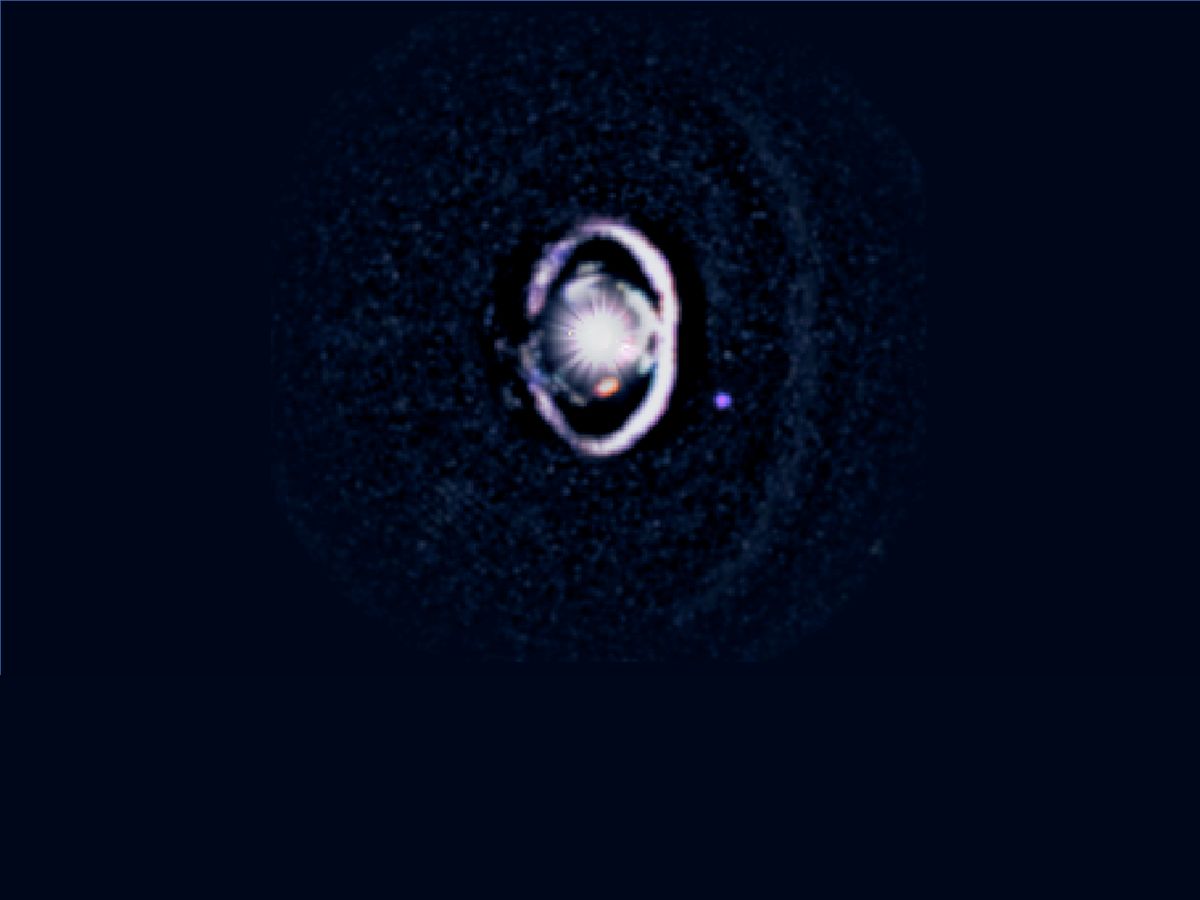
Astronomers have captured a rare portrait of a newborn giant planet carving out a path in the disk of dust and gas around its star. The young world, named WISPIT 2b, is only about 5 million years old yet already tips the scales at roughly five times the mass of Jupiter. Its location inside a ring-shaped gap in the WISPIT 2 system offers striking, direct evidence for a long-held idea: that forming planets sculpt the gaps seen in many protoplanetary disks as they gather material during their growth.
When stars are born, they are wrapped in a protoplanetary disk made of gas and dust. Over time, astronomers have noticed distinct rings and dark gaps in these disks. The leading explanation has been that infant planets are plowing through the material, pulling in gas and dust and leaving underdense lanes behind. The new image of WISPIT 2b adds strong support to that picture.
The discovery is the result of a coordinated campaign led by Laird Close of the University of Arizona and Richelle van Capelleveen of Leiden Observatory. A study led by van Capelleveen first revealed the WISPIT 2 star and its prominent ring system using VLT-SPHERE, a high-contrast instrument on the Very Large Telescope designed to hunt for exoplanets near their dazzling host stars. Building on that find, the team then turned to the Magellan Adaptive Optics system eXtreme (Mag AO-X) to spot the young protoplanet in H-alpha light, a telltale wavelength that highlights energetic regions around youthful objects. Additional observations in infrared light came from LMIRcam, part of the Large Binocular Telescope Interferometer on the University of Arizona’s Large Binocular Telescope, helping confirm the planet’s presence and characterize its glow.
In the released image, WISPIT 2b appears as a small purple dot just to the right of the WISPIT 2 star system, nestled inside one of the disk’s darker ring gaps. The team also identified a second candidate planet in another, inner gap closer to the star, a tantalizing hint that the system may host multiple growing worlds. Follow-up observations will be needed to confirm that companion and to refine measurements of WISPIT 2b’s mass and environment.
Beyond the breathtaking visual, the result matters because it connects the dots between theory and observation. Finding a massive, very young planet sitting exactly where a gap should be if it were shaping the disk strongly strengthens the case that ringed disks are active nurseries of planets. It also gives astronomers a rare window into the timing of planet formation: in just a few million years, WISPIT 2b has accumulated several Jupiter masses, suggesting rapid growth while the disk still contains abundant material.
The findings were published on August 26 in Astrophysical Journal Letters, marking a milestone for direct imaging of protoplanets and the cutting-edge instruments that make such feats possible. With more time on powerful telescopes and continued advances in adaptive optics, researchers expect to probe the WISPIT 2 system in greater detail, test whether additional planets are taking shape, and watch how these young worlds continue to sculpt their birth disk.