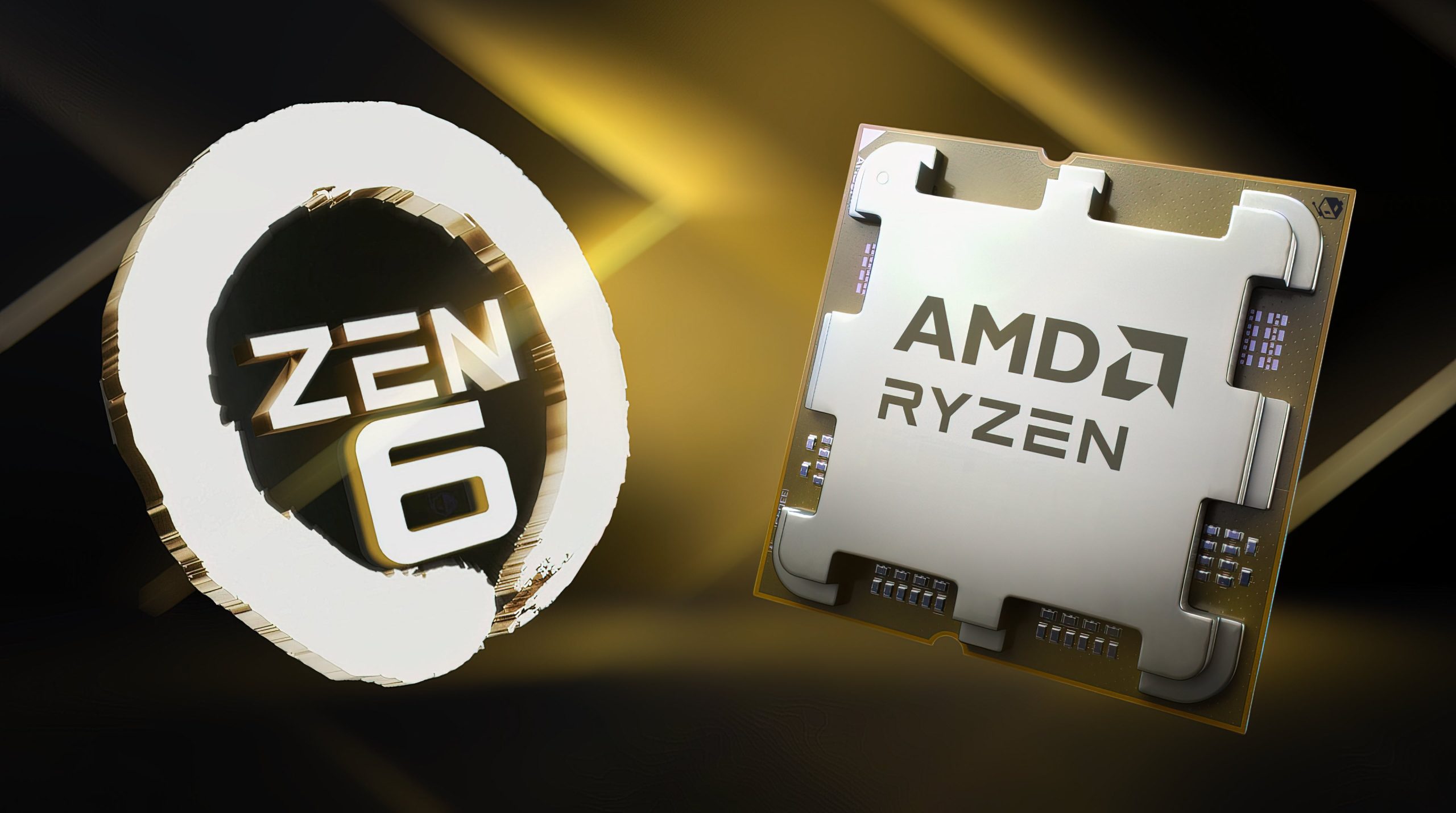
AMD’s next-generation Zen 6 architecture is coming into focus, thanks to fresh support added to the GCC compiler. A newly posted patch titled “Add AMD znver6 processor support” outlines the initial ISA features for Zen 6 and gives an early look at where AMD’s CPU roadmap is headed across servers, desktops, and mobile.
What the GCC update reveals about Zen 6
– AVX-512 FP16: Expands AMD’s AVX-512 capabilities to accelerate FP16 workloads, boosting performance in AI, HPC, and scientific computing.
– AVX_NE_CONVERT: Adds fast numeric conversion instructions that can help with data movement and mixed-precision workloads.
– AVX_IFMA: Integer fused multiply-add support for improved throughput in cryptography, signal processing, and specialized math tasks.
– AVX_VNNI INT8: Vector Neural Network Instructions for INT8 inference, a key accelerator for modern AI workloads.
Beyond the GCC patch, a new Zen 6 CPU ID (B80F00) has surfaced, hinting at one of several families within the platform.
EPYC Venice: Classic vs. Dense
Zen 6 is widely expected to power EPYC “Venice” in two variants:
– Venice Classic: Up to 12 cores per CCX. Identifiers include SP7 “B50F00” and SP8 “B90F00.”
– Venice Dense: Up to 32 cores per CCX. Identifiers include SP7 “BC0F00” and SP8 “BA0F00.”
The lineup is anticipated to scale to as many as 256 cores using eight CCXs. On the dense side, each CCX is said to carry 128 MB of L3 cache, enabling up to 1,024 MB (1 GB) of shared L3 per socket—an eye-catching figure for memory-sensitive and AI-driven workloads.
Zen 6 for desktops and laptops
At least four client families are expected to feature Zen 6:
– Olympic Ridge for AM5: Flagship desktop with up to 24 cores and 48 threads. Each CCX is described as having up to 12 cores and 48 MB of L3.
– Gator Range: Enthusiast mobile platform.
– Medusa Point and Medusa Halo: Next-gen APU lines.
Packaging and process technology
– Multi-chip module designs are slated to use TSMC’s N2P node, positioning Zen 6 for high efficiency and density in complex chiplet configurations.
– Monolithic parts within Medusa Point and Gator Range are expected on TSMC’s N3P/N3C nodes, targeting premium mobile and integrated-graphics experiences.
Timing and what to expect next
With AMD’s Financial Analyst Day approaching, small teasers are possible, but full Zen 6 announcements are currently expected next year, with the rollout likely kicking off around CES 2026. Given the ISA additions and the scale of the server and client plans, Zen 6 is shaping up to be a generational inflection point for AI inference, advanced vector workloads, and heavily threaded performance.
Why it matters
– AI and mixed-precision: FP16 and VNNI INT8 indicate a strong push into efficient AI inference on both server and client platforms.
– Massive core counts: Venice Dense paired with large L3 cache should excel in cloud-native, analytics, and EDA workloads.
– Broad coverage: From AM5 desktops to high-end mobile and APUs, Zen 6 looks set to deliver a unified architecture with tailored dies and process nodes for each market.
Keep an eye out for more details as development kits, compilers, and platform IDs continue to surface ahead of the formal launch window.