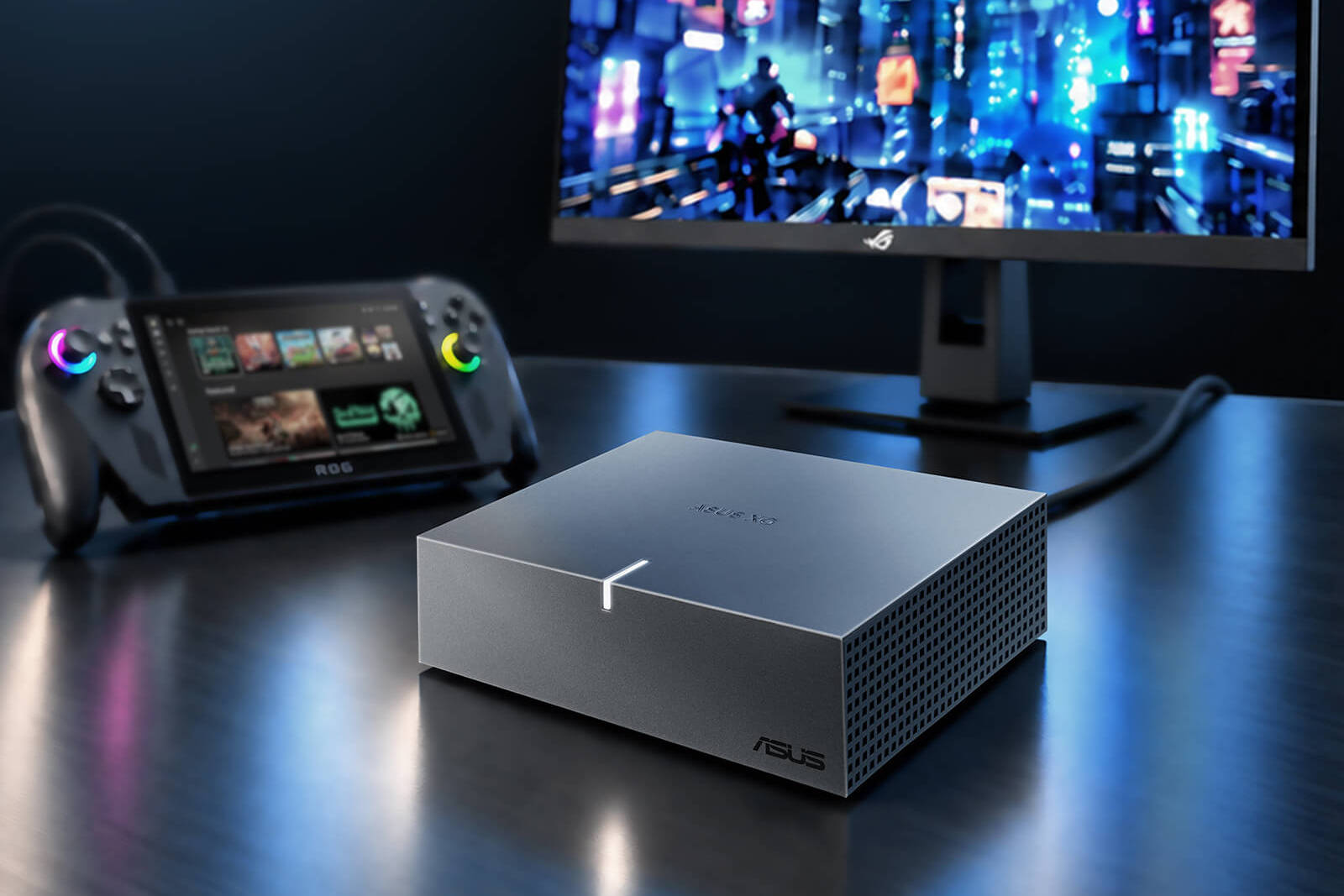
Asus has managed to fit AMD’s Radeon RX 9060 XT into a remarkably small external GPU enclosure, creating a compact graphics upgrade aimed at laptops, mini PCs, and gaming handhelds. However, the tiny design comes with a major trade-off: the GPU runs at much lower clock speeds than standard desktop versions due to its strict 75 W power limit.
The device, called the Asus XG Core Radeon RX 9060 XT LP 16GB, uses the same core GPU configuration as the desktop Radeon RX 9060 XT, including 2,048 Stream Processors and 16 GB of GDDR6 memory. It also keeps the same 20 Gbps memory speed and 128-bit memory bus. On paper, that makes it an interesting option for users who want more graphics power without moving to a full desktop PC.
The key difference is performance tuning. Asus lists the external GPU with a default game clock of 1,010 MHz and a boost clock of 1,600 MHz. When using OC mode through Asus GPU Tweak III, those speeds increase only slightly to 1,030 MHz for the game clock and 1,620 MHz for the boost clock.
That is a significant reduction compared with typical Radeon RX 9060 XT desktop graphics cards. AMD’s reference specifications for the Radeon RX 9060 XT include a game clock of 2,530 MHz and a boost clock of up to 3,130 MHz. In comparison, Asus has lowered the game clock by around 60% and the boost clock by close to 49%. The result is a GPU that may share the same name and memory configuration as its desktop counterpart, but is expected to deliver noticeably lower real-world gaming performance.
The reason behind the clock cuts is simple: power and size. The XG Core is designed to operate within a 75 W power envelope, which is extremely low for a modern desktop-class gaming GPU. By reducing clock speeds, Asus can keep heat, power draw, and noise under control inside a much smaller enclosure.
The compact size is one of the biggest selling points. The Asus XG Core measures just 144 × 117 × 39 mm, making it far smaller than most external graphics card solutions. This makes it appealing for users who want a portable GPU dock that can sit beside a handheld gaming PC, thin laptop, or compact workstation without taking up much desk space.
Connectivity is handled through a 40 Gbps USB-C interface. The external GPU also includes a separate USB-C power input, along with HDMI 2.1b and DisplayPort 2.1a outputs. With these ports, users can connect up to two external monitors, making the XG Core useful not only for gaming but also for productivity setups, content creation, and multi-display workstations.
Still, the USB-C connection introduces another possible limitation. Unlike a regular desktop graphics card installed directly into a motherboard through a PCIe slot, the XG Core depends on an external 40 Gbps link. That bandwidth is far lower than what a modern internal PCIe 5.0 interface can provide. In some games and applications, this could further limit performance, especially when combined with the reduced GPU clock speeds.
Asus has previously suggested that the XG Core Radeon RX 9060 XT LP 16GB can deliver more than 60 FPS in selected AAA games at 1440p. However, the company has not shared detailed test settings, game lists, or direct comparisons against full-size desktop Radeon RX 9060 XT graphics cards. Because of that, it is difficult to know exactly how much performance users should expect.
Clock speeds alone do not tell the whole story. Game performance will depend on resolution, graphics settings, the laptop or handheld it is connected to, driver optimization, cooling behavior, and how much the external USB-C connection affects bandwidth. Even so, the large frequency reduction makes it clear that this version of the Radeon RX 9060 XT is built more for efficiency and portability than maximum frame rates.
The Asus XG Core Radeon RX 9060 XT LP 16GB could become an attractive option for gamers who want a plug-in graphics boost for compact devices. It may be especially useful for handheld gaming PCs and ultrabooks that lack strong built-in graphics performance. At the same time, buyers should not expect it to perform like a full desktop RX 9060 XT, despite sharing many of the same core specifications.
Asus has not yet confirmed the official price or release date for the XG Core Radeon RX 9060 XT LP 16GB. Its final value will depend heavily on pricing, as the device will need to balance portability, performance, and affordability in a growing external GPU market.