ASUS ROG Strix PSU Returned From Repair With Safety Fuse Bypassed, Owner Claims
A power supply unit is one of the most important safety components inside any gaming PC. A quality PSU is designed not only to deliver stable power to expensive hardware, but also to protect the system from overcurrent, short circuits, overheating, and other potentially dangerous failures. That is why a recent report from a PC owner has raised serious concern among hardware enthusiasts.
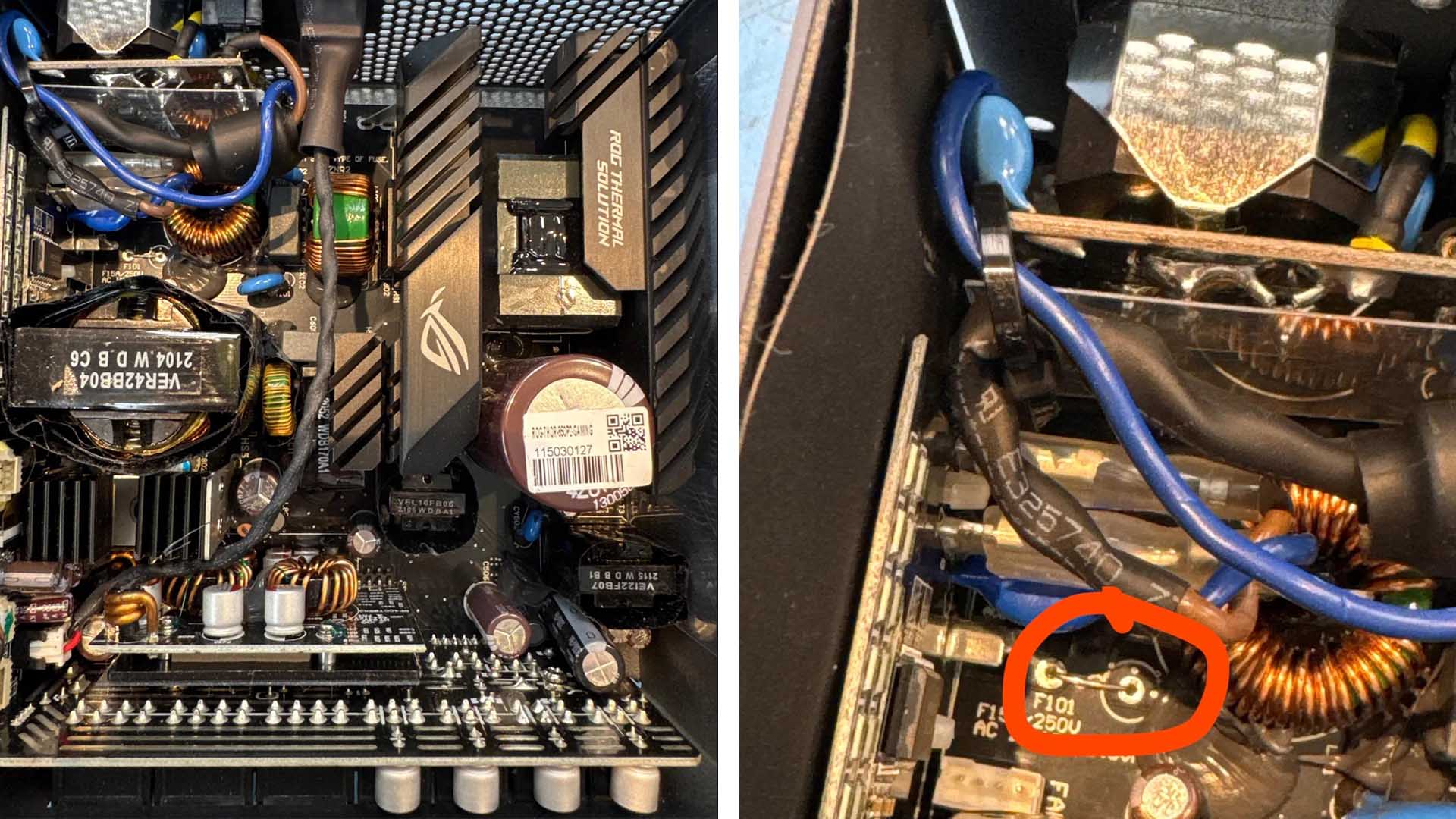
A Reddit user claimed that an ASUS ROG Strix 850W power supply returned from an RMA repair with its internal safety fuse bypassed by a soldered wire. If accurate, the discovery points to a serious repair mistake that could have put the user’s PC, home electrical system, and personal safety at risk.
The owner said the power supply was used for around two hours after being returned. During that time, the computer caused the room’s main electrical breaker to trip. After resetting the breaker and attempting to power on the PC again, the breaker tripped for a second time. That repeated failure made it clear that something was wrong.
After reportedly being denied further warranty service, the owner opened the PSU casing to inspect the inside. Opening a power supply can be dangerous and usually voids the warranty, but the user said the warranty situation was already unresolved. Inside the unit, the user found what appeared to be a wire soldered directly across the fuse contacts, effectively bypassing the fuse entirely.
That is a major problem because the fuse is there for a reason. In a properly functioning power supply, the fuse is intended to break the circuit when dangerous current levels occur. This can help prevent severe component damage and reduce the risk of electrical fire. With the fuse bypassed, the PSU would no longer have that critical internal layer of protection. Instead, the excessive current reportedly reached the home’s breaker, which then became the only thing stopping the fault from continuing.
For PC builders, this is especially alarming because the ASUS ROG Strix series is marketed as a premium power supply lineup. Buyers of high-end PSUs often choose them specifically for reliability, safety protections, and long-term peace of mind. A bypassed fuse in any power supply would be unacceptable, but it is particularly concerning in a product positioned for gaming rigs and expensive PC components.
The user said they contacted ASUS USA after discovering the issue. However, because the PSU casing had been opened, getting a standard warranty resolution may be difficult. Still, if the unit was genuinely returned from service in that condition, the responsibility could fall on the repair process rather than the customer.
This incident also serves as an important reminder for PC users: never ignore repeated breaker trips, burning smells, sudden shutdowns, or unusual behavior from a power supply. A faulty PSU can damage motherboards, graphics cards, storage drives, and other components. In worst-case scenarios, it can become a fire hazard.
It is also worth stressing that users should not open a power supply unless they are trained to do so. PSUs can retain dangerous electrical charge even after being unplugged. If a power supply appears faulty, the safest step is to disconnect it, stop using it immediately, and contact the manufacturer or a qualified technician.
For now, this case remains based on the owner’s public report and shared images. Still, the alleged repair mistake has sparked understandable concern in the PC hardware community. A safety fuse is not an optional part, and bypassing it defeats one of the most basic protections built into a power supply.
If confirmed, the incident would be a serious failure in quality control and repair handling. PC owners trust power supply manufacturers to protect their systems from dangerous electrical faults. When that trust is broken, the consequences can extend far beyond a damaged computer.