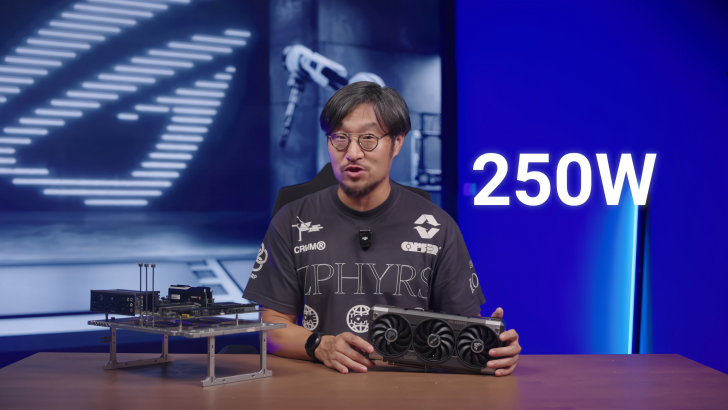
Imagine building a gaming PC without a single GPU power cable. That’s the future ASUS is teasing with a concept graphics card and motherboard that push up to 250W directly through the PCIe slot—enough for many mainstream and upper-midrange GPUs to run with zero external power connectors.
ASUS has been steadily pushing the cable-free vision forward. The company’s BTF series moves motherboard connectors to the back for cleaner builds, while its GC High Power solutions simplify GPU power delivery. It even previewed a hefty 1000W BTF 2.5 connector at Computex 2025. Now, ASUS is exploring how to make the PCIe slot itself do much more of the heavy lifting.
Today’s PCIe standard delivers only 75W through the slot, which is fine for low-end cards but not nearly enough for most modern GPUs. Even tapping the motherboard’s 12V supply isn’t sufficient, since that rail typically drives other components like fans and RGB headers. ASUS’s concept tackles this head-on by redesigning both the GPU’s edge connector and the motherboard slot.
On the graphics card side, ASUS adds extra power contacts to the gold fingers—three at the front and two at the back—creating a denser, more robust interface capable of far higher current. On the motherboard, the matching PCIe Gen5 x16 slot uses thicker, more conductive pins to handle the increased load. The board also includes a supplementary 8-pin power input that feeds the slot and other I/O with up to 150W, enabling a total of up to 250W to be delivered through the slot alone.
In a demo from ASUS’s China team, a TUF GeForce RTX 5060 Ti Gaming concept card ran entirely off the PCIe slot, pulling as much as 248W without hiccups. No 6-pin, 8-pin, or 16-pin connector required.
If this concept becomes a product, it could reshape how GPUs are powered:
– Cleaner, simpler cable management with improved airflow and aesthetics
– Reduced risk from misseated high-power GPU cables
– Easier installation and maintenance for mainstream builds up to roughly the 250–300W class
There are trade-offs. You’ll need a compatible motherboard with the reinforced slot and the extra power feed. Broader industry adoption would be essential for widespread compatibility, and questions remain about long-term wear, thermal performance at the slot, and how the ecosystem would standardize around higher slot power limits. It’s worth noting that other brands, like MSI, already offer motherboards with auxiliary 8-pin power for PCIe slots, highlighting real-world benefits for systems running multiple GPUs or high-draw expansion cards.
For now, ASUS’s connector-free PCIe GPU design remains a concept—but a very promising one. If adopted, it could make power connector-free graphics cards the norm for a wide range of gaming and creator builds, delivering tidier rigs and fewer cable-related headaches without compromising performance.