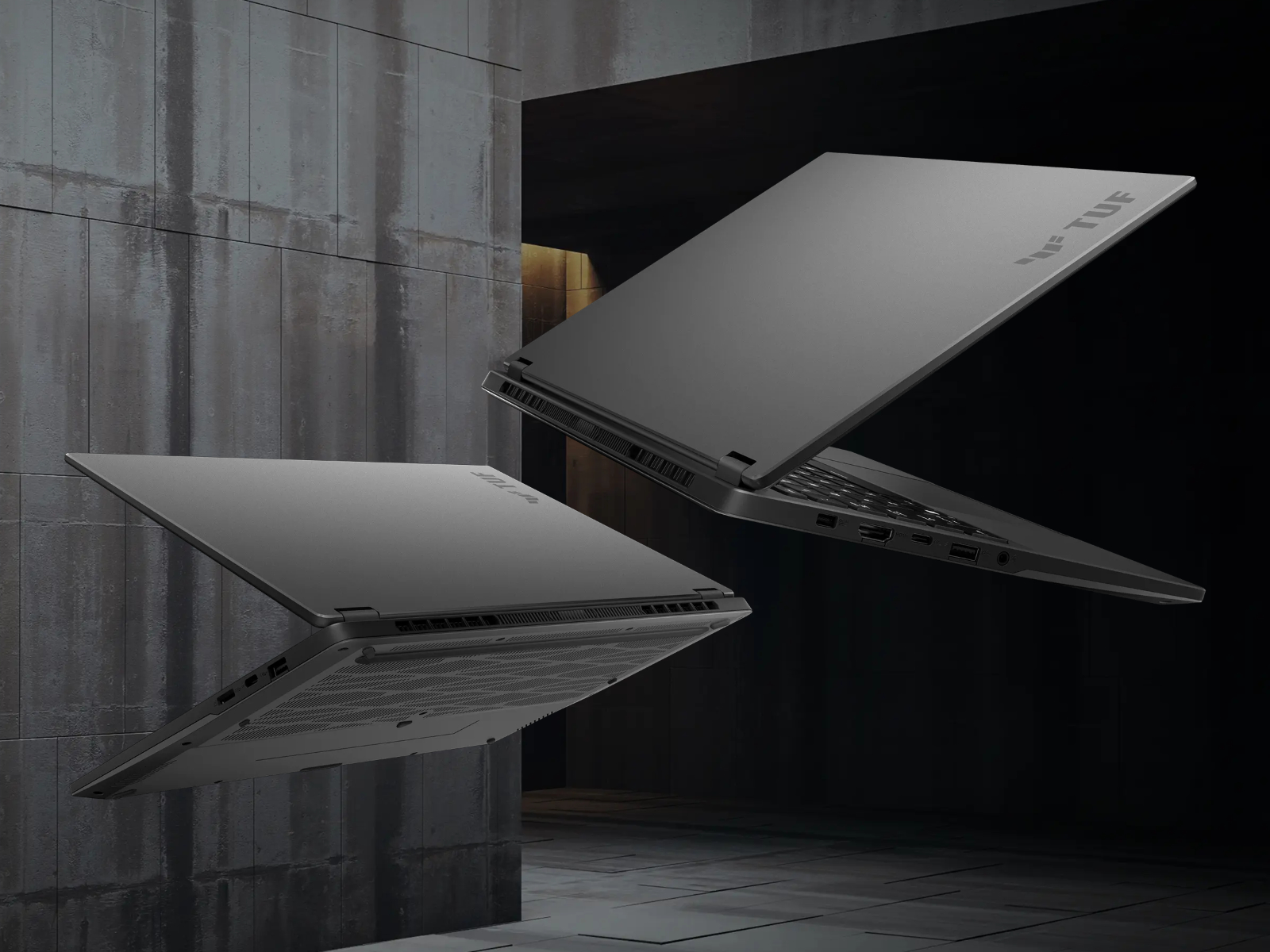
Asus has officially brought its first 14-inch gaming laptop built on AMD’s Strix Halo platform to the US, and early performance testing suggests this compact machine punches well above what you’d expect from a laptop that doesn’t rely on a dedicated graphics card.
The model in question is the Asus TUF Gaming A14 FA401EA, notable for being Asus’ only gaming laptop that skips a discrete GPU. Instead, it leans entirely on AMD’s latest high-end APU setup, pairing the Ryzen AI Max+ 392 with Radeon 8060S integrated graphics. With the North American rollout now underway, the laptop has also been stress-tested in real gaming workloads, including modern AAA titles running at 1600p—its native display resolution—with results that look very promising for an iGPU-focused gaming laptop.
At the heart of the FA401EA is AMD’s Ryzen AI Max+ 392, a Strix Halo chip that borrows much of its DNA from the higher-tier Ryzen AI Max+ 395. The 392 version comes with 12 CPU cores rather than the full 16-core configuration, along with reduced L2 cache (12 MB instead of 16 MB) and adjusted CPU clock speeds. The graphics side, however, remains fully intact: the Radeon 8060S stays unchanged, featuring 40 compute units and a boost clock reaching 2,900 MHz. That’s a key reason why gaming performance remains strong despite the CPU being cut back versus the top model.
In CPU-heavy synthetic benchmarks, the difference between the Ryzen AI Max+ 392 and the Max+ 395 is noticeable. Multi-core workloads can show roughly a 25% gap in tests like Cinebench 2024, which is expected given the reduced core count and cache. In mixed tests that reflect more gaming-oriented scenarios, such as 3DMark Time Spy, the gap appears smaller—an encouraging sign for gamers who care more about real-world frame rates than pure CPU benchmark charts.
Power behavior is also a major part of the story. In Turbo mode, the FA401EA can sustain around 100 W TDP under load, and it can push further in Manual mode with up to about 115 W FPPT. That kind of power budget is one reason the Radeon 8060S can deliver the sort of performance typically associated with lower-to-mid discrete GPUs, despite being integrated.
In actual gameplay testing at 1600p, the laptop reportedly lands around 80 FPS in modern triple-A games when running in Turbo mode. Thermals also seem well-managed for a thin 14-inch gaming laptop: even while pulling roughly 100 W, temperatures hover around 80°C using the default Asus fan curve, suggesting there’s still some cooling headroom available depending on your settings and environment.
Compared to the older FA401WV variant, the FA401EA looks like a meaningful graphics upgrade, especially when configured with 16 GB of VRAM allocated to the Radeon 8060S. Another potential advantage is flexibility: because the system isn’t built around a power-hungry discrete GPU, it may be able to maintain respectable gaming performance while charging over 100 W USB-C—something many gaming laptops with dedicated Nvidia graphics struggle to do at full speed.
For anyone searching for a portable 14-inch gaming laptop, an AMD Strix Halo laptop, or a high-performance iGPU gaming solution that can handle modern games at 1600p, the Asus TUF Gaming A14 FA401EA is shaping up to be one of the more interesting new releases to watch in 2026.