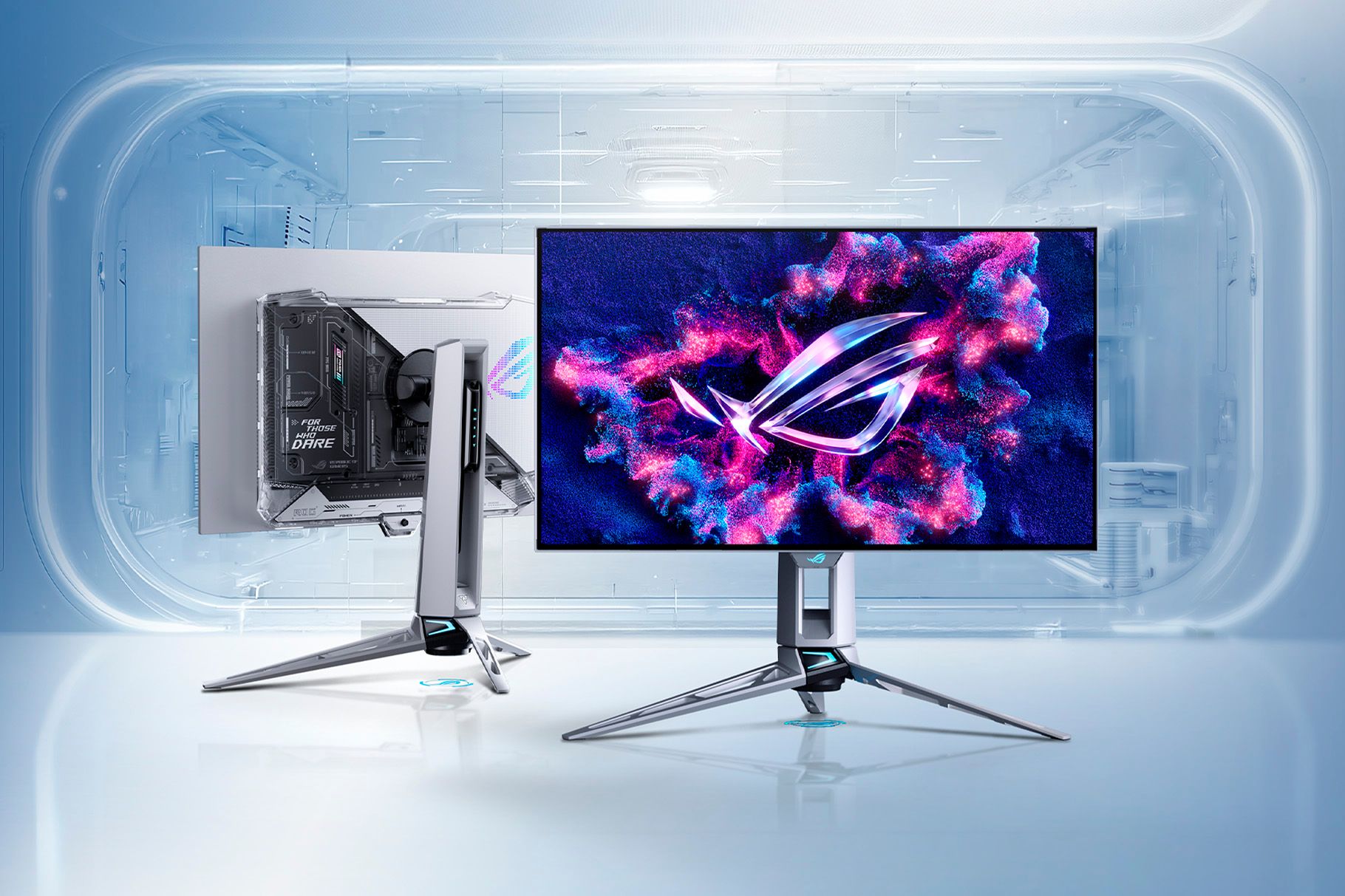
ASUS has unveiled its first gaming monitors built on LG’s latest RGB Tandem OLED technology, bringing a major leap in brightness, speed, and clarity for competitive and enthusiast gamers. By using a stacked RGB emission design, these panels deliver richer color and higher luminance, producing vivid visuals in both SDR and HDR.
Leading the lineup is the ROG Swift OLED PG27AQWP-W, positioned as the fastest OLED gaming monitor available right now. Its headline feature is a dual-mode configuration: switch between 540Hz at 1440p for ultra-fluid competitive play, or crank it to an astonishing 720Hz at 720p for pure esports speed. While the 720Hz mode is limited to 720p, the 540Hz at native 1440p makes this display a standout for high-level PC gaming. The model previously appeared in China as the ROG Super Kill 27 Pro, and ASUS has now posted its full specifications.
Joining it is the more accessible ROG Strix OLED XG27AQWMG, which uses the same LG Tandem OLED panel but targets a broader audience with a 280Hz refresh rate at 1440p. That’s plenty fast for most competitive titles, and it retains the key image-quality advantages of the new OLED tech. Compared to the flagship, the mid-range model trims some connectivity, keeping costs in check without sacrificing core performance.
Both 27-inch monitors share a glossy finish that enhances perceived contrast and clarity, along with a wide color gamut covering 99.5% DCI-P3 and 135% sRGB. Expect excellent color accuracy and crisp detail, with the added benefit of higher brightness than traditional OLED panels thanks to the tandem design.
Connectivity is a key differentiator. The ROG Swift OLED PG27AQWP-W includes HDMI 2.1 and DisplayPort 2.1 UHBR20 for cutting-edge bandwidth and future-ready support. The ROG Strix OLED XG27AQWMG opts for DisplayPort 1.4, which is still widely compatible for 1440p high-refresh gaming. Both models provide a couple of USB Type-A ports for peripherals.
ASUS hasn’t announced official pricing yet. Based on earlier reporting, the flagship is expected to land around $1100, with the mid-range model likely coming in lower. If you’re after bleeding-edge refresh rates at 1440p or a balanced, high-performance OLED for competitive play, these new ASUS gaming monitors signal a major step forward in brightness, speed, and overall visual quality.


