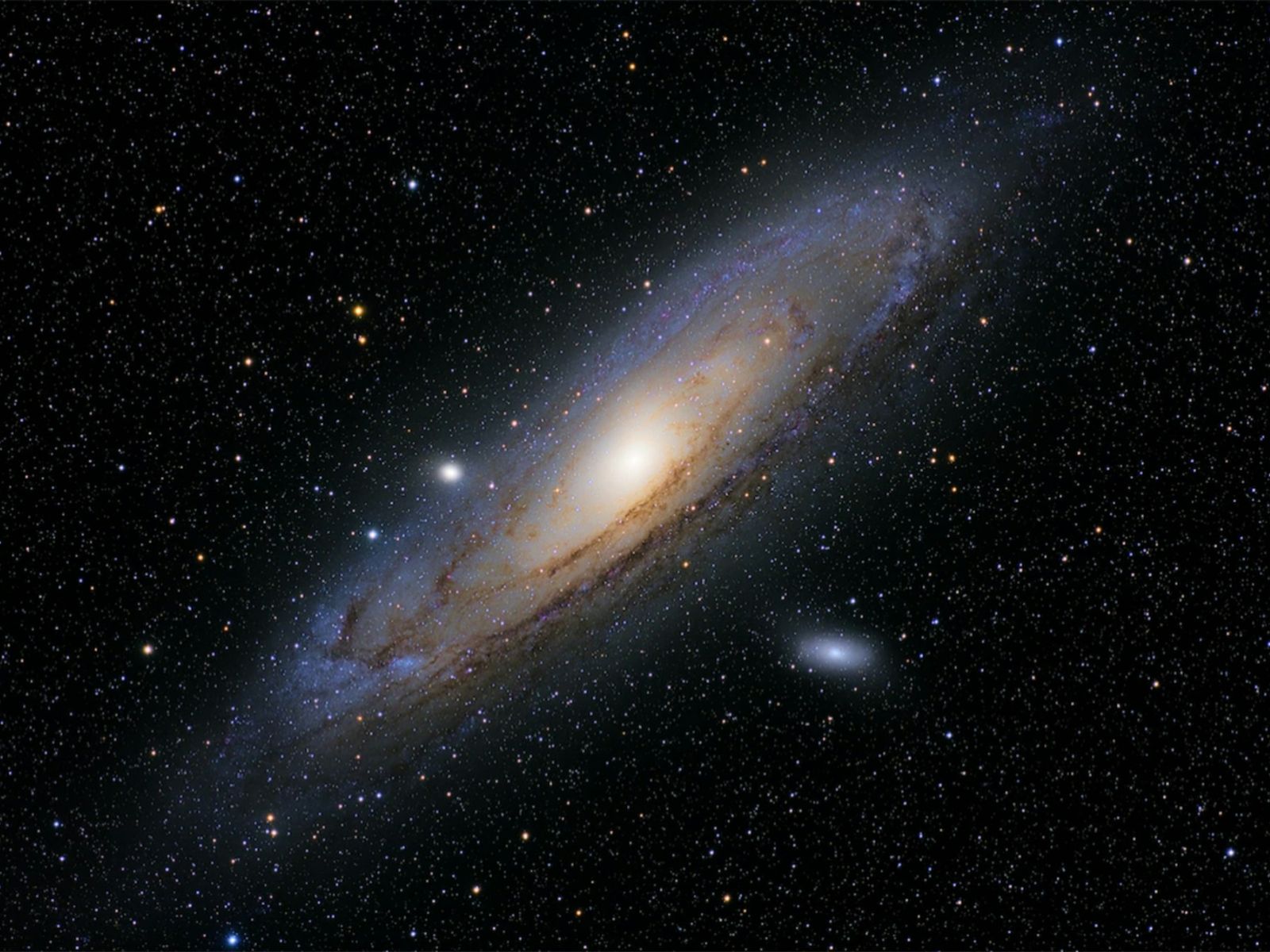
Astronomers have identified a newly confirmed dwarf galaxy lurking close to the Andromeda Galaxy, adding another intriguing piece to the puzzle of how galaxies formed in the early universe. The object, named Andromeda XXXVI, is classified as an ultra-faint dwarf galaxy—a small, dim, and sparsely developed system believed to be heavily dominated by dark matter.
Andromeda is the Milky Way’s nearest major galactic neighbor and can be spotted from Earth with the naked eye under dark skies. But it isn’t traveling through space alone. Like our own galaxy, Andromeda is surrounded by a swarm of smaller satellite galaxies, many of which are so faint and diffuse that they’re extremely difficult to detect. This is what makes the confirmation of Andromeda XXXVI especially notable: it shows that even in our cosmic “backyard,” there are still galaxies waiting to be found.
A European research team led by Joanna D. Sakowska from the Institute of Astrophysics of Andalusia confirmed Andromeda XXXVI using data connected to the Pan-Andromeda Archaeological Survey, which is designed to map Andromeda’s outer regions and uncover faint structures around it.
Measurements place Andromeda XXXVI roughly 2.53 million light-years from the Milky Way. Since the Andromeda Galaxy is about 2.5 million light-years away, that positioning suggests the dwarf galaxy sits around 388,000 light-years from Andromeda itself, indicating it is likely a true satellite companion rather than a distant background object.
Researchers estimate Andromeda XXXVI has an absolute magnitude of about -6.0 and a radius of approximately 208 light-years, underscoring just how small and faint it is compared with full-sized galaxies like Andromeda or the Milky Way. Perhaps most compelling is its estimated age: around 12.5 billion years old. That makes it a potential relic from the early universe—an ancient galactic system that formed not long after the cosmos itself began taking shape.
Ultra-faint dwarf galaxies are valuable to astronomy because they can preserve clues about early star formation, chemical evolution, and the role of dark matter in building larger galaxies. They’re also among the hardest objects to spot: they contain relatively few stars, shine weakly against the background of space, and can be easily missed unless surveys are deep and wide enough to detect their subtle stellar signatures.
Andromeda may host more than a hundred satellite galaxies, and discoveries like this hint that the census is still incomplete. With improved observations and continued sky surveys, astronomers expect more ultra-faint dwarf galaxies to emerge—each one offering another opportunity to test models of galaxy formation and to better understand how the early universe evolved.
Note: The study describing this discovery is currently a preprint and has not yet been reviewed by independent experts.