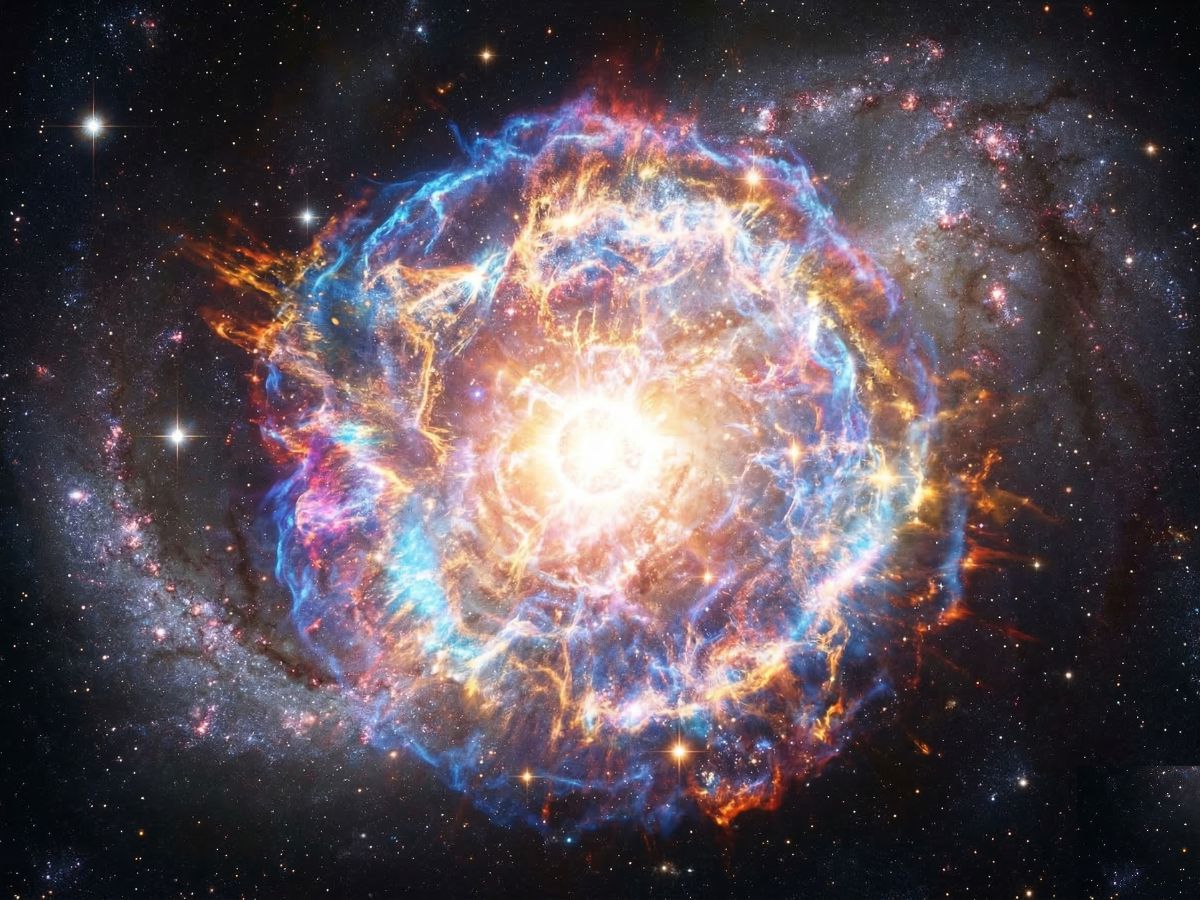
Astronomers have captured something never seen so clearly before: the apparent birth of a magnetar unfolding inside a supernova explosion. This rare observation strengthens a long-standing idea in astrophysics—that the brightest, longest-lasting “superluminous supernovae” are powered from within by a newborn magnetar.
When certain massive stars reach the end of their lives, they don’t simply fade away. They detonate in a supernova, blasting their outer layers into space while the core collapses under gravity. That crushed core becomes a neutron star—an object so dense it’s essentially a giant atomic nucleus made mostly of neutrons.
A magnetar is an even more extreme version of a neutron star. It carries an extraordinarily powerful magnetic field and can spin at astonishing rates, sometimes more than 1,000 rotations per second. With that combination of rapid rotation and intense magnetism, a magnetar can dump huge amounts of energy into the expanding wreckage of the explosion around it.
Superluminous supernovae were first recognized in the early 2000s because they behaved unlike typical stellar explosions. They can shine 10 times brighter (or more) than standard supernovae and remain luminous for much longer. In 2010, astrophysicist Dan Kasen, working with Lars Bildsten and Stan Woosley, proposed a compelling explanation: when a massive star collapses, it can create a rapidly spinning magnetar. The magnetar’s magnetic field accelerates particles, and those particles slam into the supernova debris, reheating it and keeping the blast brighter for longer than it otherwise would be.
Now, fresh evidence has arrived from detailed monitoring of a specific event, SN 2024afav. Astronomers tracked its brightness for more than 200 days and noticed a striking pattern: four distinct “bumps” in the light output. Even more intriguing, those bumps appeared closer and closer together over time, with oscillations that tightened in a way scientists describe as a “chirp”—a term often used for signals that rise in frequency.
The physics behind this chirping pattern ties directly into what happens after a magnetar is born. Not all the exploded material escapes cleanly. Some of it falls back toward the newborn compact object, forming a fast-spinning ring of matter called an accretion disk. In this scenario, the disk isn’t perfectly aligned with the magnetar’s spin axis. That mismatch sets the stage for a relativistic effect known as frame dragging—where the magnetar’s extreme gravity and rotation tug on spacetime itself, influencing how the disk behaves. As the disk gradually moves inward, the “chirp” speeds up, matching what astronomers saw in the changing brightness pattern.
What makes this exciting isn’t just that it helps explain one supernova. It offers a new way to identify newborn magnetars in real time, using the subtle timing signatures in supernova light curves. With next-generation sky surveys—especially those designed to repeatedly scan the entire sky—astronomers expect to find more of these chirping supernovae. Each new detection could reveal more about how magnetars form, how supernova debris evolves, and why some stellar explosions become the most luminous in the universe.


