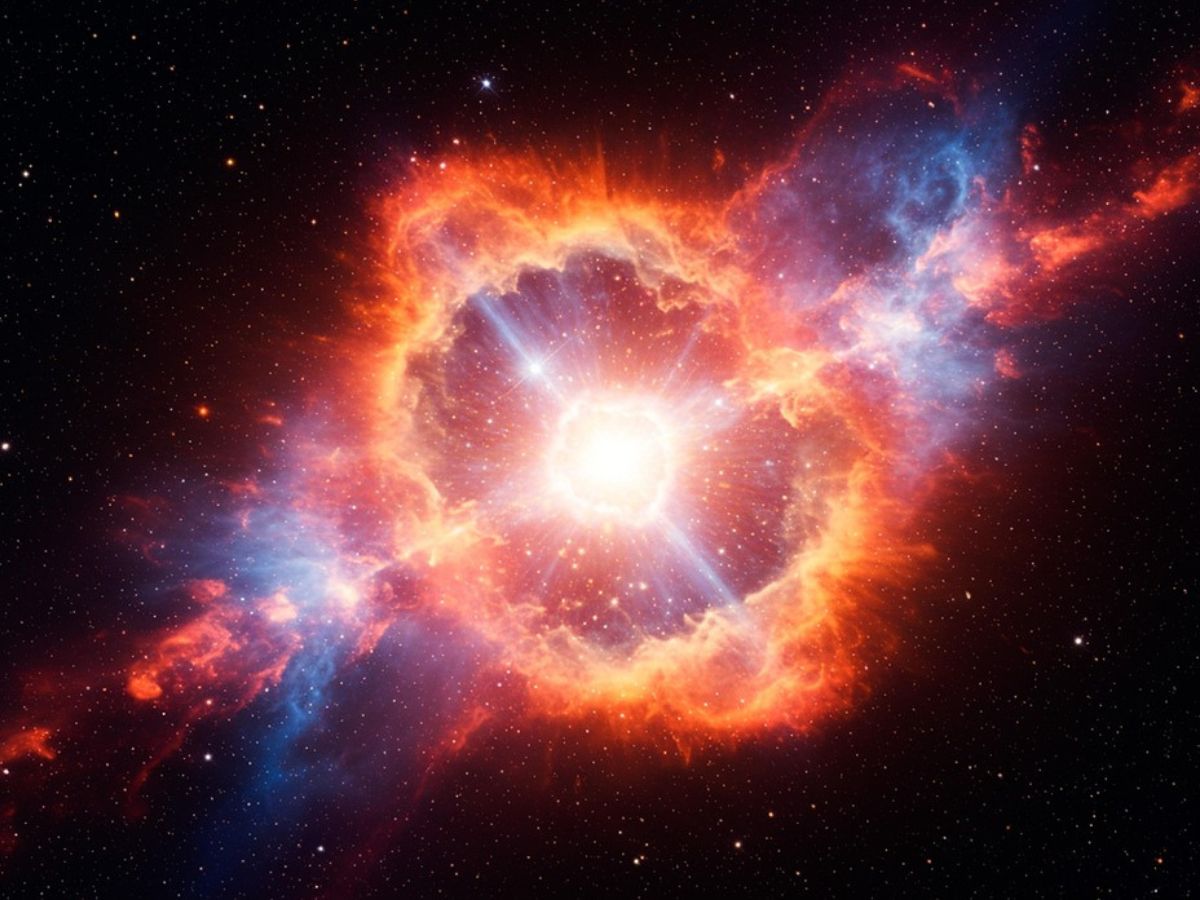
Astronomers have captured an unprecedented view of a star’s death, observing the first moments of a supernova’s shock wave as it burst into space. The stellar explosion, designated SN 2024ggi, erupted on April 10, 2024, in the spiral galaxy NGC 3621, about 22 million light-years from Earth—close enough, in cosmic terms, for detailed study.
Soon after the blast, astronomer Yi Yang of Tsinghua University secured rapid follow-up observations with the Very Large Telescope in Chile. Early data showed the dying star was a hefty red supergiant, roughly 12 to 15 times the mass of the Sun and about 500 times larger in size. The collapse left behind an ultra-dense remnant: a neutron star.
To decode the explosion’s structure, the team used the VLT’s FORS2 instrument and a technique called spectropolarimetry. This approach tracks how light is polarized across different wavelengths, revealing the geometry of the blast at scales too fine to resolve with images alone. As Lifan Wang explained, spectropolarimetry can uncover details about an explosion’s shape that other observations simply can’t reach.
The results were striking. The data indicate the supernova’s expanding material was flattened yet spread out symmetrically—a surprisingly tidy geometry for such a violent event. Even more unexpected, the blast’s shape didn’t change when it slammed into a ring of circumstellar material, likely shed by the star before it died. That stability offers new clues about how shock waves move through and interact with the environments around massive stars.
Catching these early moments is a breakthrough for supernova research. It opens a clearer window into how red supergiants end their lives, how shock waves evolve, and how neutron stars are born. With more early-time observations planned in the months ahead, astronomers expect fresh discoveries that could refine models of stellar explosions and deepen our understanding of how elements are forged and distributed across the cosmos.