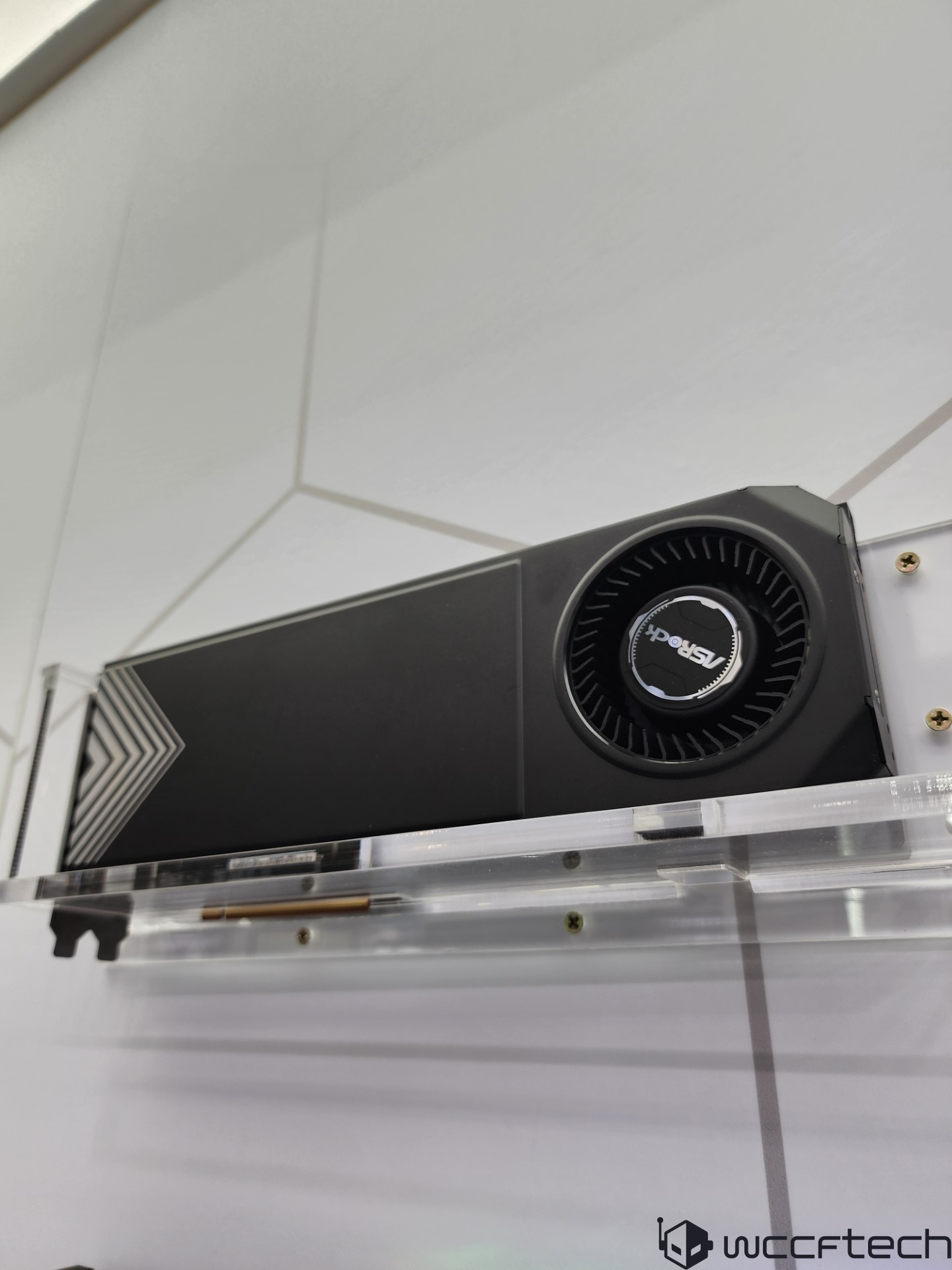
ASRock has expanded its product lineup with the introduction of the Radeon RX 7900 XTX and 7900 XT Workstation GPUs. These graphics cards are engineered to cater to AI workstation setups, boasting a 12V-2×6 power connector and a lean dual-slot blower configuration.
With the increasing demand for AI capabilities, ASRock’s latest offering reflects the industry’s shift towards providing powerful computing resources for workstations. The Radeon RX 7900 XTX Workstation GPU boasts the Navi 31 XTX GPU with a robust 6144 stream processors and a 384-bit bus interface, complemented by 24 GB of GDDR6 VRAM clocked at 24 Gbps. On the other hand, the 7900 XT Workstation variant comes equipped with 5376 cores, a 320-bit bus interface, and 20 GB of GDDR6 VRAM.
The internal components mirror those found in the standard 7900 XTX or 7900 XT GPU models. However, to accommodate the demanding nature of workstation tasks, such as AI generation (GenAI), the clock and power specifications have been optimized to deliver consistent compute-intensive performance. For example, ASRock’s Radeon RX 7900 XTX Workstation GPU features reduced base and game clock speeds at 1670 MHz and 2270 MHz, respectively, while preserving the standard 2.5 GHz boost clock rate. This adjustment ensures reliability and efficiency for prolonged workstation usage.
ASRock has implemented significant design modifications, adopting a 12V-2×6 power interface that aligns with the 16-pin configuration utilized by NVIDIA’s GeForce RTX 40 series, ensuring the GPUs can handle power needs without compromising electrical stability. Accompanying these GPUs is a custom PCB and an advanced cooling solution which includes a dual-slot cooler with a high-efficiency blower-fan, a vapor chamber heatsink, and a sleek backplate for added aesthetics and durability.
Customers can anticipate the Radeon RX 7900 XTX and 7900 XT Workstation GPUs to hit the retail market imminently. ASRock has hinted that pricing will remain competitive and in line with the manufacturer’s suggested retail price (MSRP), making these GPUs an attractive option for individuals and organizations looking to upgrade their AI workstations.
This new release signifies ASRock’s commitment to serving the growing needs of AI professionals with tailored hardware solutions that deliver on performance and reliability. Whether for advanced machine learning, data analysis, or content creation, ASRock’s new workstation GPUs are set to play a vital role in the AI-driven workplaces of the near future.