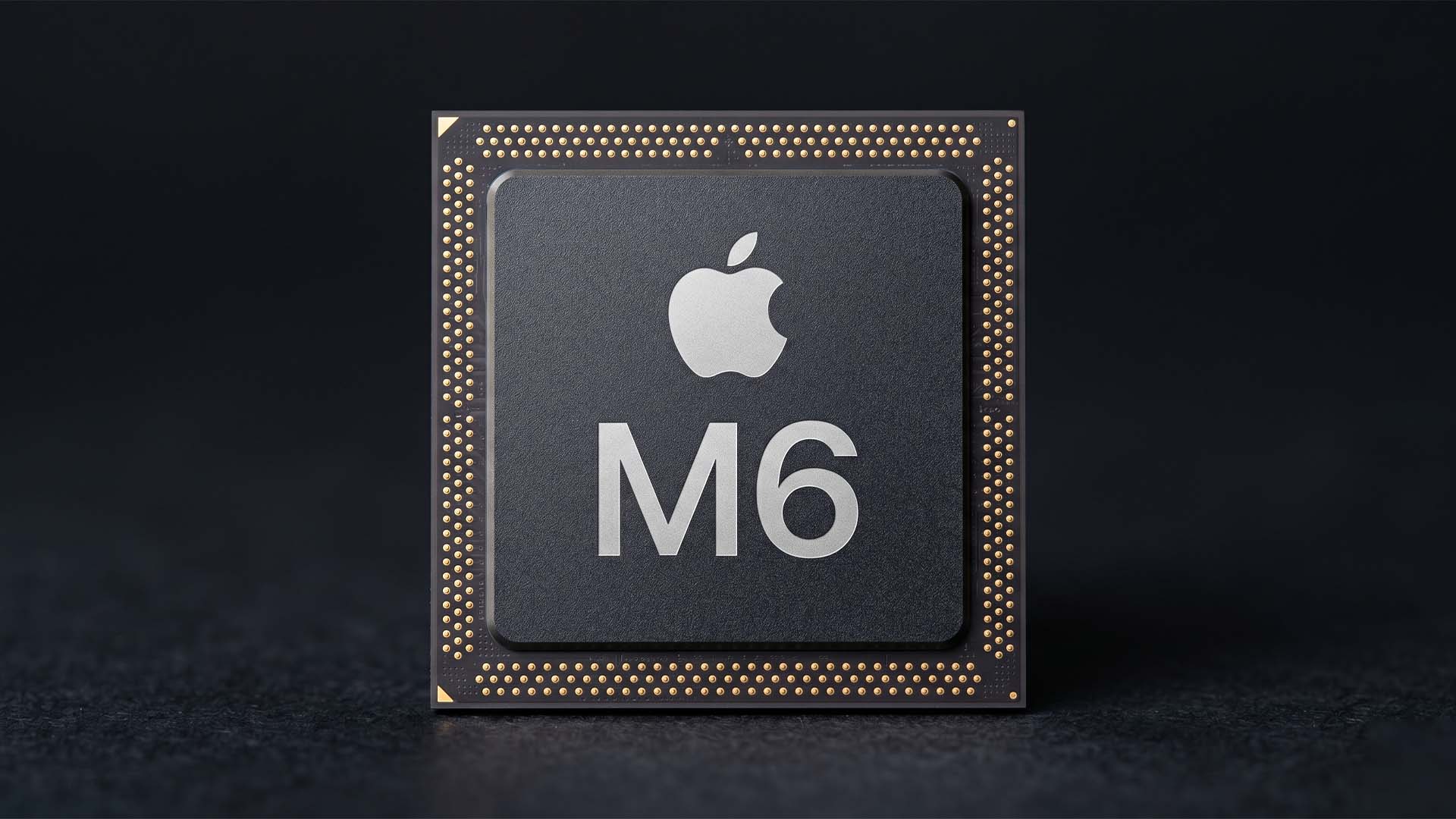
Apple may be preparing a major shift in its Mac chip roadmap, and it could change expectations for the next-generation MacBook Pro lineup. A new report claims the company may launch the base M6 chip later this year but skip the higher-end M6 Pro and M6 Max entirely. Instead, Apple is reportedly planning to move straight to the M7 family, including the M7, M7 Pro, M7 Max, and M7 Ultra.
If accurate, this would mark a surprising break from Apple’s usual M-series strategy. Since the launch of Apple Silicon, the company has typically introduced a base chip and later expanded the lineup with Pro, Max, and Ultra variants. That pattern may not continue with the M6 generation.
The base Apple M6 chip is expected to appear in an updated 14-inch MacBook Pro. However, the more powerful MacBook Pro models that were previously rumored to use the M6 Pro and M6 Max may now be pushed further down the timeline. This could also affect the long-rumored redesigned OLED MacBook Pro, which was expected to debut with Apple’s next major high-performance chip upgrade.
With the M6 Pro and M6 Max reportedly no longer part of the plan, the redesigned OLED MacBook Pro may instead arrive with the M7 Pro and M7 Max. That could mean Apple’s major MacBook Pro redesign has been delayed until late 2027, depending on how the company finalizes its product schedule.
The rumored M6 chip itself still sounds like a meaningful upgrade over the M5. It is expected to feature a unified memory architecture, an improved Neural Engine, and better video encoding and decoding performance. Apple is also said to be working on a redesigned GPU for the M6, potentially offering up to 12 cores, compared with up to 10 cores on the M5.
That GPU improvement could bring stronger graphics performance, smoother creative workflows, and better gaming capabilities on Mac. The upgraded Neural Engine may also help improve AI-related tasks, which have become increasingly important across Apple’s software and hardware ecosystem.
Still, the bigger story is not just what the M6 may offer, but what it may not include. If Apple skips the M6 Pro and M6 Max, users waiting for a major performance jump in high-end MacBook Pro models may need to wait longer than expected. Professionals who rely on Apple’s Pro and Max chips for video editing, software development, 3D work, and other demanding tasks may find the base M6 less compelling than a true high-end M-series upgrade.
The change could also suggest that Apple is adjusting its chip strategy to better align with future Mac designs, especially the OLED MacBook Pro. Rather than launching powerful M6 variants for one generation and then quickly replacing them, Apple may prefer to reserve its next major performance leap for the M7 Pro and M7 Max.
For now, the report should be treated as likely but not officially confirmed. Apple has not announced the M6, M7, or any future OLED MacBook Pro models. However, if this roadmap proves accurate, 2026 could bring a more modest MacBook Pro refresh with the base M6, while the bigger redesign and high-performance chip upgrades may arrive later with the M7 generation.