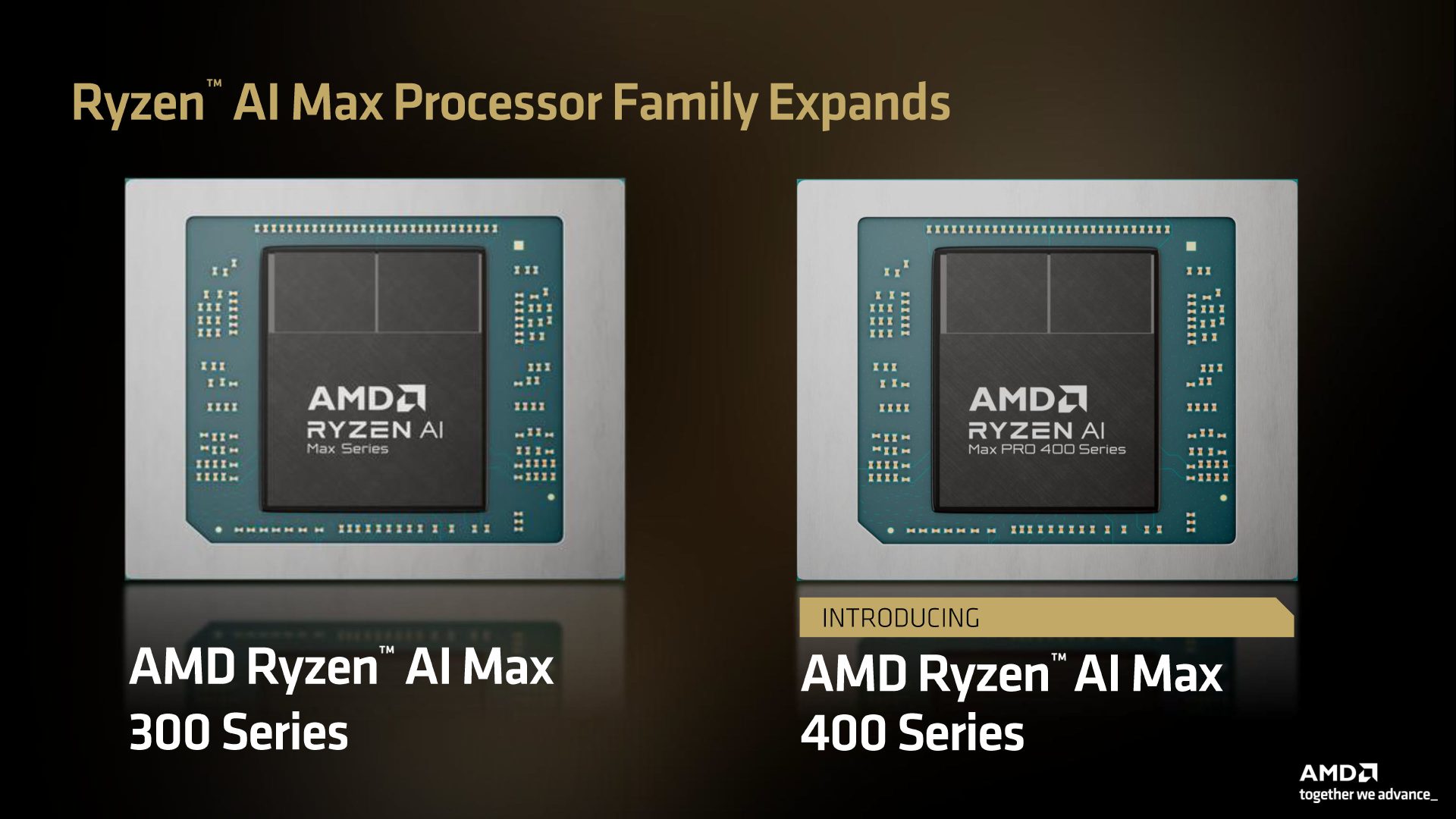
AMD Ryzen AI MAX 400 SoCs debut with up to 192GB unified memory for massive local AI workloads
AMD has introduced its Ryzen AI MAX 400 series, a new family of high-performance SoCs designed for AI PCs, mobile workstations, creators, developers, and professionals who want serious local AI processing power without relying entirely on the cloud.
The biggest upgrade is memory. The Ryzen AI MAX 400 platform supports up to 192GB of unified memory, giving users enough capacity to run extremely large AI models locally, including LLMs with more than 300 billion parameters. For AI developers, researchers, and creators working with complex local models, this is a major step forward for x86 client processors.
The new chips belong to AMD’s Gorgon Halo family and combine Zen 5 CPU cores, RDNA 3.5 integrated graphics, and an XDNA 2 AI NPU. While the core architecture is similar to the previous Ryzen AI MAX 300 lineup, AMD has improved the platform with higher CPU and GPU clock speeds, expanded memory support, and stronger workstation-focused capabilities.
One of the most important features is unified memory allocation. With configurations reaching up to 192GB, users can assign as much as 160GB of memory to the integrated GPU, a major increase over the 112GB limit available on 128GB systems. This makes the Ryzen AI MAX 400 series especially attractive for large local AI models, generative AI workflows, advanced rendering, engineering simulations, and GPU-heavy creative applications.
AMD is positioning the Ryzen AI MAX 400 series as a platform for concurrent agentic AI workloads. In practical terms, that means systems powered by these chips can support multiple local AI agents running at the same time, allowing developers and professionals to build more advanced AI workflows directly on the device.
The launch lineup includes three models: Ryzen AI MAX+ PRO 495, Ryzen AI MAX PRO 490, and Ryzen AI MAX PRO 485. These chips share similar core configurations with existing Ryzen AI MAX 300 models but receive clock speed improvements across both the CPU and GPU.
The flagship Ryzen AI MAX+ PRO 495 comes with 16 Zen 5 CPU cores and 32 threads. It also includes Radeon 8065S integrated graphics with 40 compute units. AMD has increased the CPU base and boost clocks by 100MHz, bringing them to 3.1GHz and 5.2GHz. The GPU clock has also been raised to 3.0GHz, which should help improve graphics, AI, and compute performance.
The built-in XDNA 2 NPU delivers up to 55 TOPS of AI performance. Combined with the powerful CPU cores and RDNA 3.5 graphics, the Ryzen AI MAX 400 series is built to handle demanding AI, design, rendering, simulation, and professional creative workloads in a compact system.
Expected Ryzen AI MAX 400 lineup:
Ryzen AI MAX+ 495: 16 cores, 32 threads, up to 5.2GHz, 80MB cache, Radeon 8065S graphics with 40 compute units, 45W to 120W TDP
Ryzen AI MAX 490: 12 cores, 24 threads, up to 5.0GHz, 76MB cache, Radeon 8050S graphics with 32 compute units, 45W to 120W TDP
Ryzen AI MAX 485: 8 cores, 16 threads, up to 5.0GHz, 40MB cache, Radeon 8050S graphics with 32 compute units, 45W to 120W TDP
All three models are expected to operate with a configurable TDP range, starting at 45W and scaling up to 120W depending on the system design and performance target. This flexibility should allow manufacturers to use the chips in everything from compact AI workstations to more powerful creator-focused laptops and desktop-class systems.
Systems powered by Ryzen AI MAX PRO 400 processors are expected to arrive from major OEM partners including ASUS, HP, and Lenovo starting in the third quarter of 2026.
With the Ryzen AI MAX 400 series, AMD is clearly targeting the next wave of AI PCs and professional mobile workstations. The combination of Zen 5 processing, RDNA 3.5 graphics, XDNA 2 AI acceleration, and up to 192GB of unified memory gives the platform a strong advantage for users who need to run large AI models locally.
For creators, engineers, developers, and AI professionals, the Ryzen AI MAX 400 family could become one of AMD’s most important client platforms yet, especially as demand grows for powerful on-device AI computing.