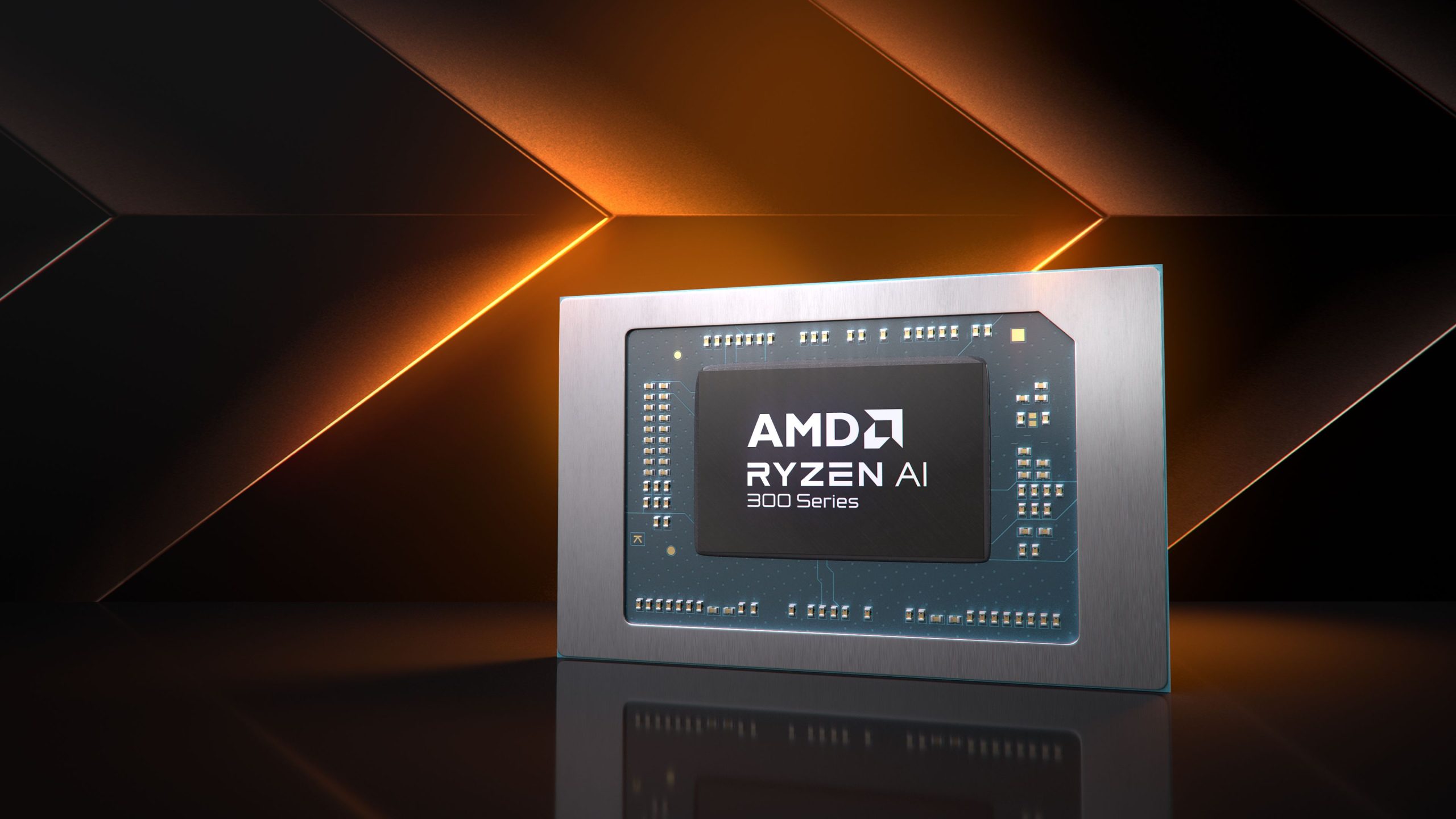
The computing landscape is set to receive another impactful wave of progress as AMD’s Ryzen AI 9 HX 370 APU emerges, displaying significant advances in CPU and GPU capabilities over its predecessors. A part of the Ryzen AI 300 “Strix Point” family, this APU is showing its potential through leaked benchmarks, indicating a herald of more powerful and efficient computing on the horizon.
Enhanced Specifications with Zen 5 and RDNA 3.5 Cores
The Ryzen AI 9 HX 370 APU is a compelling combination of innovation and performance, featuring a 12-core and 24-thread setup utilizing a mix of four Zen 5 and eight Zen 5C cores. Capable of reaching boost clocks up to 5.1 GHz and equipped with a significant 36 MB cache, it represents a generational leap from the previous flagship, the Ryzen 9 8945HS.
In terms of graphics, the integrated GPU known as the Radeon 890M displays 16 compute units or 1024 cores, hinting at a rich visual computing experience. These specifications suggest heftier raw processing power, with a 50% uptick in core count and a one-third increase in compute units.
Benchmarking the Ryzen AI 9 HX 370 APU
Leaked benchmarks, including Geekbench 5 and Geekbench 6 data, provide a glimpse into the APU’s capabilities. The tests reveal more concrete figures: in Geekbench 5.4.5, the APU chalked up 1847 points in single-core and a robust 14,316 points in multi-core assessments. Furthermore, OpenCL testing for the RDNA 3.5 iGPU yielded an impressive 41,995 points.
The Zen 5 cores’ CPU performance on the Strix Point APU appears promising, and expectations are that the final retail version of this APU could offer even higher performance thanks to its boost clock potential.
Comparative Analysis
Compared to the Ryzen 9 8945HS, the new Ryzen AI 9 HX 370 APU demonstrates a persuasive 7% and 20% advantage in single-core and multi-core tests, respectively. Most notably, graphics tests saw a soaring 40% performance increase, aligning the APU’s capability with that of the RTX 2050 discrete GPU. Such a leap in performance underscores AMD’s commitment to delivering substantial year-over-year growth in computational efficiency.
Flexible TDP and Future Availability
AMD differentiates its Ryzen AI 300 series by overriding fixed TDP classifications, thus, handing over control to manufacturers to determine the appropriate TDP targets for different devices. This is especially noteworthy considering the chips have a variable scale from 15W up to 54W, allowing for a wide array of use cases. The default TDP is set at 28W, and the efficiency of the APU might stand out even more if operated at lower TDPs.
Expect to see the Ryzen AI 300 series CPUs, including this powerful Ryzen AI 9 HX 370 APU, become available from July 2024, with wider availability anticipated by the holiday season or in the fourth quarter of that year. This release is poised to offer users a leap forward in processing power for a broad spectrum of devices and applications, continuing AMD’s trajectory of technical innovation.