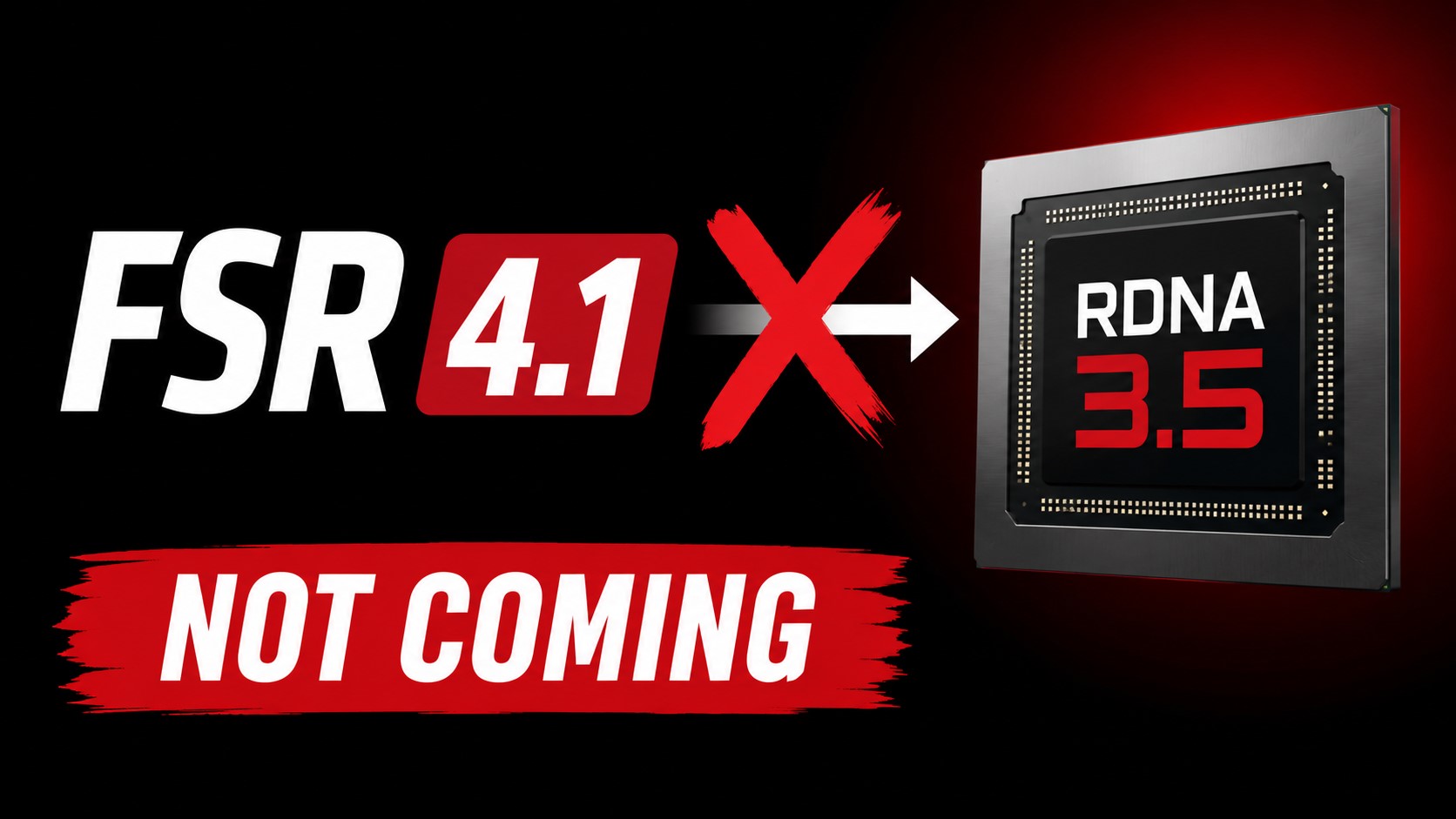
AMD reportedly has no plans to bring FSR 4.1 support to RDNA 3.5 integrated graphics, a move that could disappoint owners of Ryzen AI 300 and upcoming Ryzen AI 400 series APUs.
The situation is surprising because AMD recently confirmed that FSR 4.1 would expand beyond its newest RDNA 4 graphics cards. Support is expected to arrive for RDNA 3-based Radeon RX 7000 GPUs in July, while RDNA 2-based Radeon RX 6000 GPUs are also being prepared for support at a later stage, reportedly in early 2027. With that broader rollout, many users assumed RDNA 3.5 would naturally be included, especially since it is newer than RDNA 2 and powers some of AMD’s latest mobile processors.
However, that does not appear to be the case. According to a report from Hardware Luxx, AMD’s David McAfee indicated that FSR 4.1 is “not planned” for RDNA 3.5 integrated graphics. While that wording may leave a small amount of room for future changes, the current direction suggests that AMD is not preparing FSR 4.1 support for its RDNA 3.5 APU lineup in the near term.
This decision affects several AMD APU families built around RDNA 3.5 graphics, including Strix Point, Strix Halo, Krackan Point, and refreshed designs such as Gorgon Point and Gorgon Halo. These chips include integrated GPUs like the Radeon 890M and higher-end Radeon 8060S-class graphics, which can deliver performance close to entry-level discrete graphics cards in certain workloads.
That makes the lack of FSR 4.1 support more frustrating for users. AMD’s FidelityFX Super Resolution technology is designed to improve gaming performance by upscaling lower-resolution frames while maintaining image quality. With FSR 4.1, AMD has focused heavily on better visual stability, improved image reconstruction, and stronger results even when using performance-friendly modes such as Balanced.
For handheld gaming PCs, thin-and-light laptops, mini PCs, and other APU-powered systems, FSR 4.1 could have been especially useful. Integrated graphics are more sensitive to power and thermal limits than desktop GPUs, so any upscaling technology that improves frame rates without severely reducing image quality can make a noticeable difference. Ryzen AI 300 and Ryzen AI 400 systems would likely benefit from this feature in modern games where native resolution gaming can be demanding.
The puzzling part is that RDNA 3.5 appears technically capable of running INT8-based FSR 4.1. AMD’s updated approach to FSR 4.1 is designed to make the feature available on older GPU architectures, which is why RDNA 3 and RDNA 2 are being targeted. Since RDNA 3.5 sits between RDNA 3 and RDNA 4 in AMD’s graphics roadmap, many expected it to be part of the same support strategy.
For now, AMD’s position means desktop Radeon RX 7000 users are in line for FSR 4.1 first, followed later by Radeon RX 6000 owners, while RDNA 3.5 APU users may be left out despite owning newer hardware. That could be a disappointment for buyers who invested in Ryzen AI laptops expecting long-term feature support for AMD’s latest integrated graphics architecture.
AMD could still revise its plans later, especially if there is enough demand from laptop and handheld gaming users. But based on the current information, FSR 4.1 support for RDNA 3.5 integrated graphics is not on the roadmap. For gamers using Ryzen AI 300 or future Ryzen AI 400 APUs, that means they may have to rely on existing upscaling options rather than AMD’s newest FSR 4.1 technology.


