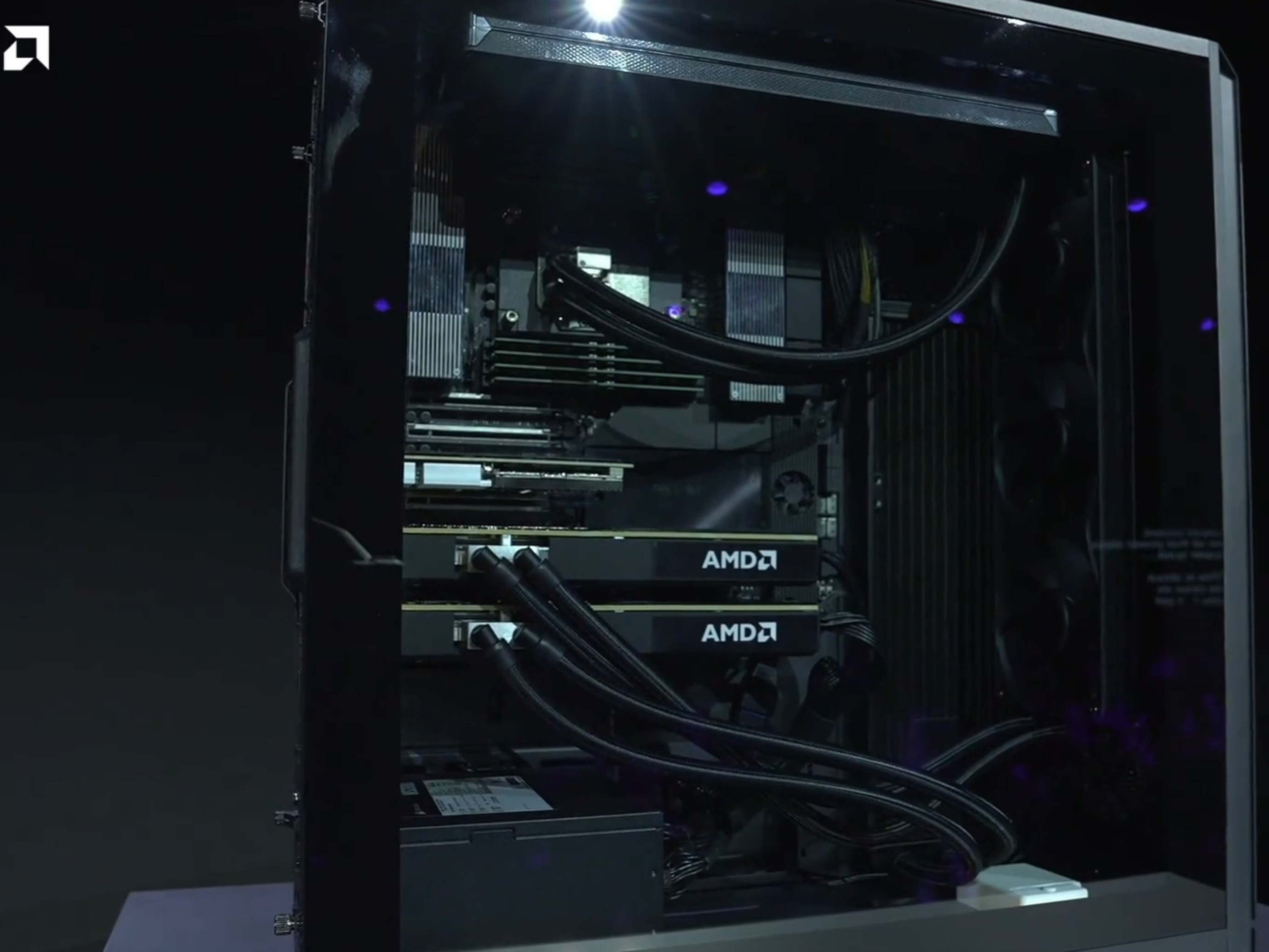
AMD Threadripper Halo Station: A 96-Core AI Workstation Built for Trillion-Parameter Models
AMD has introduced one of its most ambitious workstation systems yet: the Threadripper Halo Station, a massive liquid-cooled machine designed to bring serious AI computing power directly to the desktop or, more realistically, the server room.
Unveiled during AMD’s IFA 2026 keynote, the Threadripper Halo Station is aimed at professionals, researchers, AI developers, and enterprises that want to run large-scale artificial intelligence models locally without relying entirely on cloud infrastructure. With extreme CPU power, huge memory capacity, and enterprise-grade AI accelerators, this system is clearly built for workloads far beyond everyday productivity or gaming.
At the center of the Threadripper Halo Station is AMD’s Ryzen Threadripper Pro 9995WX, a high-end workstation processor featuring 96 Zen 5 cores and 192 threads. This chip is designed for demanding multi-threaded workloads such as AI development, scientific computing, rendering, simulation, and data-heavy professional applications.
AMD pairs the processor with 2 TB of system memory, likely DDR5 ECC memory, giving the workstation an enormous pool of RAM for complex professional tasks. The system also includes two AMD Instinct MI350P accelerators, each equipped with 144 GB of HBM3E memory. That gives the current configuration 288 GB of high-bandwidth accelerator memory.
AMD says the Threadripper Halo Station will eventually support up to four Instinct MI350P accelerators. If fully equipped, the system would offer a massive 576 GB of HBM3E memory dedicated to AI acceleration. According to AMD, that is enough to run AI models with more than one trillion parameters locally, making the Halo Station a serious option for organizations working with next-generation large language models and advanced AI workloads.
Power consumption will likely be substantial. Each Instinct MI350P accelerator can draw up to 600 W, and the Threadripper Pro 9995WX itself is rated at 350 W. With four accelerators, large memory capacity, storage, and a heavy-duty liquid-cooling setup, the complete system could potentially exceed 3 kW under full load.
That makes the Threadripper Halo Station less of a typical office workstation and more of a deskside AI server. It may look like a workstation, but its power, cooling, and infrastructure requirements suggest it is best suited for enterprise labs, research facilities, AI startups, and data-intensive professional environments.
AMD’s new system enters a growing market for powerful local AI machines. One of its most direct competitors is Nvidia’s DGX Station, which uses a Grace Blackwell-based design combining a high-performance GPU with a 72-core Grace CPU. Nvidia’s system features 252 GB of HBM3E memory for the GPU and 496 GB of LPDDR5X memory for the CPU, creating a total of 748 GB of coherent memory.
The two systems take very different approaches. Nvidia relies on a tightly integrated CPU-GPU architecture with a shared memory design connected through a high-speed NVLink-C2C interface. AMD, on the other hand, uses a more traditional high-end x86 workstation platform, combining a powerful Threadripper Pro CPU with discrete Instinct AI accelerators and an enormous 2 TB of system memory.
Because the memory architectures are so different, the systems cannot be compared purely by total memory capacity. Nvidia’s coherent memory model allows the CPU and GPU to access a shared memory space more directly, while AMD’s design offers a larger amount of physical system RAM and scalable accelerator memory through multiple Instinct cards.
AMD has not confirmed pricing or availability for the Threadripper Halo Station. However, given its 96-core workstation processor, multiple enterprise AI accelerators, liquid cooling, and multi-terabyte memory configuration, this will almost certainly be a premium enterprise-class machine.
A six-figure price tag would not be surprising, especially for a fully configured model with four Instinct MI350P accelerators. This is not a gaming PC or a conventional creator workstation. It is a purpose-built AI powerhouse designed for organizations that need local access to extreme computing performance.
With the Threadripper Halo Station, AMD is making a clear statement: the future of AI development is not limited to massive cloud data centers. For companies and researchers that want more control over their models, data, and infrastructure, high-performance local AI workstations are becoming an increasingly important part of the computing landscape.