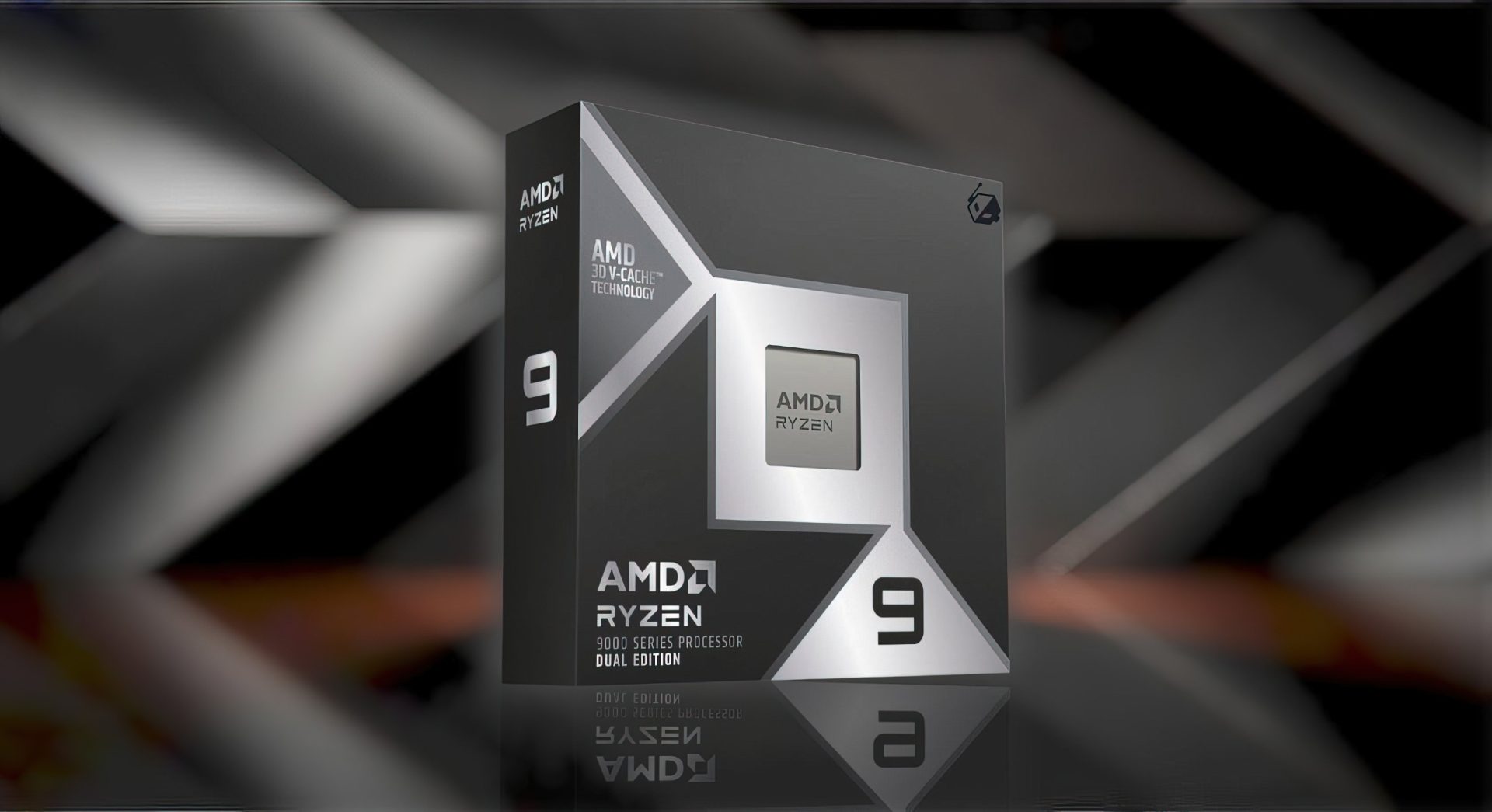
AMD’s latest “dual X3D” flagship is turning into a tough sell. According to multiple independent benchmarks, the Ryzen 9 9950X3D2 Dual Edition delivers little to no real-world benefit in gaming and only minor improvements in productivity—despite a price hovering around $900. Meanwhile, the far cheaper Ryzen 7 9800X3D continues to look like the smarter gaming CPU, often matching or beating the new top-tier chip at roughly half the cost.
For most Ryzen launches, buyers expect at least one clear advantage: higher frame rates in games, faster content creation performance, or better overall value. Zen 5 brought a welcome uplift to productivity workloads, but gaming gains from Ryzen 7000 to Ryzen 9000 weren’t particularly dramatic. That backdrop makes the Ryzen 9 9950X3D2’s positioning even more confusing, because it was supposed to stand out with a headline feature: two 3D V-Cache chiplets rather than one.
On paper, that sounds like a meaningful upgrade. The dual-cache design adds an extra 64 MB of L3 cache, and the chip is also configured with a higher power limit (with a 270W PPT versus 200W on the standard 9950X3D). In theory, more cache and more power headroom should translate into better performance in select games and demanding workloads. In practice, testing suggests the extra cache simply isn’t moving the needle.
Across a range of games at 1080p—where a high-end GPU is often used to expose CPU differences—the Ryzen 9 9950X3D2 reportedly shows essentially no gaming uplift compared with the regular Ryzen 9 9950X3D. In several comparisons, it ends up clustered with other X3D models like the Ryzen 7 9800X3D and Ryzen 7 9850X3D, sometimes even landing slightly behind the less expensive chips that many gamers are already buying.
Productivity results are only slightly more flattering. In multi-threaded applications, the dual X3D model can come out ahead, but the average gain being discussed is in the low single digits—roughly a few percentage points over the 9950X3D. That kind of improvement may show up in benchmarks, but it’s extremely hard to justify when the price premium is about $200 for what amounts to a 3–4% bump in some workloads and effectively 0% in gaming.
That pricing is the real sticking point. If a flagship CPU costs $900, buyers expect clear separation from the rest of the stack—either best-in-class gaming results, dominant creator performance, or a combination of both. Instead, the Ryzen 9 9950X3D2 Dual Edition is being viewed as an expensive experiment that doesn’t provide a tangible advantage over AMD’s existing X3D lineup. With options like the Ryzen 7 9800X3D, Ryzen 7 9850X3D, and the standard Ryzen 9 9950X3D available for hundreds less, it’s difficult to recommend paying extra for performance gains that most people won’t feel.
The bigger takeaway is that the “two 3D V-Cache chiplets” approach may not be necessary for this generation. Current results suggest one cache-stacked chiplet is already enough to hit the sweet spot in gaming, and adding more cache—at least in today’s games and software—doesn’t automatically translate into better outcomes. Unless pricing drops significantly (a figure like $749 would make the conversation more reasonable), the Ryzen 9 9950X3D2 risks being remembered less as a breakthrough and more as a costly misstep.
For shoppers building a high-end gaming PC right now, the practical advice is straightforward: prioritize proven gaming value. The Ryzen 7 9800X3D remains a standout choice for frame rates per dollar, and even users who need more cores for heavy productivity workloads will likely find better value in the Ryzen 9 9950X3D rather than paying a steep premium for marginal gains.