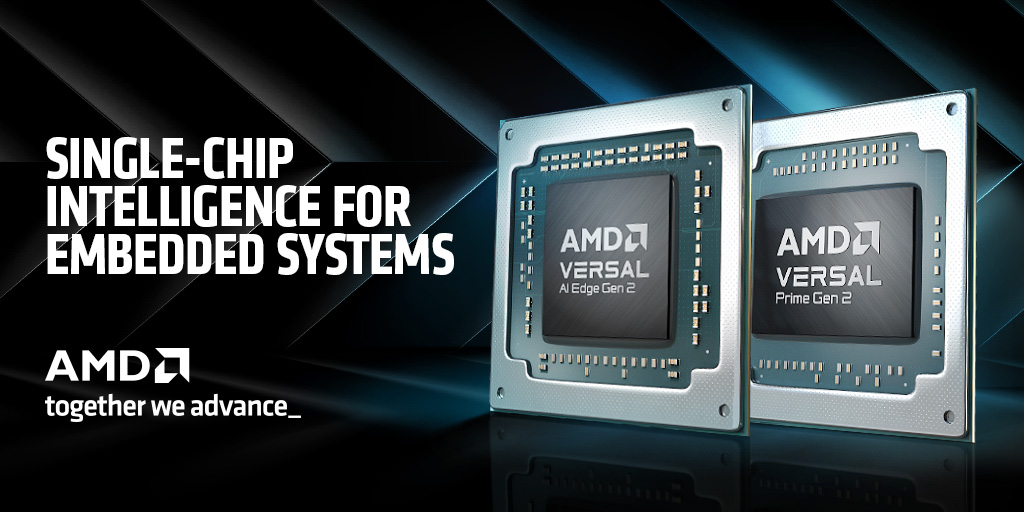
Advanced Micro Devices (AMD) has ramped up the competition within the edge AI computing segment by introducing their rejuvenated line of Versal Series chips. These chips are distinctively engineered to cater to the robust Artificial Intelligence (AI) engines that are progressively in demand.
AMD’s Versal Gen 2 Adaptive Chips Set to Revolutionize the Edge AI Landscape
During the Embedded World conference, AMD showcased its new and improved Versal AI Edge Series Gen 2 and Versal Prime Series Gen 2 adaptive chips, tailored to the burgeoning AI necessities of various markets. Noteworthy is the substantial performance leap, offering as much as a threefold increase compared to its predecessors. Central to this advancement is the integration of ARM CPU architectures that are touted to deliver a staggering 10x surge in scalar compute speeds.
Understanding the Impact of AI-Enabled Embedded Applications
The surge in demand for AI-integration within embedded applications signifies a turning of the tides towards single-chip solutions that balance power, performance, and size. AMD, with its rich legacy spanning over four decades in adaptive computing, merges various compute engines into one architecture through its latest Versal devices. This seamless integration facilitates not only enhanced compute efficacy but also remarkable performance that scales across the spectrum from entry-level to premium offerings.
Exploring the Technical Advancements of Versal AI Gen 2 Chips
The CPU setup included in the Versal AI Gen 2 chips is quite intriguing, consisting of eight Cortex A78AE processors and ten Cortex R52 cores. This ensemble is further backed by an ARM Mali-G78AE GPU tailored for display purposes. While AMD has been somewhat reserved about the intricacies of the new Versal series, it has confirmed that these platforms are compatible with DDR5/LPDDR5X memory controllers and come with various connectivity enhancements, thus broadening their appeal.
AMD’s Strides Toward Bridging the Competition in Embedded AI
There’s a clear indicator that AMD is closing gaps in the embedded AI field, as reflected in their robust Versal lineup. While AMD has typically trailed behind some of its competitors, particularly NVIDIA in terms of software ecosystems, it’s evident there’s a shifting tide. Of particular interest is AMD’s investment in the AI ecosystem, demonstrated by substantive developments in Vitis AI—AMD’s proprietary libraries aimed at streamlining AI processing.
The emphasis on AI functionality and investment in specialized software suggests that AMD is committing to a significant role within the embedded AI market. With their continued progression and innovation, they are poised to capture the attention of users and developers, and potentially redefine industry standards.
Bottom Line
The rollout of the Versal AI Edge Series Gen 2 and Versal Prime Series Gen 2 chips signifies a crucial step for AMD in the competitive landscape of edge AI. Catering to the versatile demands of AI-enhanced applications, these adaptive SoCs serve as a testament to AMD’s commitment to innovation and their dedication to serving a market that is increasingly AI-centric.