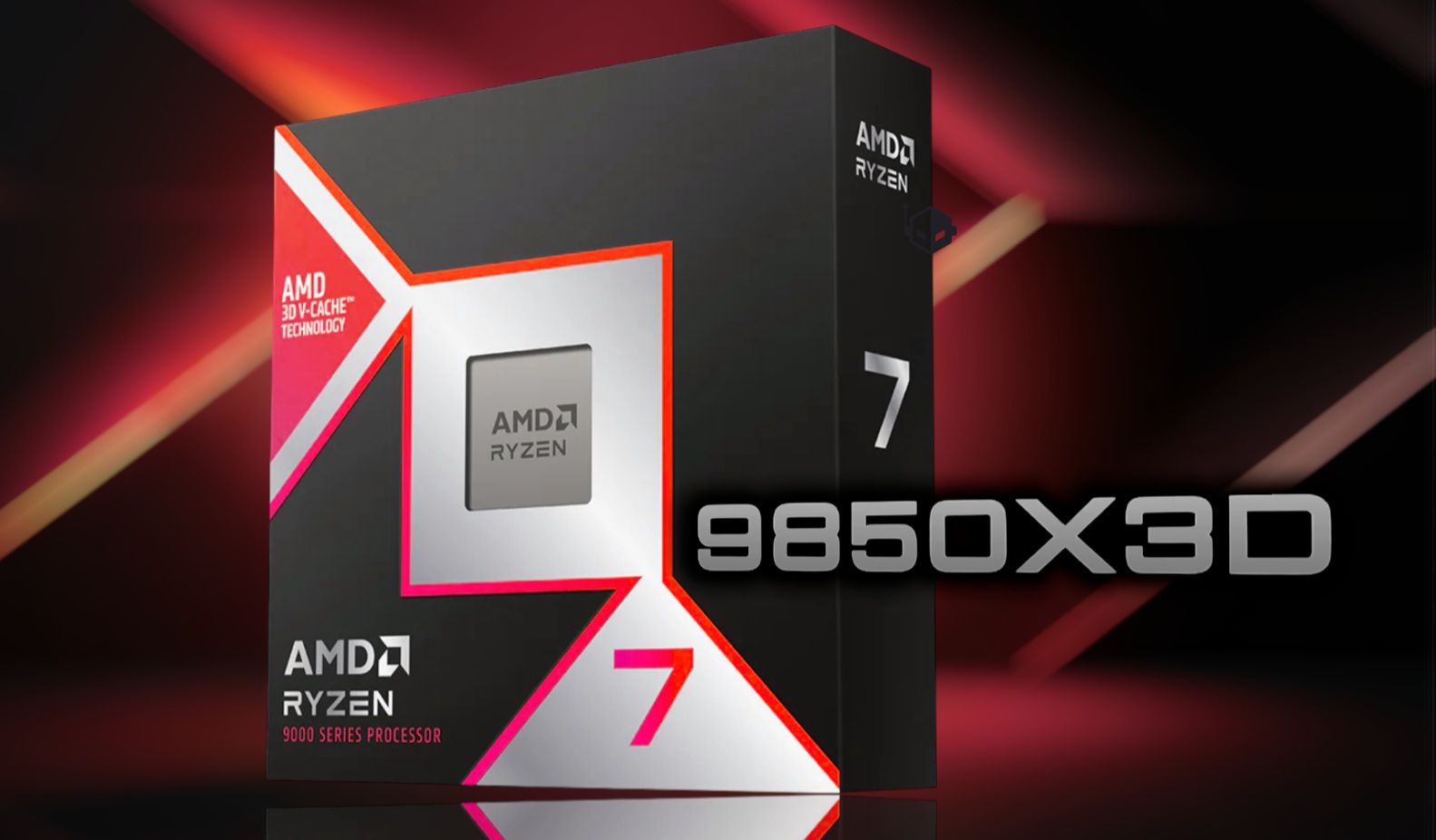
Early hands-on testing of AMD’s upcoming Ryzen 7 9850X3D is already showing what the chip might be capable of beyond its stock settings, and overclockers are wasting no time finding its limits. While official reviews still aren’t out, an early result posted by an enthusiast offers a useful preview of real-world overclocking headroom for AMD’s next high-end gaming CPU.
One overclocker, known as OC_Beer on Overclock forums, shared a screenshot indicating the Ryzen 7 9850X3D running at roughly 5.75 GHz across all cores on a GIGABYTE X870 AORUS Tachyon ICE motherboard. Detailed tuning settings weren’t provided, so we don’t know the exact voltages, power limits, or cooling used. Still, a near-5.75 GHz all-core result is a solid data point for anyone tracking how far this new X3D processor can be pushed with manual overclocking.
What makes this interesting is how the Ryzen 7 9850X3D compares to the Ryzen 7 9800X3D. AMD is shipping the 9850X3D with a noticeably higher out-of-the-box boost clock, around a 400 MHz increase over the prior model. That’s a meaningful jump on paper, especially for a gaming-focused CPU with 3D V-Cache, where frequency and cache can work together to improve performance in many titles.
It’s also worth noting what AMD’s boost numbers really mean in everyday use. The 9850X3D is rated for up to 5.6 GHz boost out of the box, but that figure is generally tied to single-core boosting under the right conditions. Sustaining higher clocks on all cores is a different challenge, which is why an all-core 5.75 GHz result is notable even if it’s not a “record-breaking” frequency.
For context, the Ryzen 7 9800X3D has already shown it can reach around 5.5 GHz on all cores, and even higher in some cases with heavy tuning. So seeing the 9850X3D push beyond that range lines up with expectations. The bigger question is how practical those speeds are for daily use, and what they mean for gaming performance versus simply chasing higher numbers. In many games, especially those sensitive to cache performance, frequency gains don’t always translate into massive improvements. On top of that, holding these clocks typically demands high-end cooling and strong motherboard power delivery to keep temperatures and stability under control.
With the official Ryzen 7 9850X3D launch roughly 10 days away, more advanced results are likely coming soon as additional testers explore voltage tuning, curve optimization, memory settings, and thermal limits. Enthusiasts will naturally be looking for the next big milestone: 6.0 GHz. Reaching an all-core 6.0 GHz on a chip like this would be an impressive achievement, and the best-binned processors paired with robust VRMs and premium liquid cooling could potentially get close.
And for extreme overclocking, the sky is even higher. Competitive overclockers chasing world-record frequencies will likely attempt to push the Ryzen 7 9850X3D far beyond typical daily settings, potentially exceeding 7.0 GHz using specialized methods—especially since similar feats have already been seen on the previous Ryzen 7 9800X3D.
For now, the 5.75 GHz all-core glimpse offers a realistic early sign of what the Ryzen 7 9850X3D might deliver for enthusiasts looking to squeeze extra performance out of AMD’s newest X3D gaming processor once it officially arrives.


