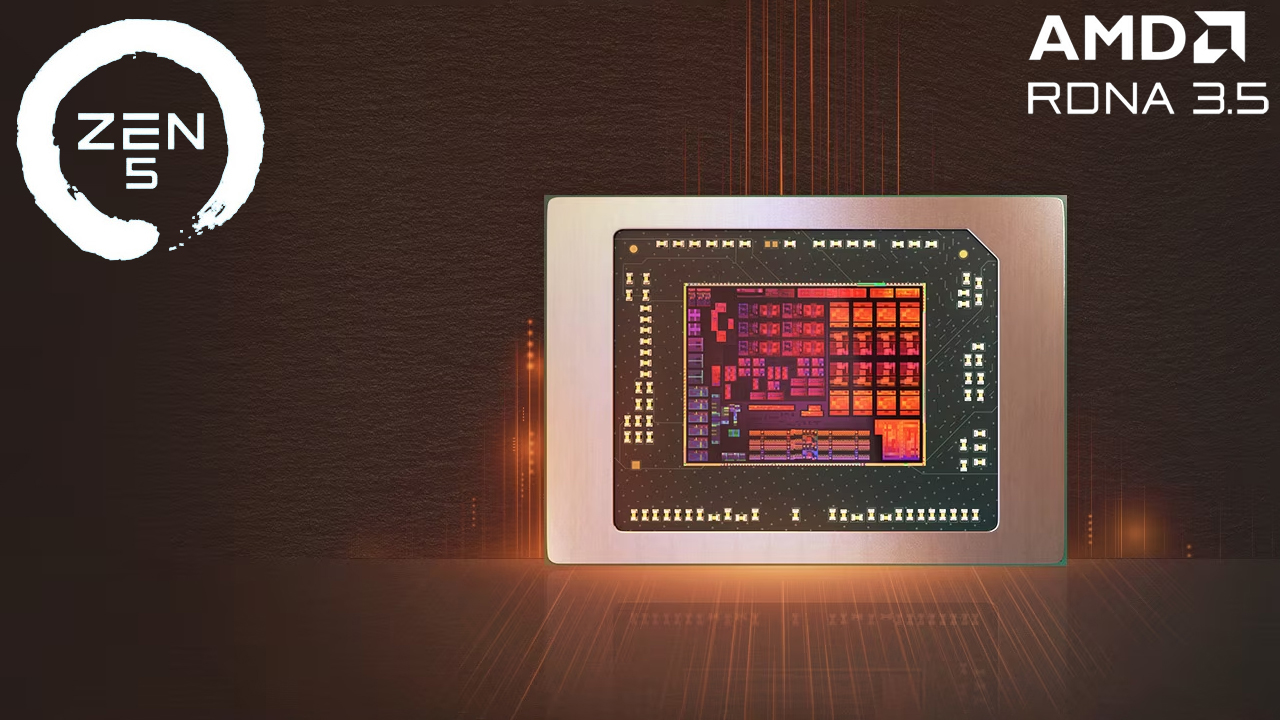
AMD’s latest RDNA 3.5 integrated GPU, the Radeon 890M, is showing promising results against NVIDIA’s dedicated RTX 2050 GPU. Recent benchmarking tests reveal that this new iGPU may offer competitive performance for future laptops and compact gaming devices.
In a leaked benchmark result posted on Bilibili, AMD’s Radeon 890M has made a striking impression with its performance in the 3DMark Time Spy test. The iGPU, housed within the Ryzen AI 9 HX 370, boasted a compelling score above 3600 points. This result narrowly trails that of the NVIDIA RTX 2050, which typically hits around 3700 points in the same benchmark setting.
The Radeon 890M’s impressive test score gives us a hint at its capability, operating with 16 compute units and a reported 2900 MHz clock speed during the benchmark. Such figures position the integrated graphics chip closely behind the output of NVIDIA’s standalone RTX 2050 laptop GPU, which is known for its competent performance in gaming laptops.
For perspective, the Radeon 780M, another integrated GPU from the Hawk Point family with 12 compute units, reaches a score of approximately 2800 at a total design power (TDP) of 55 watts. While details on the TDP for the Radeon 890M have not been disclosed, the mentioned benchmark likely represents an early iteration of the Ryzen AI 9 HX 370. Further optimization could potentially yield even higher performance in the final commercial versions of the product.
Comparing the newer Radeon 890M to its predecessor, the Radeon 780M, shows a performance increase of about 40% in Geekbench OpenCL scores. This suggests that while it may be based on a modestly updated architecture, the new iGPU is capable of significant performance improvements, which can translate into gains in gaming experiences.
With the emergence of the Radeon 890M, there is a potential for stronger gaming capabilities in compact form factors such as mini PCs. Furthermore, there’s growing excitement around how this technology could enhance the experience of gaming handhelds, offering consumers more options for portable and power-efficient gaming.
As the anticipation for laptops featuring Strix Point processors with the RDNA 3.5 iGPU grows, technology enthusiasts are watching closely for the commercial availability of these processors. With the advancing performances of integrated graphics, the boundary between dedicated and integrated GPUs continues to blur, promising exciting developments for users who prioritize both performance and portability in their computing devices.