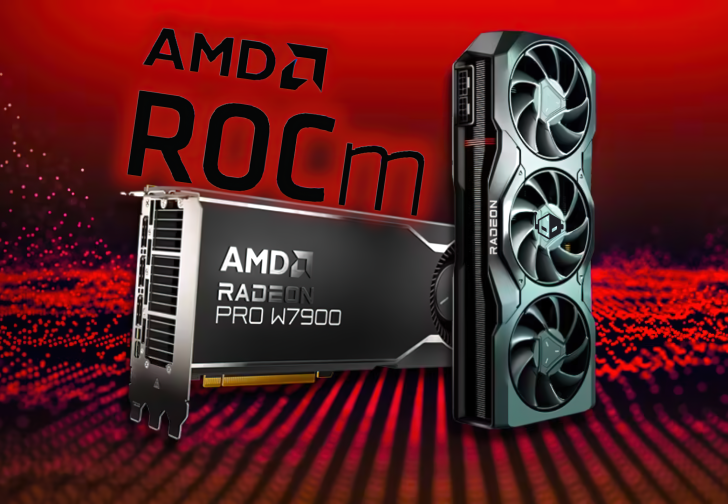
AMD is potentially taking a significant leap forward by considering extending ROCm (Radeon Open Compute) support from Linux to Windows, which could be a game-changer for both users and developers. For years, the developer community has been eager to see this transition, as it promises to enhance the flexibility and functionality of AMD’s graphics processing hardware on different operating platforms.
Despite a previous pledge from AMD to introduce ROCm support for Windows, progress seemed sluggish until it was partially realized with version 5.5.1, which was applicable to Windows 10 and 11. Currently, the more recent ROCm version 6.2.4 is available, but its compatibility is limited to a select few Radeon models, such as the RX 7900 XT and XTX, and some AMD Instinct GPUs. This leaves many users unable to take full advantage of ROCm on their Windows systems, particularly those with newer or different GPU models.
An encouraging update came when Anush Elangovan, AMD’s Vice President in charge of AI Software, hinted at expanding support for ROCm on Windows. Though details remain sparse, this affirmation suggests that AMD is committed to broadening its software stack to include more Radeon GPUs. Currently, on Windows, only certain models are supported, unlike on Linux where a wider range of RDNA 2 GPUs are compatible.
The narrow scope of support on Windows has resulted in various technical issues, including performance hiccups and application instability, which can be frustrating for users. The cheapest GPU currently supported on Windows is the RX 7900 GRE, limiting access for many potential users interested in ROCm’s powerful capabilities. Yet, if AMD successfully enhances compatibility, both older and newer GPU owners could benefit tremendously, especially when performing complex tasks like deep learning.
In the competitive arena of AI technology, graphics hardware has become a critical factor. With advancements and broader support, AMD appears poised to challenge NVIDIA more aggressively. Notably, the AMD MI300X, which could outshine NVIDIA’s offerings with robust software support, is part of this potential breakthrough. Meanwhile, tinygrad, an emerging project, has garnered AMD’s interest, with two MI300X hardware units soon to be introduced into their development process.
Such developments suggest that AMD, with strategic improvements in software and support, could significantly enhance its position in the market. There’s a growing belief that AMD might be undervalued, given the increasing demand for AI technologies and its potential to disrupt existing market dynamics. Thus, AMD’s improved software support, including broader ROCm availability, could play a pivotal role in reshaping the balance of power in the graphics card industry.