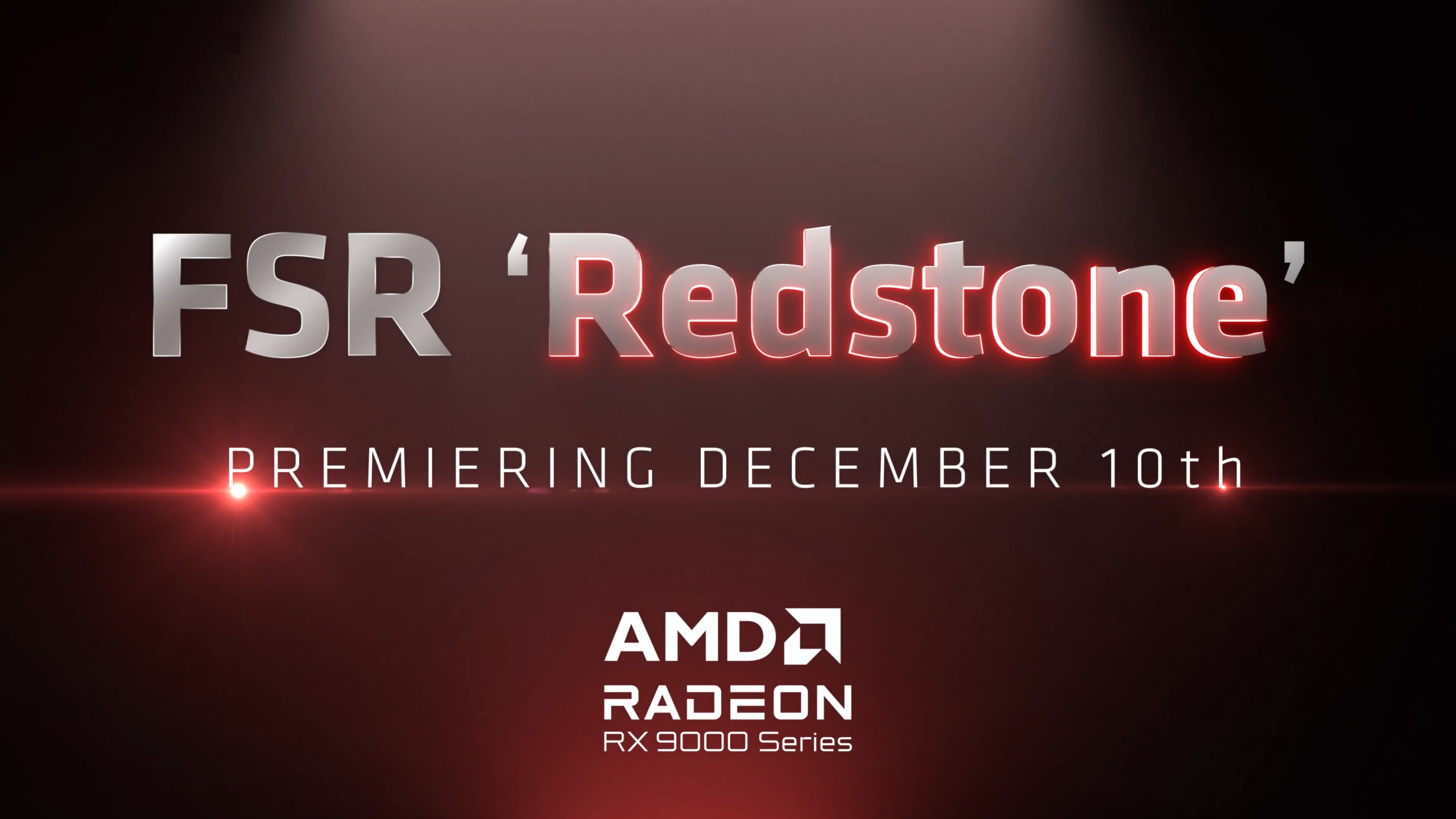
AMD is gearing up to roll out its biggest Radeon software leap in years. The FSR Redstone update, designed for Radeon RX 9000 series RDNA 4 GPUs, is officially on the way and has been teased by AMD leadership on social channels. While earlier chatter pointed to a November or December window, AMD now tags the official launch for 31 December 2025.
FSR Redstone is more than a routine driver bump. It’s a sweeping upgrade to the Radeon driver and FidelityFX Super Resolution stack, built around machine learning to boost image quality, ray-traced visuals, and overall performance. First previewed during Computex 2025, the update introduces a suite of AI-powered features that target both clarity and speed, especially in demanding, ray-traced scenes.
We’ve already seen a glimpse of what’s coming in Call of Duty: Black Ops 7, which implements ML-based Ray Regeneration. Similar in spirit to NVIDIA’s Ray Reconstruction, it replaces the traditional in-game denoiser with an AI-driven model to deliver cleaner, more stable lighting and reflections with no performance penalty in that example.
Key features AMD is bringing with FSR Redstone:
– Neural Radiance Caching: Uses a trained model to learn scene lighting behavior and predict global illumination in real time for more realistic lighting with efficient performance.
– ML Ray Regeneration: Trained on noisy, low-sample ray-traced frames to intelligently remove grain and stabilize details on the fly, improving sharpness while reducing render cost.
– ML Super Resolution: Reconstructs lower-resolution frames into crisp, high-resolution output in real time, combining clarity with higher frame rates.
– ML Frame Generation: Inserts AI-generated frames between traditionally rendered ones to significantly increase perceived performance.
Why it matters: AI-assisted rendering is rapidly becoming the new baseline for high-end PC gaming. With FSR Redstone, AMD is aligning RDNA 4 with advanced denoising, upscaling, and frame-generation techniques to elevate both visual fidelity and smoothness without demanding brute-force GPU power. For gamers, that means cleaner ray tracing, sharper images, and higher FPS. For developers, it’s a more robust toolkit to push next-gen visuals efficiently.
Launch timing: Although earlier hints suggested a rollout in November or December, AMD’s latest tease puts the official release on 31 December 2025. Expect detailed patch notes, supported game lists, and performance data as launch approaches.