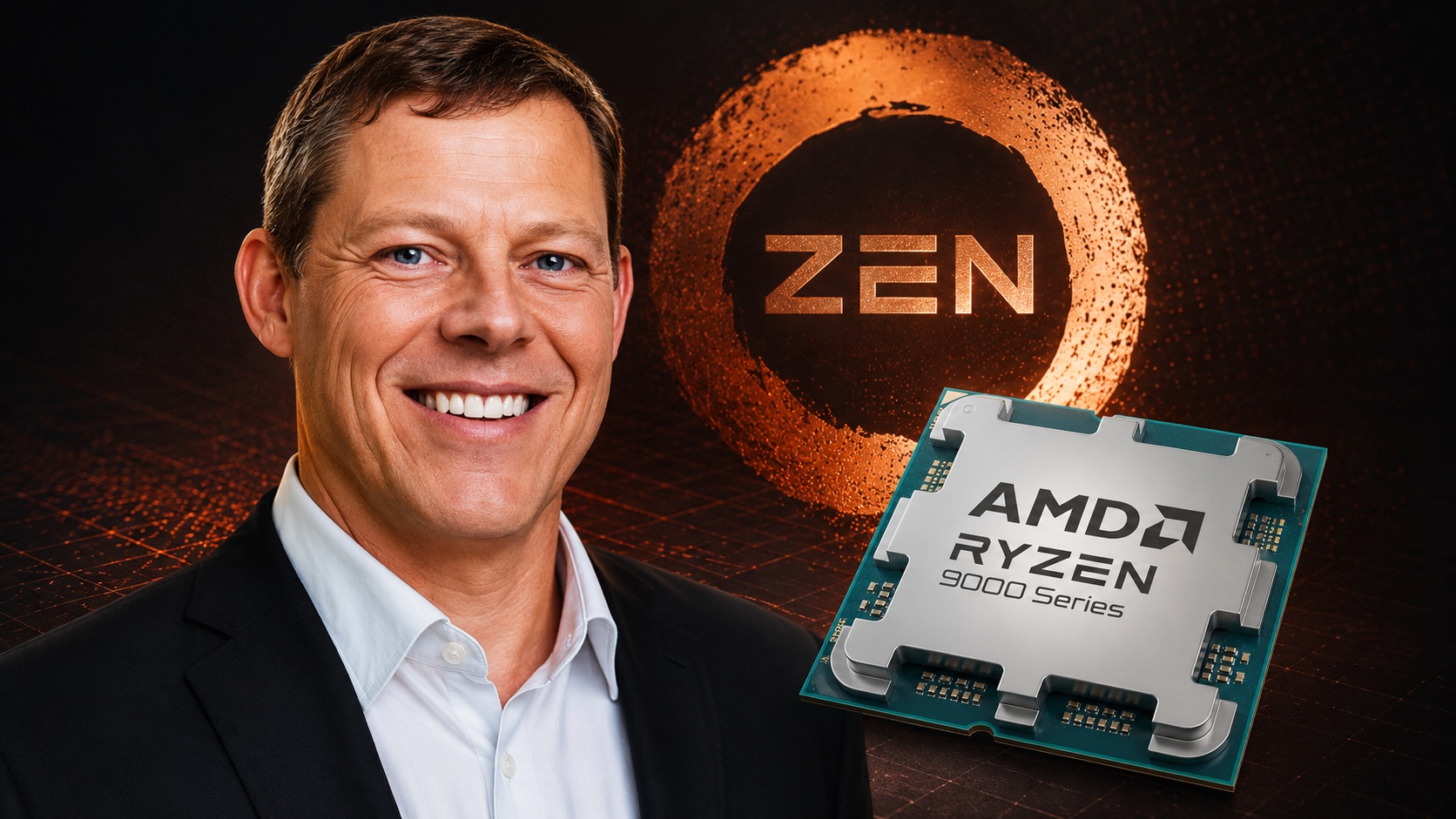
AMD AM5 Platform Gets a Longer Life as New Zen CPUs Are Planned Through 2029
AMD is making it clear that the AM5 platform is not going anywhere soon. While many PC builders expected a new desktop socket to arrive sooner, AMD says the right move is to keep supporting AM5 as long as it continues to make sense for gamers, enthusiasts, and DIY PC users.
During a discussion at Computex, AMD’s David McAfee, Vice President and General Manager of Ryzen CPU and Radeon Graphics, explained why the company is taking a patient approach to its next desktop platform. According to AMD, a socket change is not something that should happen simply because a few years have passed. It should happen only when new technologies deliver a meaningful upgrade for users and when the market is ready for the cost that comes with it.
That means AM5 is set to remain AMD’s main desktop platform for years, with new products and new Zen architectures expected to arrive through 2029.
When AM5 launched in 2022, AMD originally expected the industry to move toward DDR6 memory around the 2027 to 2028 timeframe. A major memory transition often creates a natural reason to introduce a new platform. New memory standards arrive, older memory becomes cheaper, and the broader PC market begins shifting toward fresh motherboard designs.
But the current PC hardware market has not followed the usual pattern. Memory prices have remained high, DDR5 costs are still a concern for many buyers, and the overall upgrade cycle has been slower than expected. Because of this, AMD now sees the AM5 window extending further than originally planned.
The company says it has products ready to support that longer timeline. That includes future Zen architectures as well as additional processors based on existing designs. In practical terms, AM5 owners can expect more CPU options instead of being forced into a motherboard upgrade too soon.
Two major future CPU architectures are expected to come to AM5: Zen 6 and Zen 7. These will likely be joined by refreshed products, similar to how AMD continued to release new chips for the older AM4 platform even after AM5 had already entered the market.
This is a major point for PC builders. A longer-lasting socket means users can invest in a motherboard today and still have a clear upgrade path years later. For gamers and creators, that reduces the total cost of ownership and makes AMD’s Ryzen platform more attractive compared to short-lived upgrade cycles.
AMD also reflected on its history before AM4, when desktop platforms changed much more frequently. McAfee described those earlier years as painful for users and partners because new motherboards were often required every year or two. That created frustration for PC builders, added complexity for motherboard manufacturers, and made the upgrade path less predictable.
The shift to AM4 changed that. AM4 became one of the longest-running modern desktop platforms, supporting several generations of Ryzen processors and giving users years of upgrade flexibility. AMD now appears committed to carrying that same philosophy forward with AM5.
A new socket is not a simple cosmetic change. It requires motherboard makers to redesign critical parts of the board, including memory routing, PCIe layout, signal integrity, power delivery, and overclocking support. These are not minor details. They affect stability, performance, compatibility, and cost.
That is why AMD says the bar for moving to a new platform is very high. A new socket must bring enough real-world benefit to justify breaking compatibility with existing motherboards.
The next major industry technologies on the horizon are DDR6 memory and PCIe Gen6. Both sound exciting on paper, especially for high-performance PCs. DDR6 should eventually offer faster memory speeds and improved bandwidth, while PCIe Gen6 will increase data throughput for graphics cards, storage devices, and other high-speed components.
However, AMD is looking beyond the spec sheet. The company is asking whether these technologies will actually improve the user experience enough to justify higher motherboard prices.
That concern is based on what happened with PCIe Gen5. While PCIe Gen5 can deliver impressive bandwidth, it also made motherboard design more expensive. Boards needed better materials, improved signal routing, and additional components such as re-drivers and re-timers to maintain performance across slots and storage connections.
For some users, PCIe Gen5 SSDs deliver huge benchmark gains. But in many everyday gaming scenarios, the difference is not as dramatic. Games do not always load noticeably faster, system boot times may not feel significantly improved, and many users do not experience a major real-world advantage compared to PCIe Gen4.
AMD appears to be applying that lesson to its future platform planning. The company does not want to force a costly transition unless the benefits are clear and useful for the majority of enthusiasts and gamers.
AMD says there are three big questions it considers before moving to a new socket.
First, what new industry standards are arriving? DDR6 and PCIe Gen6 are the obvious upcoming candidates.
Second, do those standards create a better experience for users? Faster numbers are not enough if games, apps, and everyday workloads do not feel meaningfully improved.
Third, have user needs changed enough to require a new platform? This includes things like more NVMe SSD slots, more PCIe expansion, additional high-speed I/O, or new power delivery requirements for future CPUs.
If those needs cannot be met properly on the current socket, then a new platform becomes more likely. But if AM5 can continue to support the performance and features users want, AMD sees no reason to rush.
Another important part of AMD’s current strategy is its X3D lineup. Ryzen processors with 3D V-Cache have become especially popular among gamers because they can deliver strong gaming performance without relying as heavily on expensive high-speed memory.
This matters even more now because memory prices remain high. AMD says its 3D V-Cache technology can help offset the need for faster or dual-channel memory in some gaming scenarios. According to AMD’s internal testing across 30 games, the performance difference between a single memory stick and a dual-channel setup on X3D processors averaged only around 0.5%.
That is a notable advantage for budget-conscious gamers. Instead of spending extra money immediately on a full memory kit, a user could start with one RAM stick and upgrade later. The saved money could go toward a better graphics card, larger SSD, stronger cooling, or another component that has a bigger impact on the gaming experience.
This also explains why AM4 continues to remain relevant. Even though AM5 is the newer platform, DDR4-based systems are still attractive while DDR5 prices remain elevated. AMD has taken advantage of this by continuing to offer AM4 refreshes, giving users more affordable upgrade options without requiring a complete system rebuild.
The bigger message is that AMD is prioritizing platform stability, affordability, and long-term value. Instead of moving quickly to a new socket just to follow a traditional release cycle, the company is waiting for the right mix of technology, market conditions, and user demand.
For anyone building or upgrading a gaming PC, that is good news. AM5 is expected to receive new Ryzen CPUs for several more years, including future Zen architectures. That makes current AM5 motherboards more appealing, especially for buyers who want an upgrade path without replacing the entire foundation of their PC.
AMD’s approach suggests that the next major platform shift will happen only when DDR6, PCIe Gen6, and future CPU requirements create a clear reason to move beyond AM5. Until then, AM5 remains the center of AMD’s desktop strategy, and it is shaping up to be another long-lived platform for gamers, creators, and PC enthusiasts.AMD’s AM5 Strategy Gets Smarter: Single-DIMM X3D Gaming, Better Overclocking, and Support Through 2029
AMD is leaning into a practical strategy for PC builders at a time when memory prices and overall component costs remain a major concern. Instead of pushing users toward expensive upgrades all at once, the company is highlighting ways gamers can build smarter today and expand later when their budget allows.
One of the most interesting points is AMD’s growing focus on single-DIMM memory configurations for Ryzen X3D gaming systems. For many PC gamers, especially those using AMD’s 3D V-Cache processors, the company says running one memory stick instead of two can offer nearly identical gaming performance in many scenarios.
According to AMD’s David McAfee, this approach is not meant for every type of user. If someone is a content creator, software developer, professional multitasker, or working with memory-heavy applications, then a dual-DIMM setup still makes more sense. Extra memory bandwidth and capacity can be important for productivity workloads.
But for users whose main priority is gaming, the story is different. AMD says that across a broad selection of around 30 games, the performance gap between single-DIMM and dual-DIMM setups on X3D processors can be as low as roughly 0.5%. In real-world gameplay, that kind of difference is essentially unnoticeable.
That matters because memory prices can have a real impact on the total cost of a gaming PC. By starting with a single RAM module, gamers could potentially save a meaningful amount of money during the initial build. Those savings could go toward a stronger graphics card, a faster processor, a better motherboard, improved cooling, or simply remain in the buyer’s pocket.
This is especially useful in the current RAM market, where high memory prices can make a full build feel harder to justify. A gamer could build a capable Ryzen X3D system now with one DIMM, enjoy excellent gaming performance, and then add a second stick later when prices improve or when they have enough savings on hand.
The idea is simple: build in stages instead of paying for everything upfront. For budget-conscious gamers, that flexibility can make the AM5 platform more appealing.
AMD is also changing its tone around overclocking. In the past, many processors were tuned so aggressively from the factory that there was very little extra performance left for enthusiasts to unlock. The best of the available headroom was often already built into the stock product, leaving users with less room to experiment.
McAfee acknowledged that overclockability remains an important part of the experience for gamers and hardware enthusiasts. AMD now appears more interested in leaving additional tuning flexibility for users who enjoy pushing their CPUs and GPUs beyond default settings.
This does not only apply to traditional overclocking. Many Ryzen users have also embraced undervolting as a way to improve efficiency while maintaining or even increasing performance. Instead of simply chasing higher clocks and higher power consumption, enthusiasts have discovered that careful voltage tuning can help Ryzen processors run cooler, quieter, and more efficiently.
That gives AMD two important directions to support: higher performance through overclocking and better efficiency through undervolting. Both are valuable for the enthusiast community, and both can extend the appeal of Ryzen desktop processors.
Another major part of AMD’s message is the long-term future of AM5. The company is committing to support the AM5 platform through 2029, with new Zen-based architectures and refreshed products planned for the socket.
That is a significant promise for PC builders. A long-lasting motherboard platform means users can upgrade their CPU later without replacing the entire foundation of their system. For gamers, this can reduce long-term costs and make the initial investment in an AM5 motherboard feel more worthwhile.
Rather than rushing into a new socket during a period of high component prices and uncertain market conditions, AMD is choosing platform stability. This strategy benefits gamers, enthusiasts, system builders, motherboard vendors, and cooler manufacturers because it keeps the ecosystem consistent for a longer period.
AMD also seems to be waiting for the next major transition to actually deliver meaningful value. A future platform shift will likely make more sense when DDR6 memory and PCIe Gen 6 are ready to provide clear performance and cost advantages. Until then, AM5 has room to continue evolving.
For PC gamers, this could be one of AMD’s strongest platform moves in years. A Ryzen X3D processor paired with a single DIMM can deliver strong gaming performance today, while leaving a simple upgrade path for more memory later. Overclocking and undervolting support give enthusiasts more control, and AM5 support through 2029 gives buyers confidence that their system will not become outdated quickly.
In a market where every dollar matters, AMD’s approach is built around flexibility, longevity, and value. For anyone planning a new gaming PC, AM5 is shaping up to be a platform that rewards patient, practical upgrading rather than forcing expensive all-at-once purchases.