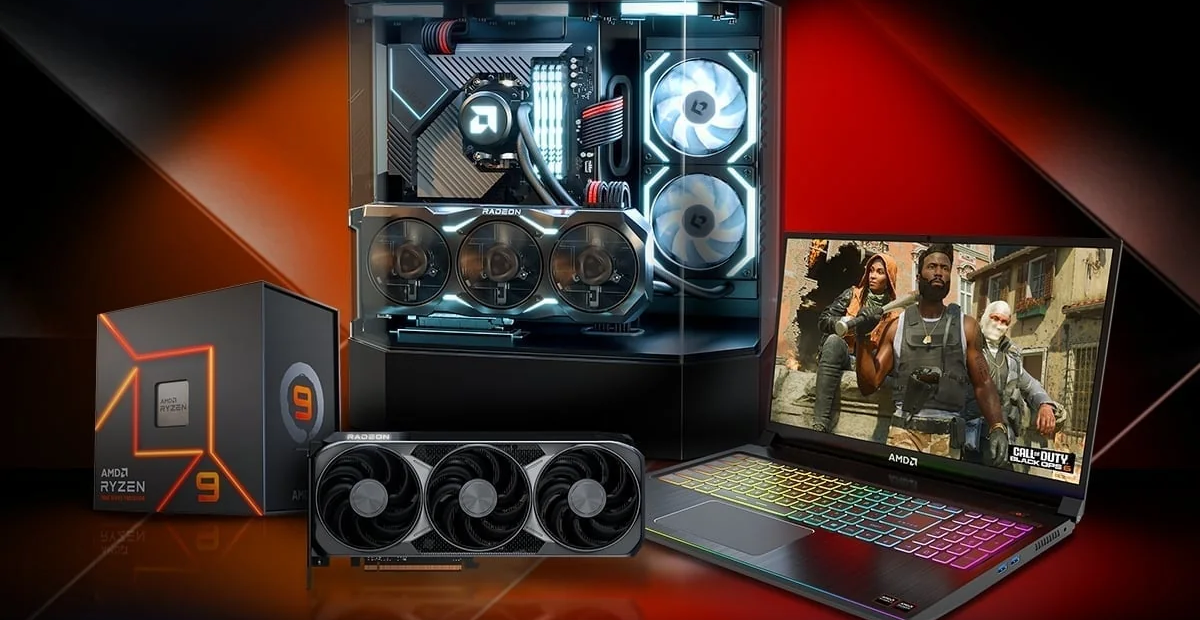
AMD maps out its next wave of PC and gaming hardware with clear timelines and big promises: Gorgon Point arrives in 2026 as a refined Zen 5-based platform, Medusa Point follows in 2027 with next‑gen Zen 6 cores, and a brand-new gaming GPU architecture signals a shift beyond the RDNA era.
After a standout 2025 for its client business—roughly $10 billion in revenue, a 50% jump in CPU average selling price, and about 28% PC revenue share—AMD is pressing forward with aggressive roadmaps for AI PCs and gaming. The company’s latest briefing highlighted two key client CPU families and teased sweeping changes to its graphics architecture.
Gorgon Point in 2026: a sharpened Zen 5 refresh
– Positioned as an evolution of today’s Strix/Kraken-class processors
– Keeps the proven trio: Zen 5 CPU cores, RDNA 3.5 graphics, and XDNA 2 NPU for on-device AI
– Expands the product stack with additional SKUs for broader coverage across thin-and-light notebooks and performance PCs
– Designed to bridge the gap to the next architectural leap while boosting efficiency, AI responsiveness, and integrated graphics capability
Medusa Point in 2027: the Zen 6 leap for AI PCs
– Introduces next-gen Zen 6 CPU cores with fresh GPU and XDNA AI IP
– Targets more than 10x AI performance gains compared to current solutions, according to AMD
– Part of a wider Zen 6 wave that will also include EPYC “Venice” for servers and the high-end Ryzen desktop family codenamed “Olympic Range”
– Built to accelerate the AI PC transition with stronger NPUs, faster inference, and next-level power efficiency
Next-gen gaming GPUs move beyond the RDNA branding
AMD’s gaming roadmap points to a clean break from the RDNA naming for its upcoming architecture. While the company hasn’t revealed the new brand, it has outlined several cornerstone features set to define its next generation of graphics:
– Radiance Cores for advanced ray tracing
– Neural Arrays to supercharge AI-driven graphics and upscaling
– Universal Compression Engine for smarter bandwidth use and higher effective performance
This next-gen architecture is slated to power both gaming graphics cards and future consoles, promising a unified platform with richer visuals, faster ray tracing, and dramatically improved AI capabilities. More details are expected around the CES 2026 timeframe.
What it means for buyers and builders
– 2026 will deliver refined Zen 5 laptops and desktops with stronger AI-on-chip performance and upgraded integrated graphics via Gorgon Point.
– 2027 brings the full architecture jump to Zen 6 with Medusa Point, aiming at major AI uplift, new GPU IP, and broader platform efficiency gains.
– For gamers, the retirement of the RDNA label suggests a foundational shift, with new hardware blocks purpose-built for ray tracing and AI workloads.
Key questions answered
– When is Gorgon Point expected? 2026.
– What cores power Gorgon? Zen 5, paired with RDNA 3.5 graphics and XDNA 2 NPU.
– What is Medusa Point? AMD’s Zen 6-based client platform planned for 2027 with new GPU and AI IP.
– How big is the AI jump? AMD is targeting greater than 10x AI performance with Medusa.
– What’s changing for GPUs? A new architecture name and feature set, including Radiance Cores, Neural Arrays, and a Universal Compression Engine.
– Will it impact consoles? Yes, the same next-gen GPU architecture is intended for both PC graphics cards and gaming consoles.
Bottom line: AMD’s PC roadmap locks in an evolutionary step in 2026 and a generational leap in 2027, while its next graphics architecture sets the stage for a new era in gaming performance, ray tracing, and AI acceleration.