AMD is pushing deeper into local AI computing with a new class of high-performance hardware aimed at developers, researchers, creators, and professionals who want serious AI power at their desk instead of relying on cloud services. The company has introduced its Threadripper Halo Station concept alongside a new wave of Ryzen AI MAX systems, signaling a major focus on personal AI workstations and portable local AI PCs.
The timing makes sense. Demand for local AI performance is rising quickly as large language models, AI agents, generative tools, and custom enterprise workflows become more complex. Running these workloads in the cloud can be expensive, restrictive, and dependent on network access. AMD’s answer is to bring workstation and data center-class AI hardware into systems that can live in an office, studio, lab, or development environment.
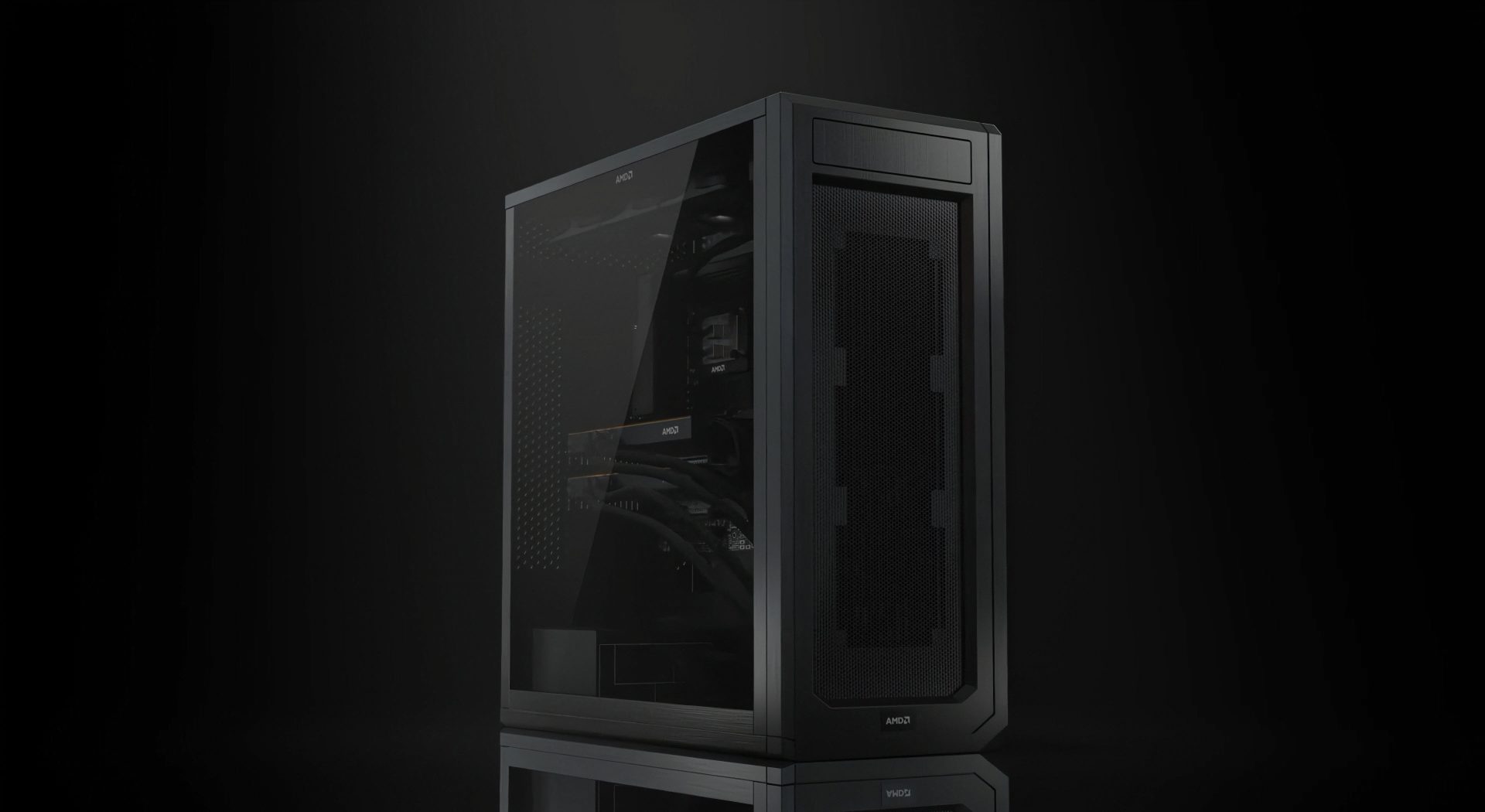
The centerpiece is the AMD Threadripper Halo Station, described as an “Ultimate Personal AI Workstation.” This is not a standard desktop workstation. It combines AMD’s top-tier professional CPU platform with powerful Instinct accelerators to create a machine designed for local model training, fine-tuning, inference, and agentic AI workflows.
At the heart of the system is AMD’s Ryzen Threadripper PRO 9995WX, a flagship workstation processor with up to 96 Zen 5 cores and 192 threads. It can boost up to 5.4 GHz and includes a massive 384 MB cache. That level of CPU performance is especially important for complex AI pipelines, where data processing, orchestration, coding workloads, simulations, and multi-agent systems can all demand strong single-core and multi-core performance.
The GPU side is where the Threadripper Halo Station becomes even more ambitious. AMD’s prototype system uses dual Instinct-class accelerators, with configurations expected to scale up to four AMD Instinct MI350P GPUs. Each MI350P includes 144 GB of HBM3e memory, meaning a four-GPU setup could offer up to 576 GB of ultra-fast HBM3e memory. With up to 4 TB/s of bandwidth per GPU, a fully loaded system could reach up to 16 TB/s of combined GPU memory bandwidth.
That massive pool of high-bandwidth memory is designed for demanding AI models and large inference workloads. AMD says the system is built to handle trillion-parameter models locally, a key selling point for teams that want to avoid the cost and limitations of cloud AI platforms.
System memory is another major advantage. The Threadripper Halo Station can support up to 2 TB of DDR5 RDIMM memory. When combined with the HBM3e memory on the accelerators, the full memory footprint can reach around 2.6 TB. AMD’s approach pairs the speed of HBM for AI acceleration with the capacity of traditional workstation memory, giving developers more flexibility when working with large datasets and advanced models.
Cooling is handled by a full liquid-cooling design, and the system is expected to fit inside a more conventional E-ATX-style chassis. AMD has also given it visual cues inspired by the “Halo” design language used in its Ryzen AI Halo mini PC concepts, with a clean workstation look and AMD branding on the front.
One of the biggest advantages of the Threadripper Halo Station is that it is based on components that are easier to source, service, and replace compared with highly integrated proprietary AI boxes. That could make it appealing to organizations that want powerful local AI hardware but also value upgrade paths, repairability, and configuration flexibility.
AMD is positioning the Threadripper Halo Station against NVIDIA’s DGX Station class of systems. The comparison is especially interesting because both machines target local AI development, but they take different architectural approaches.
AMD’s system uses the Threadripper PRO 9995WX with 96 Zen 5 cores and 192 threads, while NVIDIA’s DGX Station GB300 uses a Grace CPU with 72 Arm-based Neoverse V2 cores. On raw CPU core and thread count, AMD has the advantage, and Zen 5 is expected to provide strong single-threaded and multi-threaded performance for workstation workloads.
For acceleration, AMD’s system can use two to four Instinct MI350P GPUs, while NVIDIA’s DGX Station GB300 is built around a Blackwell Ultra GB300 superchip and can be paired with additional RTX PRO GPUs. AMD’s fully configured system can offer up to 576 GB of HBM3e accelerator memory, while the GB300 system provides 252 GB of HBM3e in its main accelerator memory pool.
NVIDIA’s advantage is its tightly connected, unified CPU-GPU memory architecture using NVLink-C2C, offering a coherent memory pool of up to 748 GB when CPU and GPU memory are combined. AMD’s setup is more discrete, separating host DDR5 memory and GPU HBM memory, but it offers far more total memory capacity when fully configured.
On memory bandwidth, AMD’s four-GPU configuration can reach up to 16 TB/s of combined HBM3e bandwidth. NVIDIA’s GB300 offers 7.1 TB/s in a single cohesive pool. The difference comes down to architecture: AMD provides a larger multi-GPU pool with very high combined bandwidth, while NVIDIA emphasizes unified memory and deep software integration.
Power consumption will depend on configuration, but AMD’s highest-end setup could exceed 1,550 W when using multiple high-power accelerators and a 350 W-class workstation CPU. NVIDIA’s DGX Station GB300 is listed around 1,600 W, placing both machines in similar high-end workstation territory.
Software will also play a major role. AMD’s system is expected to support ROCm, PyTorch, Llama.cpp, and standard x86 development environments. NVIDIA continues to rely on its established CUDA, TensorRT, and DGX software ecosystem. For developers, the decision may depend not only on hardware specifications but also on which AI software stack best fits their workflow.
The Threadripper Halo Station is expected to launch in 2027. Pricing has not been officially confirmed, but estimates place it somewhere around the $100,000 to $150,000 range, depending on configuration. NVIDIA’s DGX Station-class systems also sit near the $100,000 level, so AMD may compete either through pricing, memory capacity, CPU performance, or flexibility.
Alongside the Threadripper Halo Station, AMD also highlighted its Ryzen AI MAX platform for smaller local AI systems, including laptops, mini PCs, and compact workstations. These devices are designed for developers and professionals who want powerful AI capabilities without a full-size workstation.
AMD’s Ryzen AI Halo systems are set to support Microsoft’s Project Zenith out of the box. This will bring a developer-focused Windows experience optimized for high-performance AI PCs, with tools such as Visual Studio Code, Windows Subsystem for Linux, GitHub Copilot CLI, and PowerShell preinstalled. The goal is to help developers start building and testing local AI applications immediately.
AMD also announced collaboration with SUSE to help developers move AI applications from local Ryzen AI Halo development systems into secure, supported enterprise production environments. This could be important for businesses that want to prototype AI tools locally before scaling them into larger production deployments.
One of the most impressive demonstrations involved a Ryzen AI MAX+ 495 system with up to 192 GB of unified memory. AMD showed the system running GLM-5.3 Flash, a 320-billion-parameter AI model, locally with a throughput of 58 tokens per second. That is a significant result for a compact platform, especially for developers looking to reduce dependency on subscription-based AI services.
AMD positioned this as a way to reduce AI costs. Instead of paying recurring fees for cloud-based model access, users with capable Ryzen AI MAX systems can run advanced AI workloads locally. For developers, researchers, and businesses that generate large numbers of tokens, local AI hardware can become financially attractive over time.
Several AMD partners also displayed Ryzen AI MAX laptops and mini PCs, including systems from HP, Lenovo, GMKtec, Acer, Minisforum, Geekom, ACEMAGIC, and others. These devices are expected to move toward newer Ryzen AI MAX 400-class hardware, bringing stronger local AI performance to more portable and compact machines.
AMD’s broader message is clear: local AI is becoming a major computing category, and the company wants to support it from pocket-sized mini PCs all the way up to extreme desktop AI workstations. The Threadripper Halo Station targets the highest end of the market with massive CPU resources, huge memory capacity, and powerful Instinct acceleration. Ryzen AI MAX systems bring that same local AI philosophy to smaller PCs that developers can use every day.
If AMD can deliver competitive pricing, strong software support, and reliable performance, its local AI hardware push could become a serious alternative for professionals who want control over their AI workloads, lower long-term operating costs, and the ability to run advanced models directly on their own machines.


