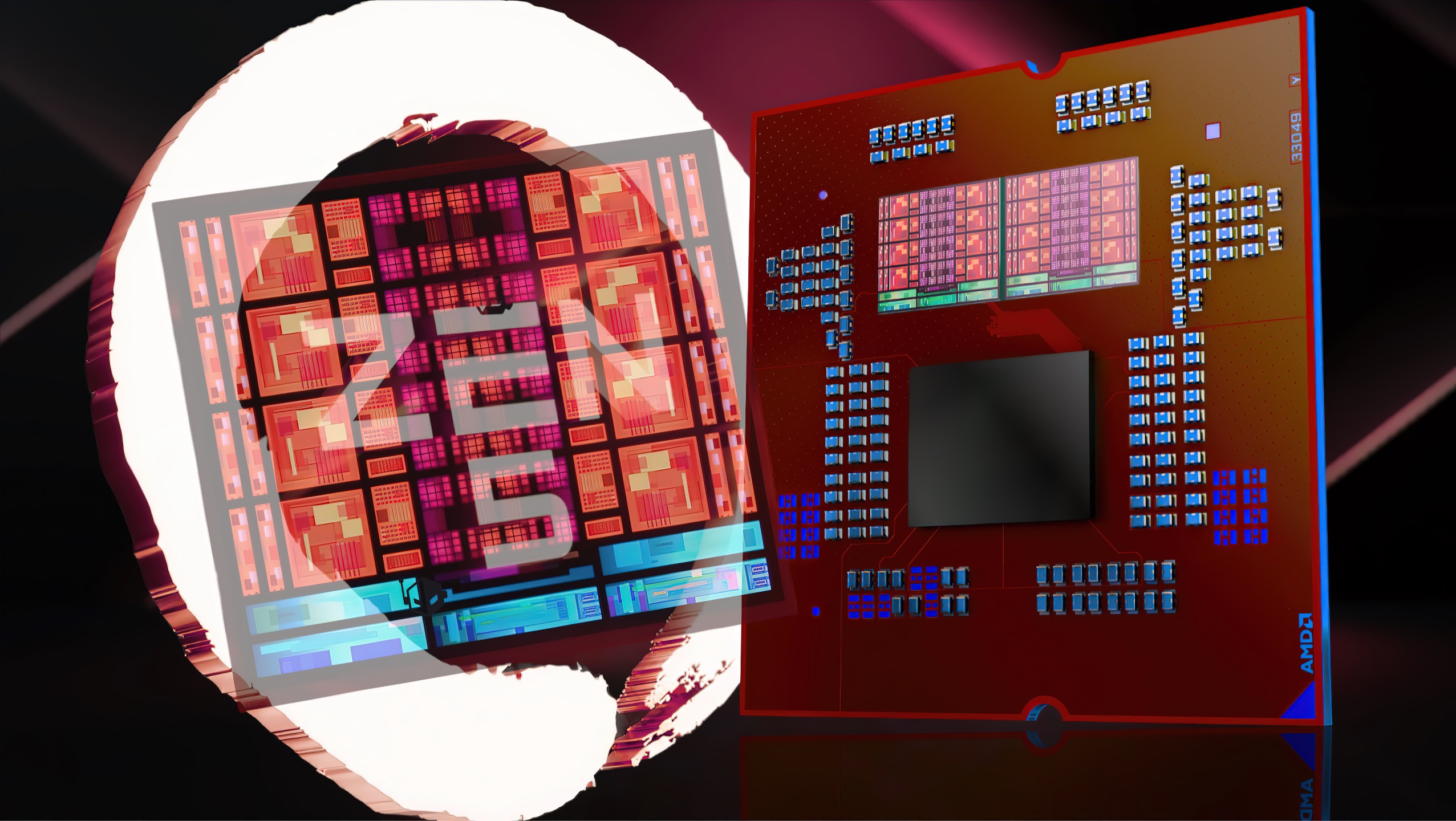
AMD has been hard at work addressing inter-core latency issues with its latest Zen 5 “Ryzen 9000” CPUs. Users are now seeing significant improvements thanks to the introduction of the AGESA 1.2.0.2 BIOS update.
Earlier in the year, some tech enthusiasts reported that the Ryzen 9000 series CPUs experienced higher-than-expected latencies, with figures shooting up to 180-200ns when cores from different Core Chiplet Dies (CCDs) communicated. This suboptimal performance was notably worse than what users had seen with the previous generation, Ryzen 7000 “Zen 4” CPUs.
Fast forward a few weeks, and AMD seems to have rectified this with the latest BIOS update. ASUS was the first to roll out AGESA 1.2.0.2, now available across various X670E, B650E, and B650 motherboards. This update is expected to bring noticeable performance boosts for PC users equipped with the Ryzen 9000 chips.
An interesting case was highlighted in Anandtech’s forums by a member named Det0x. He successfully updated his ASUS ROG Crosshair X670E Gene motherboard and shared a comparison using the CapFrameX core-to-core latency tool. The improvements were nothing short of impressive. Before the BIOS update, Det0x noted an average latency of 180ns between CCDs, and about 18-20ns within the same CCD. Post-update, the latency between CCDs dropped dramatically by 58% to 75ns.
While inter-core latency might not drastically affect overall performance since AMD’s scheduler typically utilizes the fastest CCD for gaming applications, the benefits in multi-threaded applications are significant. Users have reported increases of 400-600 points in the Cinebench R23 benchmarks. Additionally, Ryzen 9 9950X owners have also noticed improved scores in both CPU-z and 3DMark CPU benchmarks, with the BIOS running seamlessly.
A notable insight came from the author of the Y-Cruncher benchmark, who explained that the initial latency issues stemmed from tuning parameter changes in Zen 5. The intention behind these changes was to optimize certain workloads. However, these parameters didn’t fare well in synthetic benchmarks, prompting AMD to roll back the changes in the new patch. The rapid rollout of this update came as a pleasant surprise, especially considering the initial projections suggested a longer wait due to the need for validation.
Overall, this update is a game-changer for AMD Ryzen 9000 “Zen 5” CPU owners and signifies AMD’s commitment to refining and optimizing their technology. Other motherboard manufacturers are expected to follow suit with their respective AGESA 1.2.0.2 BIOS updates later this month. This update will also introduce a new “105W TDP” mode for the AMD Ryzen 7 9700X and Ryzen 5 9600X CPUs, promising a smoother and more stable experience for Zen 5 users.
This news brings a fresh wave of excitement for the tech community and positions AMD favorably in an increasingly competitive market.