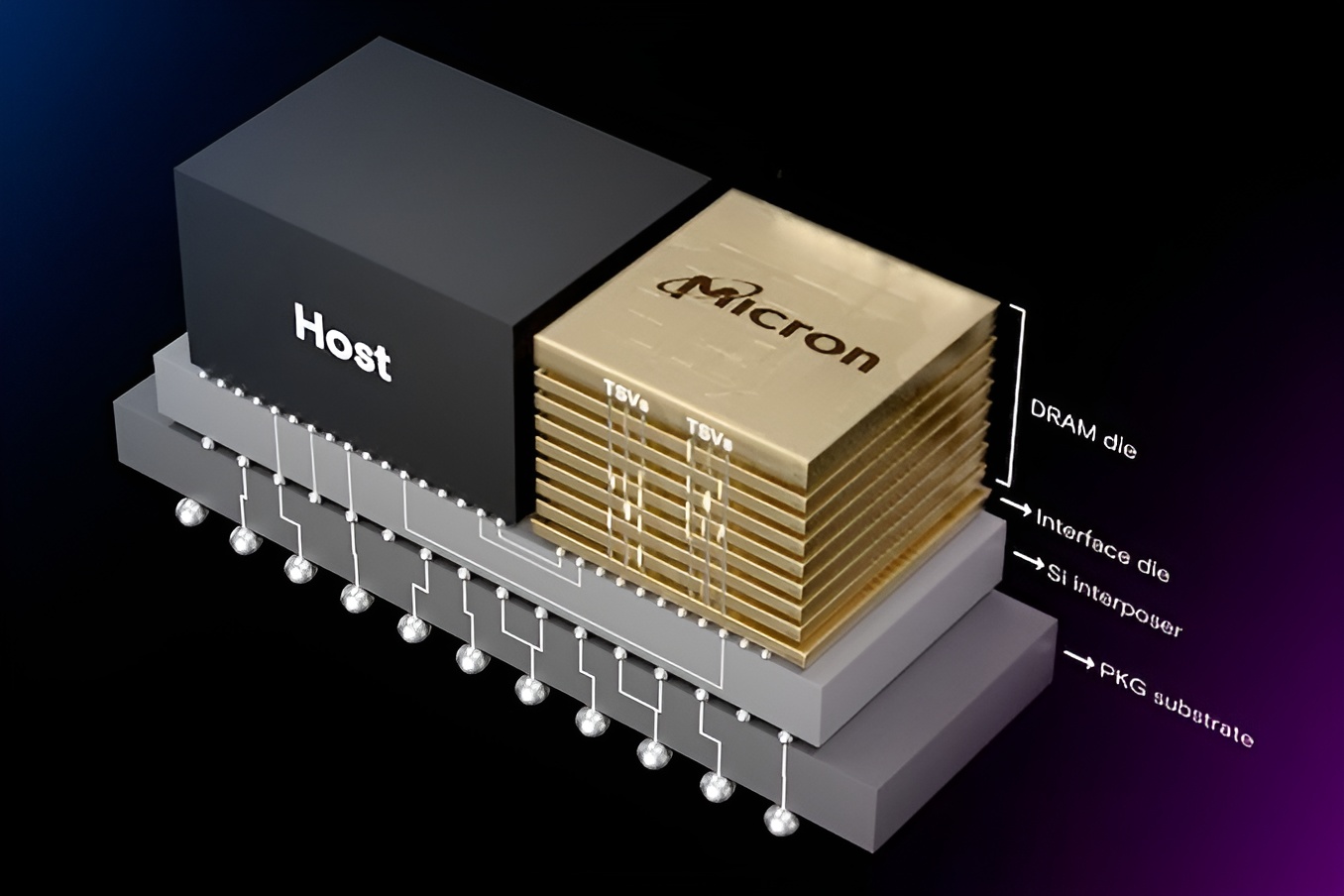
The next generation of High Bandwidth Memory (HBM) is on the horizon, with industry leaders Samsung and SK hynix gearing up to deliver HBM4 memory standards. The anticipation for the latest in high-density, high-speed memory has the tech community eagerly looking towards a 2025-2026 release window.
Development by Samsung and SK hynix is underway, with both companies embracing 3D packaging technologies and aiming for up to 16-Hi stack architectures to surge past current VRAM capacities and memory bandwidths. These advancements promise significant leaps in memory solutions, targeting the most demanding applications.
Samsung is focusing on utilizing 1c DRAM in their HBM4 offerings to counteract energy inefficiencies compared to their competitors. Their strategic shift comes after the revelation that Samsung’s previous HBM products failed to pass qualification tests for certain NVIDIA AI GPUs. With an eye on regaining market momentum, Samsung aims to kickstart the production of 1c DRAM by the end of 2024, hoping to hit a monthly output of approximately 3000 units.
On the other hand, SK hynix has plans to adopt 1b DRAM initially for their HBM4 memory products, while the cutting-edge 1c DRAM is reserved for the forthcoming HBM4E memory evolution.
The movement towards HBM4 also sees the involvement of Taiwan Semiconductor Manufacturing Company (TSMC). At the TSMC European Technology Symposium 2024, the company detailed their preparation for the shift in HBM memory from 1024-bit to 2048-bit interfaces. TSMC is pioneering new base dies using 12nm and 5nm process nodes that will cater to the complex integration needed for HBM4’s escalated performance requirements.
According to TSMC, collaboration is key. They’ve joined forces with EDA partners to certify channel signal integrity and to ensure accuracy in thermal and electromigration (IR/EM) analyses. Their efforts are set to culminate in HBM4 full stack integration, leveraging Chip on Wafer on Substrate (CoWoS) technologies to yield memory products with up to 16-Hi stacks.
The integration of 5nm node technology by TSMC promises benefits in power efficiency, performance, and memory density. As a result, the tech world is keenly anticipating the launch of next-generation HBM4 memory products, set to invigorate next-gen GPU accelerators and revolutionize memory technology.
With HBM4 on the horizon, the tech community can expect a new landscape of memory solutions that will propel the capabilities of high-performance computing platforms. As Samsung, SK hynix, and TSMC journey towards this future, the anticipation for the next pinnacle of memory technology continues to build.